


Seasonal influenza vaccination coverage among adult populations in the United States, 2005-2011
- PMID: 24008912
- PMCID: PMC5824626
- DOI: 10.1093/aje/kwt158
Seasonal influenza vaccination coverage among adult populations in the United States, 2005-2011
Abstract
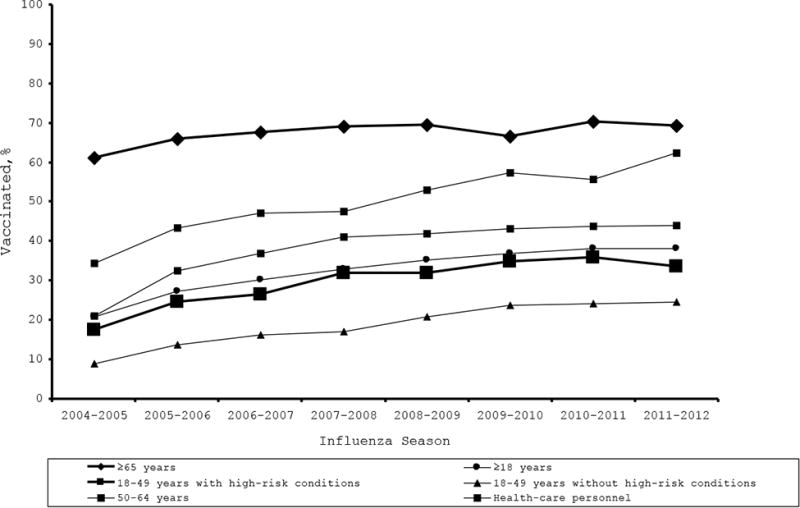
The most effective strategy for preventing influenza is annual vaccination. We analyzed 2005-2011 data from the National Health Interview Survey (NHIS), using Kaplan-Meier survival analysis to estimate cumulative proportions of persons reporting influenza vaccination in the 2004-2005 through 2010-2011 seasons for persons aged ≥18, 18-49, 50-64, and ≥65 years, persons with high-risk conditions, and health-care personnel. We compared vaccination coverage by race/ethnicity within each age and high-risk group. Vaccination coverage among adults aged ≥18 years increased from 27.4% during the 2005-2006 influenza season to 38.1% during the 2010-2011 season, with an average increase of 2.2% annually. From the 2005-2006 season to the 2010-2011 season, coverage increased by 10-12 percentage points for all groups except adults aged ≥65 years. Coverage for the 2010-2011 season was 70.2% for adults aged ≥65 years, 43.7% for adults aged 50-64 years, 36.7% for persons aged 18-49 years with high-risk conditions, and 55.8% for health-care personnel. In most subgroups, coverage during the 2010-2011 season was significantly lower among non-Hispanic blacks and Hispanics than among non-Hispanic whites. Vaccination coverage among adults under age 65 years increased from 2005-2006 through 2010-2011, but substantial racial/ethnic disparities remained in most age groups. Targeted efforts are needed to improve influenza vaccination coverage and reduce disparities.
Keywords: adults; high-risk conditions; influenza; influenza vaccine; vaccination; vaccination coverage.
Figures
References
-
- Fiore AE, Uyeki TM, Broder K, Finelli L, Euler GL, Singleton JA, et al. Prevention and control of influenza: recommendations of the Advisory Committee on Immunization Practices. MMWR. 2010;59(RR08):1–62. - PubMed
-
- Thompson WW, Shay DK, Weintraub E, et al. Mortality associated with influenza and respiratory syncytial virus in the United States. JAMA. 2003;289(2):179–186. - PubMed
-
- Thompson WW, Shay DK, Weintraub E, et al. Influenza-associated hospitalization in the United States. JAMA. 2004;292(11):1333–1340. - PubMed
-
- Bridges CB, Katz JM, Levandowski RL, Cox NJ. Vaccines. fifth. Elsevier Saunders; Philadelphia, PA: 2007. Inactivated influenza vaccine; pp. 259–290.
-
- Bridges CB, Thompson WW, Meltzer MI, Reeve GR, Talamonti WJ, Cox NJ, et al. Effectiveness and cost-benefit of influenza vaccination of healthy working adults: A randomized controlled trial. JAMA. 2000;284(13):1655–63. - PubMed
MeSH terms
Substances
Grants and funding
LinkOut - more resources
Full Text Sources
Other Literature Sources
Medical
