Review
. 2013 Aug 28:4:228.
doi: 10.3389/fphys.2013.00228. eCollection 2013.

Hyperkalemic cardioplegia for adult and pediatric surgery: end of an era?

Affiliations
Review

Hyperkalemic cardioplegia for adult and pediatric surgery: end of an era?

Geoffrey P Dobson et al. Front Physiol. .

Abstract

Despite surgical proficiency and innovation driving low mortality rates in cardiac surgery, the disease severity, comorbidity rate, and operative procedural difficulty have increased. Today's cardiac surgery patient is older, has a "sicker" heart and often presents with multiple comorbidities; a scenario that was relatively rare 20 years ago. The global challenge has been to find new ways to make surgery safer for the patient and more predictable for the surgeon. A confounding factor that may influence clinical outcome is high K(+) cardioplegia. For over 40 years, potassium depolarization has been linked to transmembrane ionic imbalances, arrhythmias and conduction disturbances, vasoconstriction, coronary spasm, contractile stunning, and low output syndrome. Other than inducing rapid electrochemical arrest, high K(+) cardioplegia offers little or no inherent protection to adult or pediatric patients. This review provides a brief history of high K(+) cardioplegia, five areas of increasing concern with prolonged membrane K(+) depolarization, and the basic science and clinical data underpinning a new normokalemic, "polarizing" cardioplegia comprising adenosine and lidocaine (AL) with magnesium (Mg(2+)) (ALM™). We argue that improved cardioprotection, better outcomes, faster recoveries and lower healthcare costs are achievable and, despite the early predictions from the stent industry and cardiology, the "cath lab" may not be the place where the new wave of high-risk morbid patients are best served.

Keywords: cardiac surgery; cardioplegia; endothelium; heart; history; hyperkalemia; ischemia; potassium.


Figures
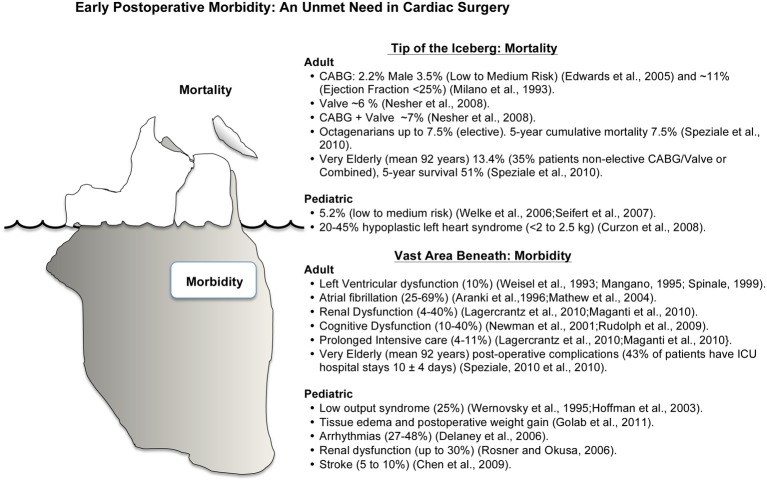
Figure 1
Figure 1
Schematic representation of mortality and morbidity in cardiac surgery. Mortality and morbidity have many interacting and confounding factors with ischemia-reperfusion injury playing a significant role in the underlying etiologies. Improving early post-operative morbidity is an unmet need in cardiac surgery (see text for Discussion).
Figure 2
Figure 2
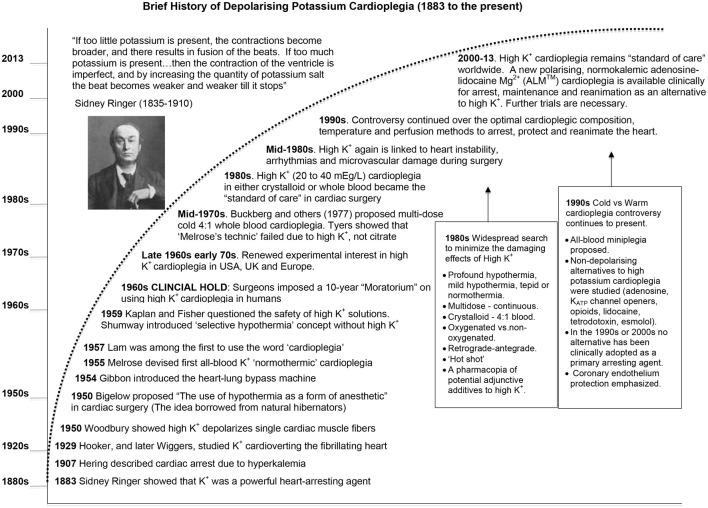
A brief history of the development of potassium cardioplegia from basic science to cardiac surgery (See text for details).
Figure 3
Figure 3
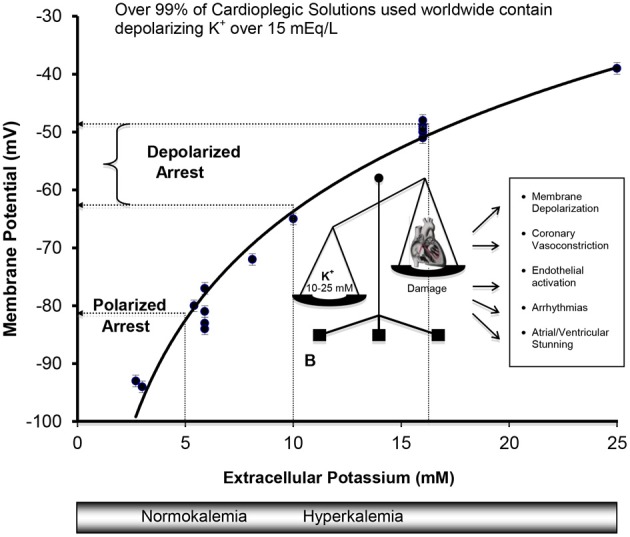
Cell Membranes of the Atria, Purkinje, and Ventricular Myocytes in vivo behave as a K+ electrode over a range of extracellular K+ from 3 to 25 mM. Data were obtained from isolated rat, rabbit, and guinea-pig hearts (Kleber, ; Masuda et al., ; Sloots and Dobson, ; Dobson and Jones, ; Dobson, 2010) and from isolated cells (Wan et al., 2000). The membrane potential φ (mV) = 27 ln [K+] − 126, R2 = 0.97, where [K+] is extracellular potassium concentration in mM. Membrane potentials (φ) were measured directly using potassium microelectrodes (Kleber, ; Masuda et al., ; Snabaitis et al., ; Wan et al., 2000) or calculated from Nerstian distributions of potassium (Dobson and Jones, ; Sloots and Dobson, 2010). The relation between potassium and membrane potential for ventricular muscle also agree well with microelectrode measurements on isolated human atrial muscle (Gelband et al., 1972), and for isolated purkinje fibers above 5.4 mM K+ bathed in Tyrode's solution (Sheu et al., 1980).
Figure 4
Figure 4
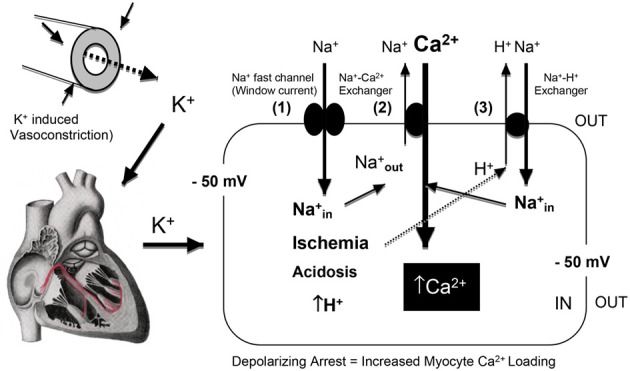
A schematic of the effect of hyperkalemia and prolonged myocardial membrane depolarization on Na+ entry through the “window current” and the net influx of Ca2+ into the myocardial cell via the reversal of the Na+/Ca2+ exchanger [3Na+ ions are extruded in exchange for 1 Ca2+ entry (Bers and Despa, 2009) at a membrane potential of −50 mV (Baczko et al., 2003)]. Global or regional ischemia and metabolic acidosis impact further on Ca2+ loading, with increases in intracellular H+ further activating the Na+/H+ exchanger (Avkiran, 2001) resulting in 1Na+ ion being exchange for 1 H+ ion. The diagram was adapted from Bers and colleagues (Bers et al., ; Bers and Despa, 2006).
Figure 5
Figure 5
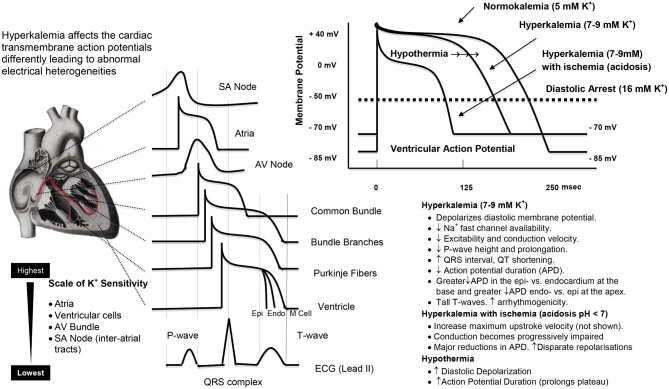
A representation of the regional sensitivities in the heart to high potassium, and the effects of hyperkalemia, ischemia (acidosis), and hypothermia on the ventricular action potential. The effects were obtained from the empirical data in rabbit ventricle and the ventricular modeling studies of Shaw and Rudy (1997) and Cimponeriu et al. (2001). The effects of hypothermia to prolong the action potential are from West et al. (1959), Lathrop et al. (1998) and Coraboeuf et al. (; Aoki et al., 1994).
Figure 6
Figure 6
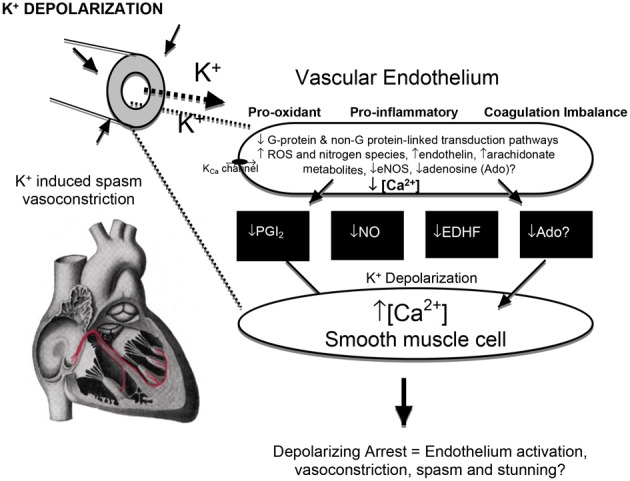
The effect of high potassium on the endothelium and smooth muscle interactions, vasoconstriction, and possible injury. Membrane K+ depolarization decreases the driving force for Ca2+ entry into endothelial cells through Ca2+-activated K+ channels (Coleman et al., 2004), increases voltage sensitive endothelial NADPH oxidases (and other oxidants) (Sellke et al., ; Li and Shah, 2004) which can lead to vascular smooth muscle contraction and vasoconstriction (van Breemen et al., 1997) from a reduced availability of endothelial-derived vasodilators [prostacyclin (PGI2), nitric oxide (NO), non-NO/PGI2 relaxation factors (EDHF's) and adenosine] (He, ; Wu et al., ; Yang and He, 2005). Hyperkalemia in cardioplegia has been linked to loss of ACh-dependent relaxation, which may be exacerbated by ischemia and hypothermia (Tyers, ; Parolari et al., ; Yang and He, 2005).
Figure 7
Figure 7
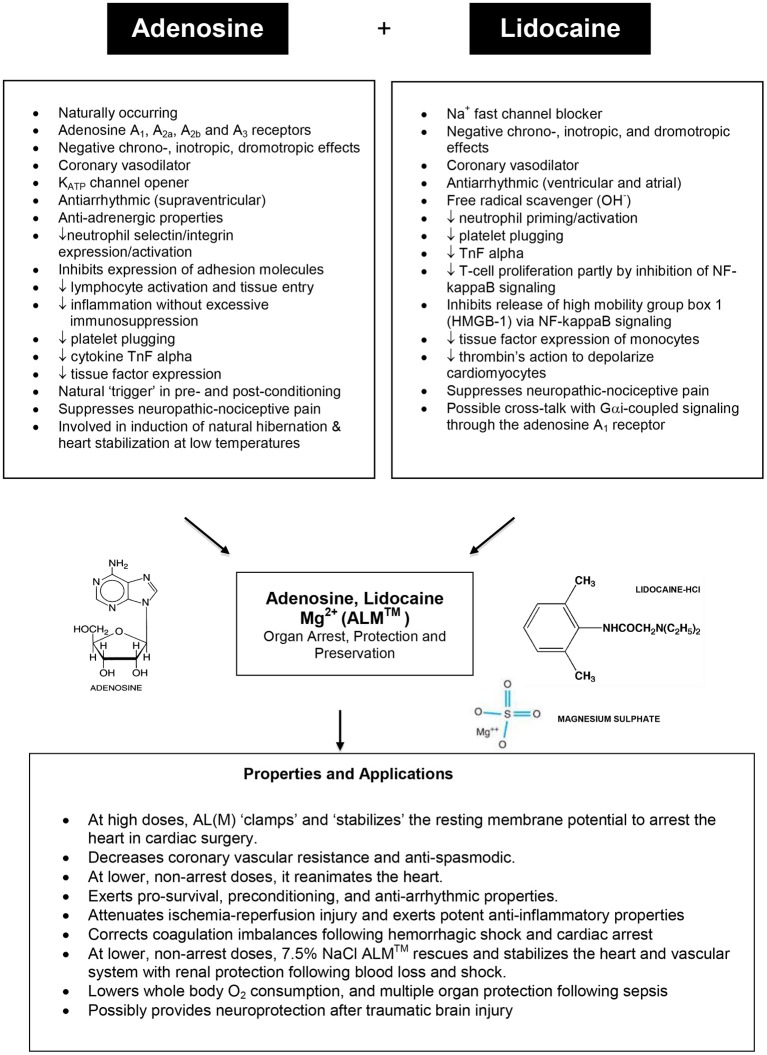
Summary of the major properties and structures of adenosine and lidocaine (with Mg2+), and their potential mechanisms of action for heart arrest, protection and preservation (see text for details).
Figure 8
Figure 8
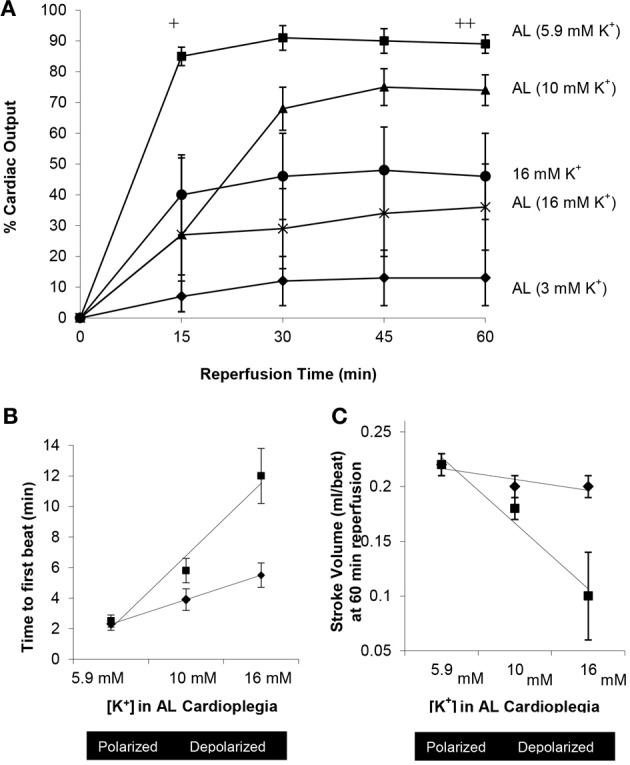
Effect of increasing extracellular potassium in AL cardioplegia on return of cardiac output, time to first beat and stroke volume after 1 and 2 h arrest at 32–33°C in the isolated working rat heart [Adapted from Sloots and Dobson (2010)]. (A) Percentage recovery of cardiac output in following 2 h arrest at 32–33°C. +AL (5.9 mM K+) p < 0.01 (One-Way analysis of variance) compared with AL (3, 10, 16 mM K+) and 16 mM K+ alone. ++AL (5.9 mM K+) p < 0.01 (One-Way analysis of variance) compared with AL (3 mM K+); p < 0.05 (repeated measures) compared with AL (3,16 mM K+) and 16 mM K+ alone. *AL (10 mM K+) p < 0.01 (repeated measures) compared with AL (3 mM K+). (B) Relationship between the time to first beat at reanimation after 1 or 2 h arrest and the concentration of potassium in AL cardioplegia solution (5.9, 10, and 16 mM K+). (C) Relationship between stroke volume and increasing concentrations of potassium in AL cardioplegia solution (5.9, 10, and 16 mM K+) at 60 min reperfusion after 1 and 2 h arrest.

References

    1. Abramov D., Tamariz M. G., Fremes S. E., Guru V., Borger M. A., Christakis G. T., et al. (2000). Trends in coronary artery bypass surgery results: a recent, 9-year study. Ann. Thorac. Surg. 70, 84–90 10.1016/S0003-4975(00)01249-2 - DOI - PubMed
    1. Ahlsson A., Sobrosa C., Kaijser L., Jansson E., Bomfim V. (2012). Adenosine in cold blood cardioplegia – a placebo-controlled study. Interact. Cardiovasc. Thorac. Surg. 14, 48–55 10.1093/icvts/ivr027 - DOI - PMC - PubMed
    1. Al-Badry K. S., Taha H. M. (1983). Hibernation-hypothermia and metabolism in hedgehogs. Changes in water and electrolytes. Comp. Biochem. Physiol. A Comp. Physiol. 74, 435–441 10.1016/0300-9629(83)90627-8 - DOI - PubMed
    1. Alexander J. H., Granger C. B., Sadowski Z., Aylward P. E., White H. D., Thompson T. D., et al. (1999). Prophylactic lidocaine use in acute myocardial infarction: incidence and outcomes from two international trials. The GUSTO-I and GUSTO-IIb investigators. Am. Heart J. 137, 799–805 10.1016/S0002-8703(99)70402-3 - DOI - PubMed
    1. Algarni K. D., Maganti M., Yau T. M. (2011). Predictors of low cardiac output syndrome after isolated coronary artery bypass surgery: trends over 20 years. Ann. Thorac. Surg. 92, 1678–1684 10.1016/j.athoracsur.2011.06.017 - DOI - PubMed