


Predictors and outcomes of infection-related hospital admissions of heart failure patients
- PMID: 24009684
- PMCID: PMC3751916
- DOI: 10.1371/journal.pone.0072476
Predictors and outcomes of infection-related hospital admissions of heart failure patients
Abstract
Background: Infections are one of the most common causes for hospitalization of patients with heart failure (HF). Yet, little is known regarding the prevalence and predictors of different types of acute infections as well as their impact on outcome among this growing population.
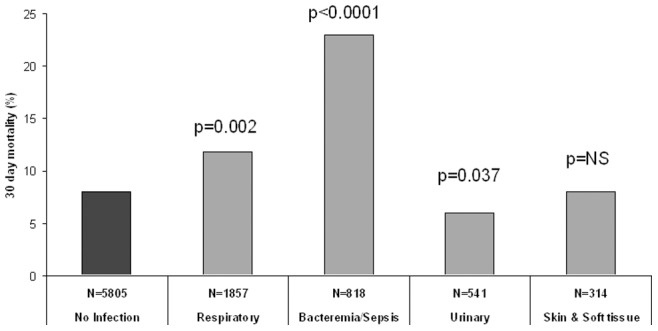
Methods and results: We identified all patients aged 50 or older with a major diagnosis of HF and at least one echocardiography examination who had been hospitalized over a 10-year period (January 2000 and December 2009). Infection-associated admissions were identified according to discharge diagnoses. Among 9,335 HF patients, 3530 (38%) were hospitalized at least once due to infections. The most frequent diagnoses were respiratory infection (52.6%) and sepsis/bacteremia (23.6%) followed by urinary (15.7%) and skin and soft tissue infections (7.8%). Hospitalizations due to infections compared to other indications were associated with increased 30-day mortality (13% vs. 8%, p<0.0001). These higher mortality rates were predominately related to respiratory infections (OR 1.28 [95% CI 1.09, 1.5]) and sepsis\bacteremia (OR 3.13 [95% CI 2.6, 3.7]). Important predictors for these serious infections included female gender, chronic obstructive pulmonary disease, past myocardial infarction and echocardiography-defined significant right (RV) but not left ventricular dysfunction.
Conclusions: Major infection-related hospitalizations are frequent among patients with HF and are associated with increased mortality rates. Elderly female patients with multiple comorbidities and those with severe RV dysfunction are at higher risk for these infections.
Conflict of interest statement
Figures
References
-
- Fonarow GC (2008) Epidemiology and risk stratification in acute heart failure. Am Heart J 155: 200–207. - PubMed
-
- Sarmento PM, Fonseca C, Marques F, Ceia F, Aleixo A (2006) Acutely decompensated heart failure: characteristics of hospitalized patients and opportunities to improve their care. Rev Port Cardiol 25: 13–27. - PubMed
-
- Stein GY, Kremer A, Shochat T, Bental T, Korenfeld R, et al. (2012) The diversity of heart failure in a hospitalized population: the role of age. J Card Fail 18: 645–653. - PubMed
-
- Dai S, Walsh P, Wielgosz A, Gurevich Y, Bancej C, et al. (2012) Comorbidities and mortality associated with hospitalized heart failure in Canada. Can J Cardiol 28: 74–79. - PubMed
-
- Castro P, Vukasovic JL, Garces E, Sepulveda L, Ferrada M, et al. (2004) [Cardiac failure in Chilean hospitals: results of the National Registry of Heart Failure, ICARO]. Rev Med Chil 132: 655–662. - PubMed
MeSH terms
LinkOut - more resources
Full Text Sources
Other Literature Sources
Medical
Research Materials
Miscellaneous
