


Relationship between post-exercise heart rate variability and skinfold thickness
- PMID: 24010045
- PMCID: PMC3758487
- DOI: 10.1186/2193-1801-2-389
Relationship between post-exercise heart rate variability and skinfold thickness
Abstract
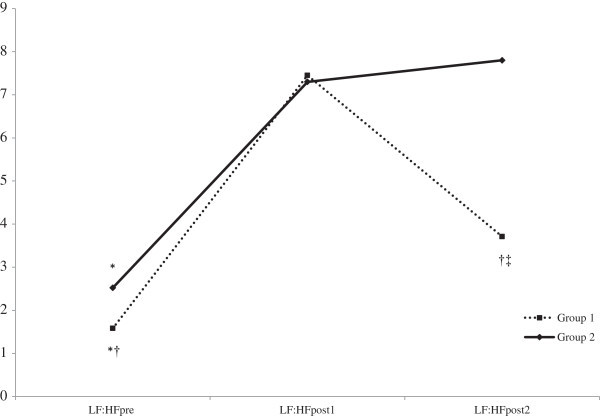
This investigation aimed to determine if groupings based upon sum of skinfold thickness (SF) would reflect the differences in heart rate variability (HRV) measured for up to 30-minutes following maximal exercise, and to determine the extent in variation in post-exercise HRV that could be accounted for between the following independent variables: SF, body mass index (BMI) and maximal oxygen consumption (VO2max). SF and BMI measurements were performed on fifty-four men who completed maximal exercise testing to determine VO2max. HRV was evaluated for five-minutes before (Pre), at 0-5 minutes post- (Post1) and 25-30 minutes post-exercise (Post2), and analyzed by frequency domain [high frequency (HF) power, and HF to low frequency power ratio (LF:HF)). Two groups were formed based on being above or below the sample mean value of SF. HF and LF:HF were significantly higher and lower, respectively, at Pre and Post 2 in Group 1 compared to Group 2 (p < 0.05), which remained after controlling for VO2max and BMI. Furthermore, there was a significant trend toward baseline in post-exercise HRV in Group 1 (p < 0.05) but not in Group 2 (p > 0.05). In addition, SF was the only variable to significantly relate to the post-exercise HRV parameters (p < 0.05). The findings of this investigation suggest greater SF is related to a delayed return of HRV toward baseline from maximal exercise. The association between SF and HRV is independent of VO2max and BMI.
Keywords: Autonomic nervous system; Body composition; Cardiovascular; Exercise; Fitness.
Figures

References
-
- ACSM’s guidelines for exercise testing and prescription. 8. Philadelphia, PA: Lippincott Williams and Williams; 2009. pp. 66–68.
-
- Ashida T, Ono C, Sugiyama T. Effects of short-term hypocaloric diet on sympatho-vagal interaction assessed by spectral analysis of heart rate and blood pressure variability during stress tests in obese hypertensive patients. Hypertens Res. 2007;30:1199–1203. doi: 10.1291/hypres.30.1199. - DOI - PubMed
-
- Blumenthal JA, Babyak MA, Hinderliter A, Watkins LL, Craighead L, Lin PH, Caccia C, Johnson J, Waugh R, Sherwood A. Effects of the DASH diet alone and in combination with exercise and weight loss on blood pressure and cardiovascular biomarkers in men and women with high blood pressure: the ENCORE study. Arch Intern Med. 2010;170:126–135. doi: 10.1001/archinternmed.2009.470. - DOI - PMC - PubMed
-
- Byrne EA, Fleg JL, Vaitkevicius PV, Wright J, Porges SW. Role of aerobic capacity and body mass index in the age associated decline in heart rate variability. J Appl Physiol. 1996;81:743–750. - PubMed
LinkOut - more resources
Full Text Sources
Other Literature Sources
Research Materials
Miscellaneous
