


Quality of life in dementia: a study on proxy bias
- PMID: 24011428
- PMCID: PMC3844427
- DOI: 10.1186/1471-2288-13-110
Quality of life in dementia: a study on proxy bias
Abstract
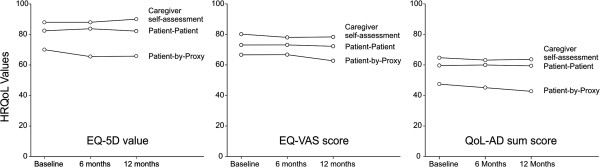
Background: Measurement of health-related quality of life (HRQoL) in dementia is difficult. At some point people with dementia become unable to meaningfully assess their own HRQoL. At such a point in time researchers need to rely on other types of information such as observation or assessments from informal caregivers (proxies). However, caregiver assessments may be biased by several mechanisms. The current study explores whether caregivers project part of their own HRQoL in their assessments of patient HRQoL.
Methods: The participants in the current study were 175 pairs, consisting of community-dwelling persons with dementia and their caregivers. The EQ-5D, the EQ-VAS and the QoL-AD were administered to collect HRQoL measurements from patients and caregivers at baseline, 6 months and 12 months. Two linear mixed models were used to investigate factors that bias proxy ratings, one with the EQ-VAS as dependent variable, and one with the EQ-5D utility as dependent variable. The independent variables were caregiver age, caregiver sex and caregiver QoL-AD items.
Results: The linear mixed model with EQ-VAS as dependent variable indicated that 3 caregiver characteristics, namely caregiver age, money (caregiver's financial situation) and valuation of life as a whole were significant predictors of the patient-by-proxy VAS scores. The linear mixed model with utility value as the dependent variable showed that caregiver age and valuation of the ability to do things for fun were significant predictors of the patient-by-proxy EQ-5D utility values.
Conclusions: The current study was a first step in identifying factors that bias patient-by-proxy HRQoL assessments. It was discovered that caregivers project part of their own HRQoL onto patients when assessing patient HRQoL. This implies that patient-by-proxy HRQoL values should be interpreted with caution and not be used as a direct substitute for patient self-assessment, even when patients are no longer able meaningfully assess themselves.
Figures
References
-
- Diagnostic and Statistical Manual of Mental Disorders DSM-IV-TR Fourth Edition (Text Revision) 4. Washington, DC: American Psychiatric Association; 2000.
-
- Albert SM, Del Castillo-Castaneda C, Sano M, Jacobs DM, Marder K, Bell K, Bylsma F, Lafleche G, Brandt J, Albert M. et al.Quality of life in patients with Alzheimer's disease as reported by patient proxies. J Am Geriatr Soc. 1996;44(11):1342–1347. - PubMed
-
- Wimo A, Prince M. World Alzheimer Report: the global economic impact of dementia. London: Alzheimer’s Disease International; 2010.
Publication types
MeSH terms
LinkOut - more resources
Full Text Sources
Other Literature Sources
Medical
