


Dynamic indices of methamphetamine dependence and HIV infection predict fluctuations in affective distress: a five-year longitudinal analysis
- PMID: 24012068
- PMCID: PMC3845675
- DOI: 10.1016/j.jad.2013.07.036
Dynamic indices of methamphetamine dependence and HIV infection predict fluctuations in affective distress: a five-year longitudinal analysis
Abstract
Background: Methamphetamine (METH) use and human immunodeficiency virus (HIV) infection are highly comorbid, and both are associated with increased prevalence of affective distress. Delineating the trajectory of affective distress in the context of METH dependence and HIV infection is important given the implications for everyday functional impairment, adverse health behaviors, and increased risk for adverse health outcomes.
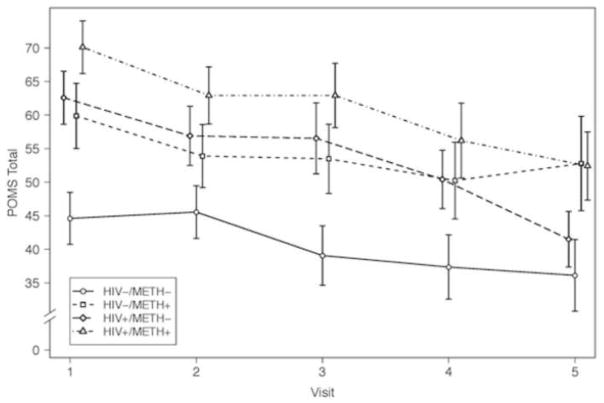
Methods: We conducted a five-year longitudinal investigation involving 133 METH-dependent (74 HIV seropositive) and 163 non-METH-dependent (90 HIV seropositive) persons to examine both long-standing patterns and transient changes in affective distress. Mixed-effect regression models with random subject-specific slopes and intercepts evaluated the effect of METH dependence, HIV serostatus, and related variables on affective distress, as measured by the Profile of Mood States.
Results: Transient changes in affective distress were found to be greater among those with a diagnosis of current MDD, briefer durations of abstinence from METH, and higher quantity of METH consumed. Weak associations were observed among static (time-independent predictors) covariates and long-standing patterns in affective distress.
Limitations: Study lacked data pertaining to the participants' involvement in METH treatment and relied on respondent-driven sampling.
Conclusions: Our longitudinal investigation of the trajectory of affective distress indicated that specific and dynamic indices of current METH use were associated with greater transient changes in mood. In the evaluation and treatment of affective distress, recency and quantity of current METH use are important to consider given their association with heightened affective distress and mood instability over time.
Keywords: Affective distress; HIV; Longitudinal; Methamphetamine dependence.
© 2013 Elsevier B.V. All rights reserved.
Conflict of interest statement
Conflict of Interest
The authors have no actual or potential conflict of interest, including any financial, personal or other relationships with other people or organizations within three years of beginning the work submitted that could inappropriately influence, or be perceived to influence, their work.
Figures
References
-
- Abramson I, Wolfson T. A Likelihood Approximation and Shrinkage for Unbalanced Repeated Measures. SankhyƒÅ: The Indian Journal of Statistics, Series B. 2002:301–321.
-
- Baker TB, Japuntich SJ, Hogle JM, McCarthy DE, Curtin JJ. Pharmacologic and behavioral withdrawal from addictive drugs. Current Directions in Psychological Science. 2006;15:232–236.
-
- Baker TB, Piper ME, McCarthy DE, Majeskie MR, Fiore MC. Addiction motivation reformulated: an affective processing model of negative reinforcement. Psychol Rev. 2004;111:33–51. - PubMed
-
- Benjamini Y, Hochberg Y. Controlling the false discovery rate: a practical and powerful approach to multiple testing. Journal of the Royal Statistical Society. Series B (Methodological) 1995:289–300.
Publication types
MeSH terms
Substances
Grants and funding
LinkOut - more resources
Full Text Sources
Other Literature Sources
Medical
