


Assessing the mechanism of response in the retrosplenial cortex of good and poor navigators
- PMID: 24012136
- PMCID: PMC3878422
- DOI: 10.1016/j.cortex.2013.08.002
Assessing the mechanism of response in the retrosplenial cortex of good and poor navigators
Abstract
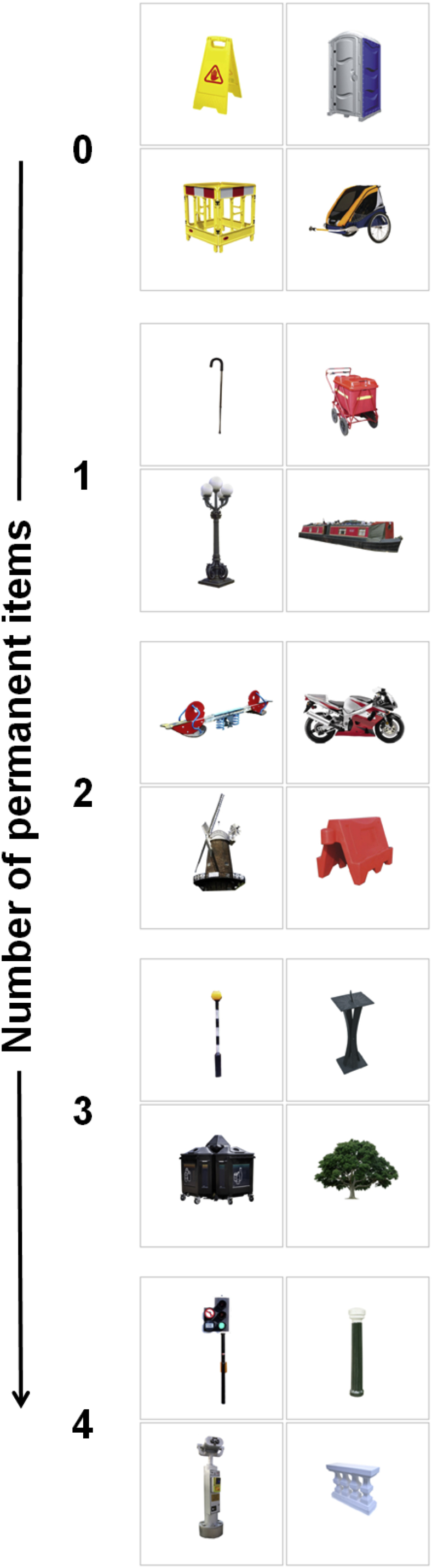
The retrosplenial cortex (RSC) is consistently engaged by a range of tasks that examine episodic memory, imagining the future, spatial navigation, and scene processing. Despite this, an account of its exact contribution to these cognitive functions remains elusive. Here, using functional MRI (fMRI) and multi-voxel pattern analysis (MVPA) we found that the RSC coded for the specific number of permanent outdoor items that were in view, that is, items which are fixed and never change their location. Moreover, this effect was selective, and was not apparent for other item features such as size and visual salience. This detailed detection of the number of permanent items in view was echoed in the parahippocampal cortex (PHC), although the two brain structures diverged when participants were divided into good and poor navigators. There was no difference in the responsivity of the PHC between the two groups, while significantly better decoding of the number of permanent items in view was possible from patterns of activity in the RSC of good compared to poor navigators. Within good navigators, the RSC also facilitated significantly better prediction of item permanence than the PHC. Overall, these findings suggest that the RSC in particular is concerned with coding the presence of every permanent item that is in view. This mechanism may represent a key building block for spatial and scene representations that are central to episodic memories and imagining the future, and could also be a prerequisite for successful navigation.
Keywords: Episodic memory; Landmarks; Navigation; Permanence; Retrosplenial cortex.
Copyright © 2013 The Authors. Published by Elsevier Ltd.. All rights reserved.
Figures


References
-
- Aggleton J.P. Understanding retrosplenial amnesia: insights from animal studies. Neuropsychologia. 2010;48(8):2328–2338. - PubMed
-
- Ashburner J., Friston K.J. Voxel-based morphometry – the methods. NeuroImage. 2000;11(6 Pt 1):805–821. - PubMed
-
- Ashburner J., Friston K.J. Unified segmentation. NeuroImage. 2005;26(3):839–851. - PubMed
Publication types
MeSH terms
Grants and funding
LinkOut - more resources
Full Text Sources
Other Literature Sources
