


Carney complex and McCune Albright syndrome: an overview of clinical manifestations and human molecular genetics
- PMID: 24012779
- PMCID: PMC3943598
- DOI: 10.1016/j.mce.2013.08.022
Carney complex and McCune Albright syndrome: an overview of clinical manifestations and human molecular genetics
Abstract
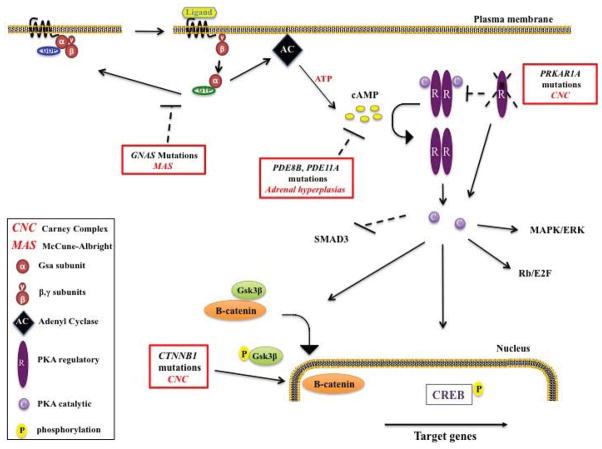
Endocrine neoplasia syndromes feature a wide spectrum of benign and malignant tumors of endocrine and non-endocrine organs associated with other clinical manifestations. This study outlines the main clinical features, genetic basis, and molecular mechanisms behind two multiple endocrine neoplasia syndromes that share quite a bit of similarities, but one can be inherited whereas the other is always sporadic, Carney complex (CNC) and McCune-Albright (MAS), respectively. Spotty skin pigmentation, cardiac and other myxomas, and different types of endocrine tumors and other characterize Carney complex, which is caused largely by inactivating Protein kinase A, regulatory subunit, type I, Alpha (PRKAR1A) gene mutations. The main features of McCune-Albright are fibrous dysplasia of bone (FD), café-au-lait macules and precocious puberty; the disease is caused by activating mutations in the Guanine Nucleotide-binding protein, Alpha-stimulating activity polypeptide (GNAS) gene which are always somatic. We review the clinical manifestations of the two syndromes and provide an update on their molecular genetics.
Keywords: Carney complex; Endocrine neoplasia; GNAS; McCune–Albright; PRKAR1A.
Published by Elsevier Ireland Ltd.
Figures
References
-
- Akintoye SO, Chebli C, et al. Characterization of gsp-mediated growth hormone excess in the context of McCune-Albright syndrome. J Clin Endocrinol Metab. 2002;87(11):5104–5112. - PubMed
-
- Alman BA, Greel DA, et al. Activating mutations of Gs protein in monostotic fibrous lesions of bone. J Orthop Res. 1996;14(2):311–315. - PubMed
-
- Beggs AD, Latchford AR, et al. Peutz-Jeghers syndrome: a systematic review and recommendations for management. Gut. 2010;59(7):975–986. - PubMed
-
- Bertherat J, Chanson P, et al. The cyclic adenosine 3′,5′-monophosphate-responsive factor CREB is constitutively activated in human somatotroph adenomas. Mol Endocrinol. 1995;9(7):777–783. - PubMed
Publication types
MeSH terms
Grants and funding
LinkOut - more resources
Full Text Sources
Other Literature Sources
Medical
