


Growing Right Onto Wellness (GROW): a family-centered, community-based obesity prevention randomized controlled trial for preschool child-parent pairs
- PMID: 24012890
- PMCID: PMC3886237
- DOI: 10.1016/j.cct.2013.08.013
Growing Right Onto Wellness (GROW): a family-centered, community-based obesity prevention randomized controlled trial for preschool child-parent pairs
Abstract
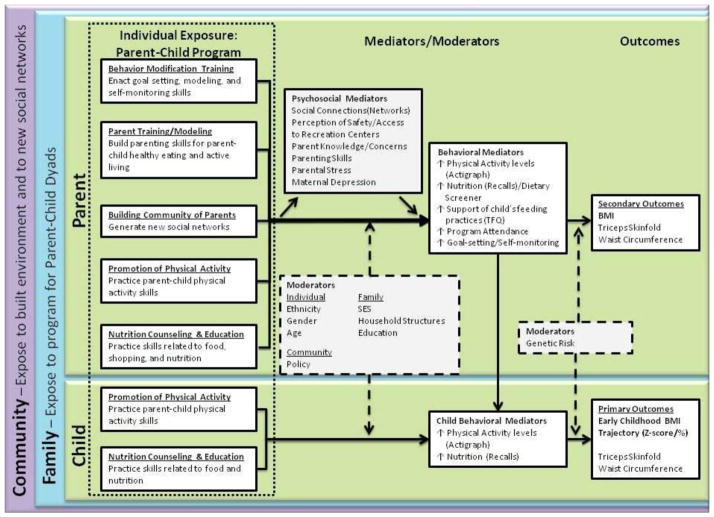
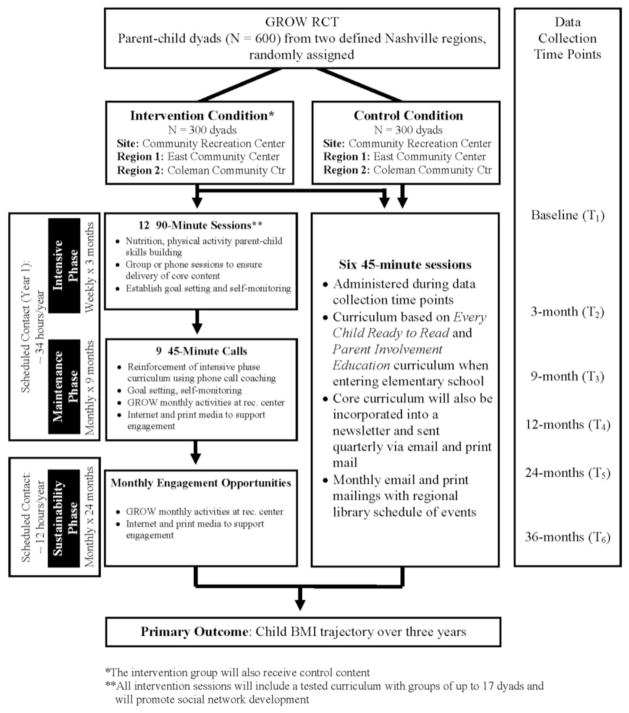
Growing Right Onto Wellness (GROW) is a randomized controlled trial that tests the efficacy of a family-centered, community-based, behavioral intervention to prevent childhood obesity among preschool-aged children. Focusing on parent-child pairs, GROW utilizes a multi-level framework, which accounts for macro (i.e., built-environment) and micro (i.e., genetics) level systems that contribute to the childhood obesity epidemic. Six hundred parent-child pairs will be randomized to a 3-year healthy lifestyle intervention or a 3-year school readiness program. Eligible children are enrolled between ages 3 and 5, are from minority communities, and are not obese. The principal site for the GROW intervention is local community recreation centers and libraries. The primary outcome is childhood body mass index (BMI) trajectory at the end of the three-year study period. In addition to other anthropometric measurements, mediators and moderators of growth are considered, including genetics, accelerometry, and diet recall. GROW is a staged intensity intervention, consisting of intensive, maintenance, and sustainability phases. Throughout the study, parents build skills in nutrition, physical activity, and parenting, concurrently forming new social networks. Participants are taught goal-setting, self-monitoring, and problem solving techniques to facilitate sustainable behavior change. The GROW curriculum uses low health literacy communication and social media to communicate key health messages. The control arm is administered to both control and intervention participants. By conducting this trial in public community centers, and by implementing a family-centered approach to sustainable healthy childhood growth, we aim to develop an exportable community-based intervention to address the expanding public health crisis of pediatric obesity.
Keywords: Childhood obesity; Family-centered intervention; Obesity prevention; Preschool children; Underserved.
© 2013.
Conflict of interest statement
None of the authors have any conflicts of interest to disclose.
Figures
References
-
- Prevalence of Obesity Among Children and Adolescents: United States, Trends 1963–1965 through 2007–2008. [ http://www.cdc.gov/nchs/data/hestat/obesity_child_07_08/obesity_child_07...]
-
- Olshansky SJ, Passaro DJ, Hershow RC, Layden J, Carnes BA, Brody J, Hayflick L, Butler RN, Allison DB, Ludwig DS. A potential decline in life expectancy in the United States in the 21st century. N Engl J Med. 2005;352(11):1138–1145. - PubMed
Publication types
MeSH terms
Grants and funding
LinkOut - more resources
Full Text Sources
Other Literature Sources
Medical
