


Transition to sarcopenia and determinants of transitions in older adults: a population-based study
- PMID: 24013673
- PMCID: PMC4022098
- DOI: 10.1093/gerona/glt131
Transition to sarcopenia and determinants of transitions in older adults: a population-based study
Abstract
Background: Diagnostic criteria for sarcopenia from appendicular lean mass (ALM), strength, and performance have been proposed, but little is known regarding the progression of sarcopenia. We examined the time course of sarcopenia and determinants of transitioning toward and away from sarcopenia.
Methods: ALM, gait speed, and grip strength were assessed seven times over 9 years in 2,928 initially well-functioning adults aged 70-79. Low ALM was defined as less than 7.95 kg/m(2) (men) or less than 6.24 kg/m(2) (women), low performance as gait speed less than 1.0 m/s, low strength as grip strength less than 30 kg (men) or less than 20 kg (women). Presarcopenia was defined as low ALM and sarcopenia as low ALM with low performance or low strength. Hidden Markov modeling was used to characterize states of ALM, strength, and performance and model transitions leading to sarcopenia and death. Determinants of transitioning toward and away from sarcopenia were examined with logistic regression.
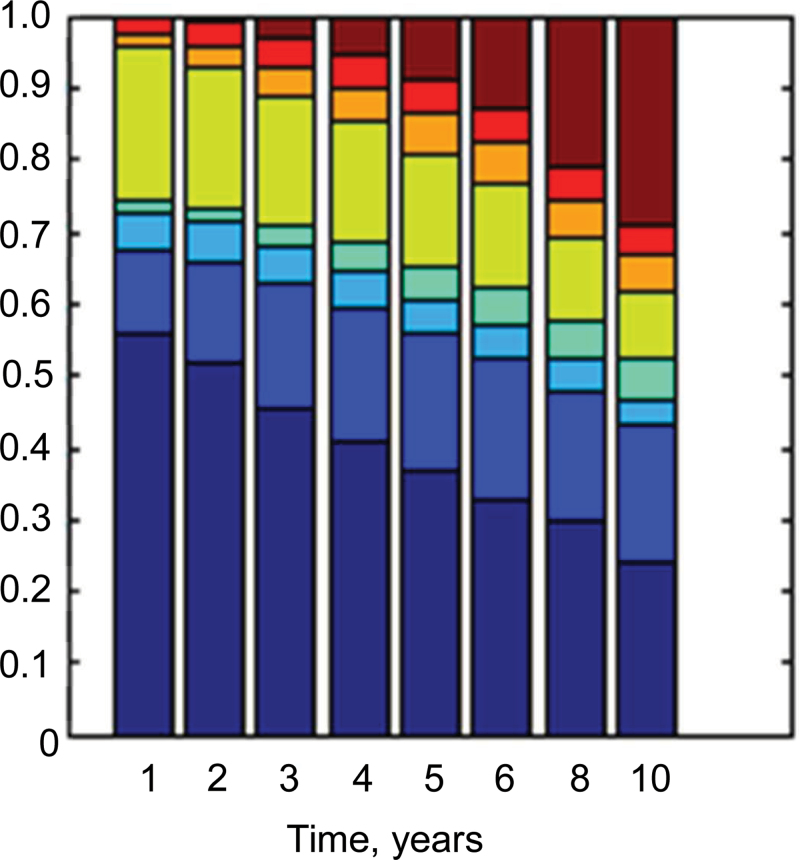
Results: Initially, 54% of participants had normal ALM, strength, and performance; 21% had presarcopenia; 5% had sarcopenia; and 20% had intermediate characteristics. Of participants with normal ALM, strength, and performance, 1% transitioned to presarcopenia and none transitioned to sarcopenia. The greatest transition to sarcopenia (7%) was in presarcopenic individuals. Low-functioning and sarcopenia states were more likely to lead to death (12% and 13%). Higher body mass index (p < .001) and pain (p = .05) predicted transition toward sarcopenia, whereas moderate activity predicted transition from presarcopenia to more normal states (p = .02).
Conclusions: Pain, physical activity, and body mass index, potentially modifiable factors, are determinants of transitions. Promotion of health approaching old age is important as few individuals transition away from their initial state.
Keywords: Aging; Epidemiology.; Muscle; Physical function; Sarcopenia.
Published by Oxford University Press on behalf of the Gerontological Society of America 2013.
Figures


References
-
- Thompson DD. Aging and sarcopenia. J Musculoskelet Neuronal Interact. 2007;7:344–345 - PubMed
-
- Paddon-Jones D, Short KR, Campbell WW, Volpi E, Wolfe RR. Role of dietary protein in the sarcopenia of aging. Am J Clin Nutr. 2008;87:1562S–1566S - PubMed
-
- Visser M, Goodpaster BH, Kritchevsky SB, et al. Muscle mass, muscle strength, and muscle fat infiltration as predictors of incident mobility limitations in well-functioning older persons. J Gerontol A Biol Sci Med Sci. 2005;60:324–333 - PubMed
-
- Lauretani F, Russo CR, Bandinelli S, et al. Age-associated changes in skeletal muscles and their effect on mobility: an operational diagnosis of sarcopenia. J Appl Physiol. 2003;95:1851–1860 - PubMed
Publication types
MeSH terms
Grants and funding
LinkOut - more resources
Full Text Sources
Other Literature Sources
Medical
