


FAS-1377 G/A (rs2234767) polymorphism and cancer susceptibility: a meta-analysis of 17,858 cases and 24,311 controls
- PMID: 24014103
- PMCID: PMC3754923
- DOI: 10.1371/journal.pone.0073700
FAS-1377 G/A (rs2234767) polymorphism and cancer susceptibility: a meta-analysis of 17,858 cases and 24,311 controls
Abstract
Background and objectives: Disruption of apoptosis has been implicated in carcinogenesis. Specifically, various single-nucleotide polymorphisms (SNPs) in apoptotic genes, such as FAS-1377 G/A SNP, have been associated with cancer risk. FAS-1377 G/A SNP has been shown to alter FAS gene promoter transcriptional activity. Down-regulation of FAS and cell death resistance is key to many cancers, but an association between FAS-1377 G/A SNP and cancer risk is uncertain. Therefore, we conducted a meta-analysis of the current literature to clarify this relationship.
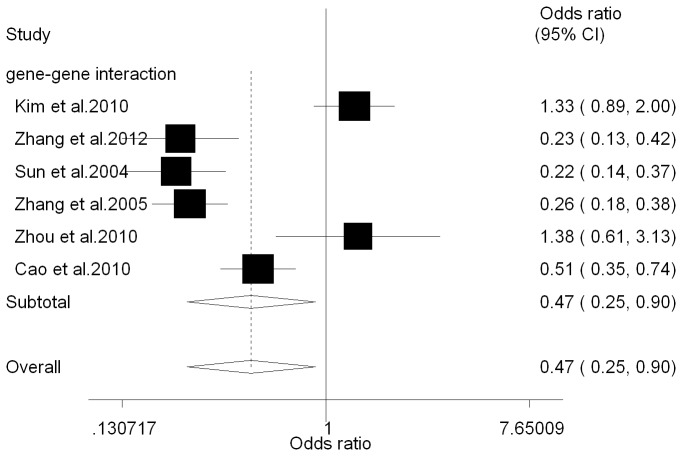
Methodology/principal findings: From PubMed and Chinese language (CNKI and WanFang) databases, we located articles published up to March 5, 2013, obtaining 44 case-control studies from 41 different articles containing 17,858 cases and 24,311 controls based on search criteria for cancer susceptibility related to the FAS gene -1377 G/A SNP. Odds ratios (ORs) and 95% confidence intervals (CI) revealed association strengths. Data show that the -1377 G allele was protective against cancer risk. Similar associations were detected in "source of control," ethnicity and cancer type subgroups. Lower cancer risk was found in both smokers with a GG+GA genotype and in non-smokers with the GG+GA genotype, when compared to smokers and nonsmokers with the AA genotype. Males carrying the -1377G allele (GG+GA) had lower cancer incidence than those with the AA genotype. Individuals who carried both FAS-1377(GG+GA)/FASL-844(TT+TC) genotypes appeared to have lower risk of cancer than those who carried both FAS-1377 AA/FASL-844 CC genotypes.
Conclusions/significance: The FAS-1377 G/A SNP may decrease cancer risk. Studies with larger samples to study gene-environment interactions are warranted to understand the role of FAS gene polymorphisms, especially -1377 G/A SNP, in cancer risk.
Conflict of interest statement
Figures
References
-
- World Health Organization (2008) The Global Burden of Disease: 2004 Update. Geneva: World Health Prganization.
-
- Dong LM, Potter JD, White E, Ulrich CM, Cardon LR et al. (2008) Genetic susceptibility to cancer: the role of polymorphisms in candidate genes. JAMA 299: 2423-2436. doi:10.1001/jama.299.20.2423. PubMed: 18505952. - DOI - PMC - PubMed
-
- Wokolorczyk D, Gliniewicz B, Sikorski A, Zlowocka E, Masojc B et al. (2008) A range of cancers is associated with the rs6983267 marker on chromosome 8. Cancer Res 68: 9982-9986. doi:10.1158/0008-5472.CAN-08-1838. PubMed: 19047180. - DOI - PubMed
-
- Harismendy O, Frazer KA (2009) Elucidating the role of 8q24 in colorectal cancer. Nat Genet 41: 868-869. doi:10.1038/ng0809-868. PubMed: 19639026. - DOI - PubMed
Publication types
MeSH terms
Substances
LinkOut - more resources
Full Text Sources
Other Literature Sources
Research Materials
Miscellaneous
