


Usefulness of parent-completed ASQ for neurodevelopmental screening of preterm children at five years of age
- PMID: 24014166
- PMCID: PMC3754941
- DOI: 10.1371/journal.pone.0071925
Usefulness of parent-completed ASQ for neurodevelopmental screening of preterm children at five years of age
Abstract
Introduction: Preterm children are at greater risk of developmental impairment and require close follow-up for early and optimal medical care. Our goal was to examine use of the parent-completed Ages and Stages Questionnaire (ASQ) as a screening tool for neurodevelopmental disabilities in preterm infants at five years of age.
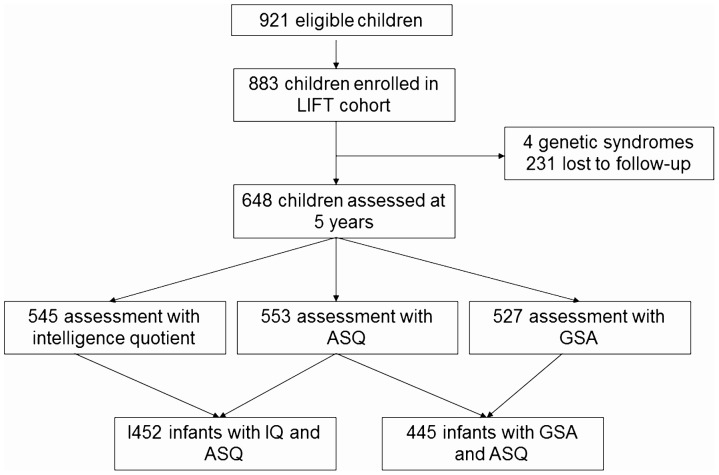
Patients and methods: A total of 648 preterm children (<35 weeks gestational age) born between 2003 and 2004 and included in the regional Loire Infant Follow-up network were evaluated at five years of age. ASQ was compared with two validated tools (Intelligence Quotient and Global School Adaptation Score) and the impact of maternal education on the accuracy of this questionnaire was assessed.
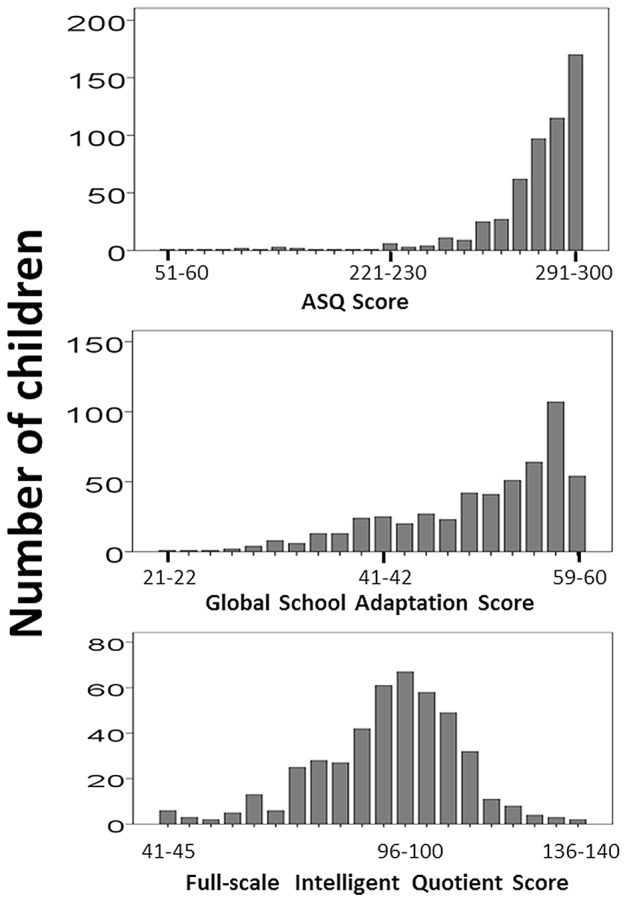
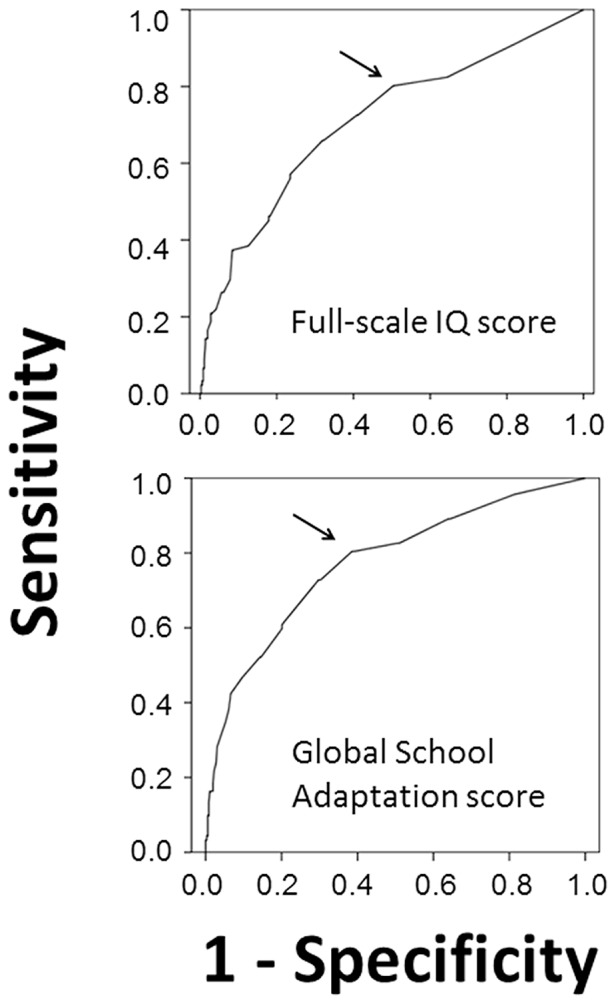
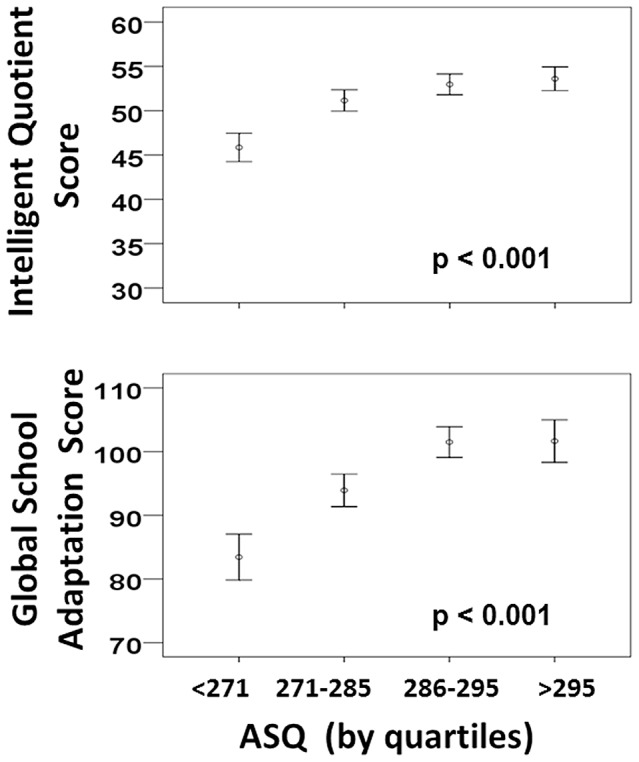
Results: Overall ASQ scores for predicting full-scale IQ<85 and GSA score produced an area under the receiver operating characteristic curve of 0.73±0.03 and 0.77±0.03, respectively. An ASQ cut-off value of 285 had optimal discriminatory power for identifying children with IQ scores<85 and GSA scores in the first quintile. ASQ values<285 were significantly associated with a higher risk of non-optimal neurologic outcomes (sensitivity of 0.80, specificity of 0.54 for IQ<85). ASQ values>285 were not distinctive for mild delay or normal development. In children with developmental delay, no difference was found when ASQ scores according to maternal education levels were analyzed.
Conclusions: ASQ at five years is a simple and cost-effective tool that can detect severe developmental delay in preterm children regardless of maternal education level, while its capacity to identify children with mild delay appears to be more limited.
Conflict of interest statement
Figures
References
-
- Bhutta AT, Cleves MA, Casey PH, Cradock MM, Anand KJ (2002) Cognitive and behavioural outcomes of school-aged children who were born preterm: a meta-analysis. JAMA 288(6): 728–37. - PubMed
-
- Wilson-Costello D, Friedman H, Minich N, Syber B, Taylor G, et al. (2007) Improved neurodevelopmental outcomes for extremely low birth weight infants in 2000–2002. Pediatrics 119(1): 37–45. - PubMed
-
- Larroque B, Ancel PY, Marret S, Marchand L, André M, et al. (2008) Neurodevelopmental disabilities and special care of 5-year-old children born before 33 weeks of gestation (the EPIPAGE study): a longitudinal cohort study. Lancet 371(9615): 813–20. - PubMed
-
- Parry TS (1992) The effectiveness of early intervention: a critical review. J Paediatr Child Health 28(5): 343–6. - PubMed
MeSH terms
LinkOut - more resources
Full Text Sources
Other Literature Sources
Medical
