. 2013 Oct 8;110(41):16526-31.
doi: 10.1073/pnas.1310478110. Epub 2013 Sep 6.

Efficient nonmeiotic allele introgression in livestock using custom endonucleases

Affiliations

Efficient nonmeiotic allele introgression in livestock using custom endonucleases

Wenfang Tan et al. Proc Natl Acad Sci U S A. .

Abstract

We have expanded the livestock gene editing toolbox to include transcription activator-like (TAL) effector nuclease (TALEN)- and clustered regularly interspaced short palindromic repeats (CRISPR)/Cas9-stimulated homology-directed repair (HDR) using plasmid, rAAV, and oligonucleotide templates. Toward the genetic dehorning of dairy cattle, we introgressed a bovine POLLED allele into horned bull fibroblasts. Single nucleotide alterations or small indels were introduced into 14 additional genes in pig, goat, and cattle fibroblasts using TALEN mRNA and oligonucleotide transfection with efficiencies of 10-50% in populations. Several of the chosen edits mimic naturally occurring performance-enhancing or disease- resistance alleles, including alteration of single base pairs. Up to 70% of the fibroblast colonies propagated without selection harbored the intended edits, of which more than one-half were homozygous. Edited fibroblasts were used to generate pigs with knockout alleles in the DAZL and APC genes to model infertility and colon cancer. Our methods enable unprecedented meiosis-free intraspecific and interspecific introgression of select alleles in livestock for agricultural and biomedical applications.


Conflict of interest statement

Conflict of interest statement: D.F.C., C.A.L., D.A.W., P.B.H., and S.C.F. either have equity in and/or work for Recombinetics, Inc., a biotechnology company that receives funding from the National Institutes of Health to develop gene editing in commercial livestock.

Figures
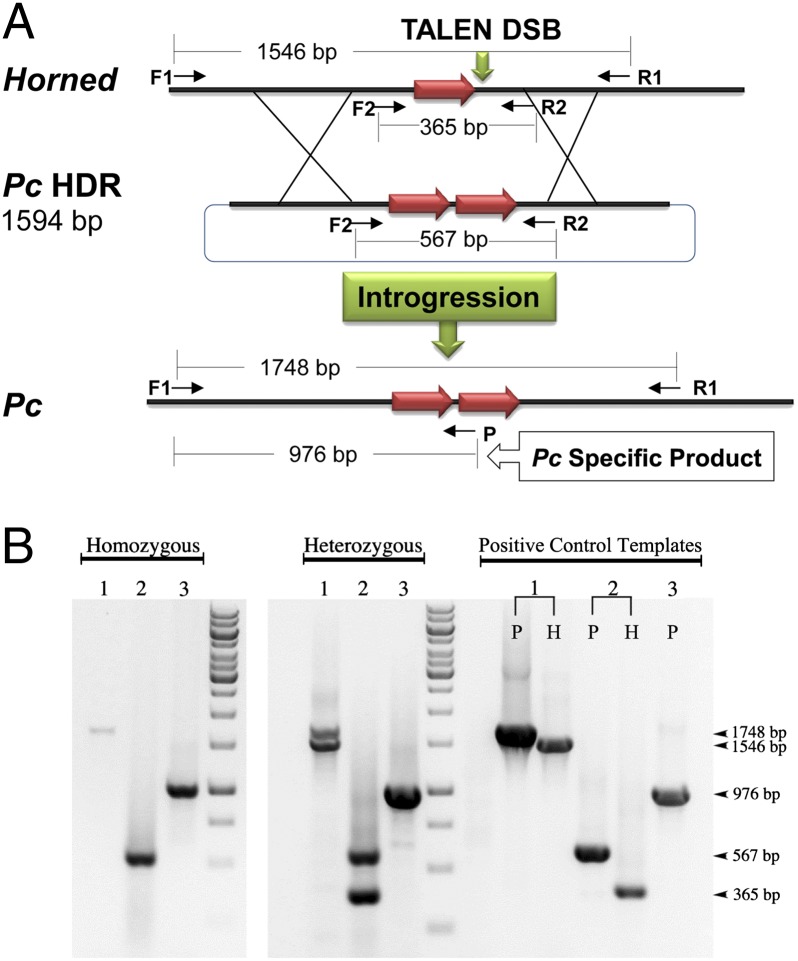
Fig. 1.
Fig. 1.
TALEN-mediated introgression of Polled. (A) Strategy for introgressing the Pc allele into Holstein (HORNED) cells. The Pc allele is a tandem repeat of 212 bp (red arrow) with a 10-bp deletion (not shown). TALENs were developed to specifically target the HORNED allele (green vertical arrow), which could be repaired by homologous recombination using the Pc HDR plasmid. Primer sets used in B are depicted. (B) Representative images of colonies with homozygous or heterozygous introgression of Pc. Three primer sets, indicated by number, were used for positive classification of candidate colonies: set 1, F1+R1; set 2, F2+R2; and set 3, F1+P (Pc-specific). Amplicons generated using positive control templates (P, plasmid template containing a sequence-verified Pc 1,748-bp insert between primers F1 and R1; H, Holstein bull genomic DNA) are shown. The identity of the PCR products was confirmed by sequencing of F1+R1 amplicons.
Fig. 2.
Fig. 2.
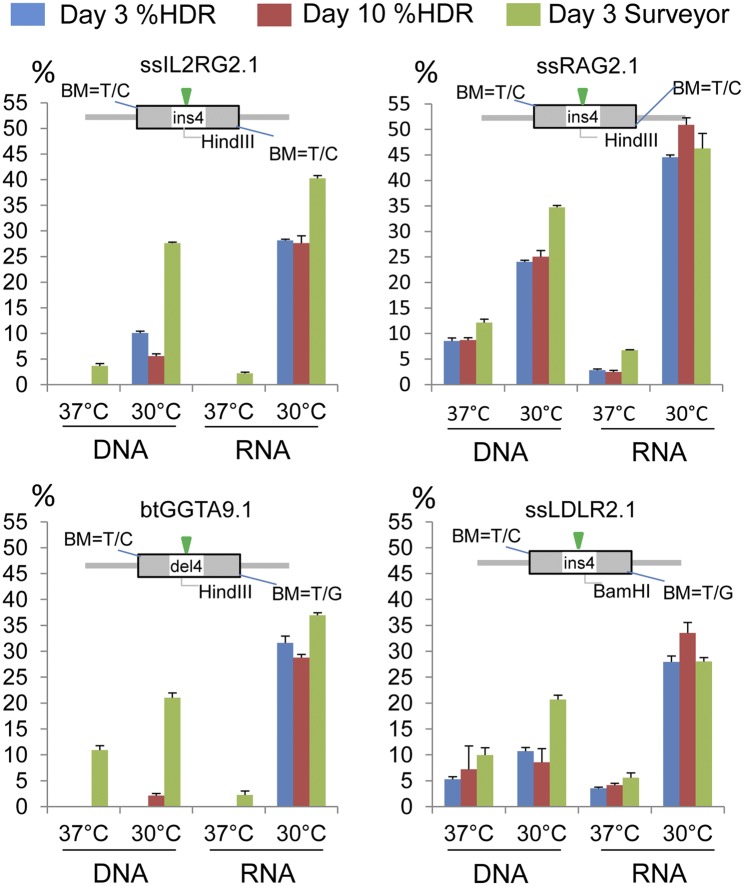
An mRNA source of TALENs stimulates efficient and consistent HDR using an oligo donor. Each chart displays results of targeting a specific locus in fibroblasts (e.g., ssIL2RG; “ss” for Sus scrofa and “bt” for Bos taurus) using oligo donor templates and TALENs delivered as plasmid DNA or mRNA. (Insets) Diagrams of the oligo templates, in which the shaded boxes represent the TALEN-binding site and the spacers are shown in white. Each oligo contains either a 4-bp insertion (ins4) or deletion (del4) that introduces a novel restriction site for RFLP analysis. Presumptive BMs replace the conserved −1 thymidine (relative to the TALEN-binding site) with the indicated nucleotide. Fibroblasts were transfected with either TALEN-encoding plasmids (3 µg) or mRNA (1 µg) along with 3 µM of their cognate oligo-homologous template (SI Appendix, Table S4). Cells were then incubated at 37 °C or 30 °C for 3 d before expansion at 37 °C until day 10. TALEN activity was measured by the Surveyor assay at day 3 (Day3 Surveyor), and HDR was measured at days 3 and 10 by RFLP analysis (Day3 %HDR and Day10 %HDR). Each bar displays the average and SEM from three replicates.
Fig. 3.
Fig. 3.
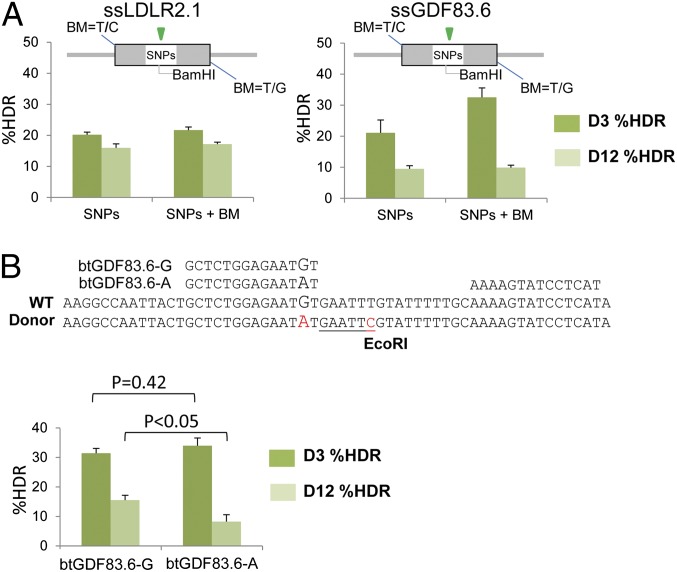
SNP introgression using oligo donors. (A) The influence of BMs on maintenance of HDR alleles was evaluated. Each oligo was designed to introduce the same SNPs/restriction sites with or without BMs. HDR was quantified by RFLP assay in transfected populations initially cultured at 30 °C for 3 d and then maintained at 37 °C up to day 12. Values are averaged (n = 3). (B) Introgression of myostatin C313Y into Wagyu fibroblasts. The C313Y missense mutation is caused by a G-to-A transition (indicated by oversized text) at nucleotide 938 of bovine myostatin (–25). The HDR template also includes a T-to-C transition (red) to introduce a novel EcoRI site for RFLP screening. Two left TALENs were designed against the locus: btGDF83.6-G, targeting the WT alelle (Wt), and btGDF83.6-A targeting the mutant allele (C313Y). The two share a common right TALEN. Transfection, culture, and measurement were conducted as described above. The average and SEM values for btGDF83.6-G (n = 30) and btGDF83.6-A (n = 5) represent 12 and 3 biological replicates, respectively. A two-sided Student t test was used to compare averages between groups; P values are indicated.
Fig. 4.
Fig. 4.
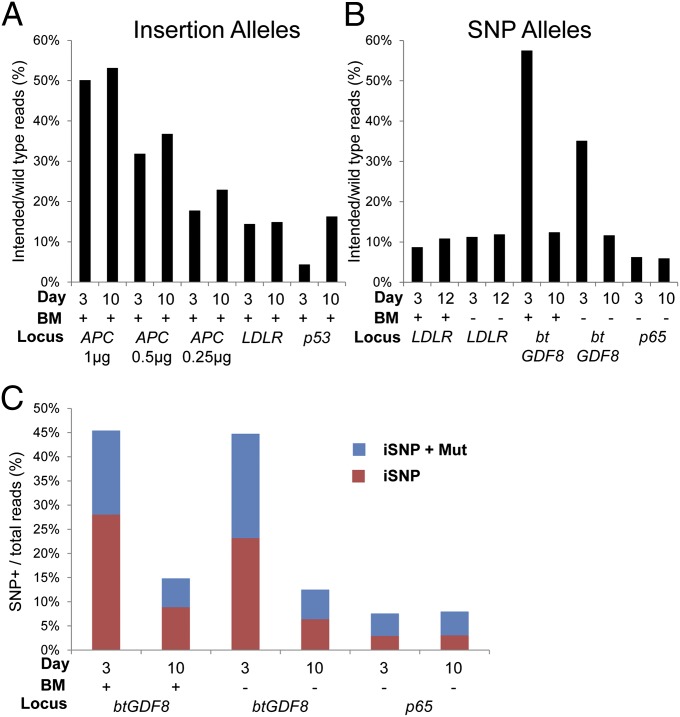
Sequence analysis of TALEN-stimulated HDR alleles. PCR amplicons flanking the target site (200–250 bp total) derived from TALEN mRNA and oligo-transfected cell populations were sequenced by Illumina sequencing. The total read count ranged from 10,000 to 400,000 per sample. (A and B) The counts of perfect, intended HDR reads versus the WT reads are plotted for insertion (A) and SNP alleles (B). The target locus, time point, and whether or not BMs were included in the oligo are indicated. (C) Reads from btGDF8 and p65 populations were sorted for incorporation of the target SNP and then classified into intended (iSNP only) vs. those with the target SNP plus an additional mutation (iSNP+Mut) and plotted against the total number of reads.
Fig. 5.
Fig. 5.
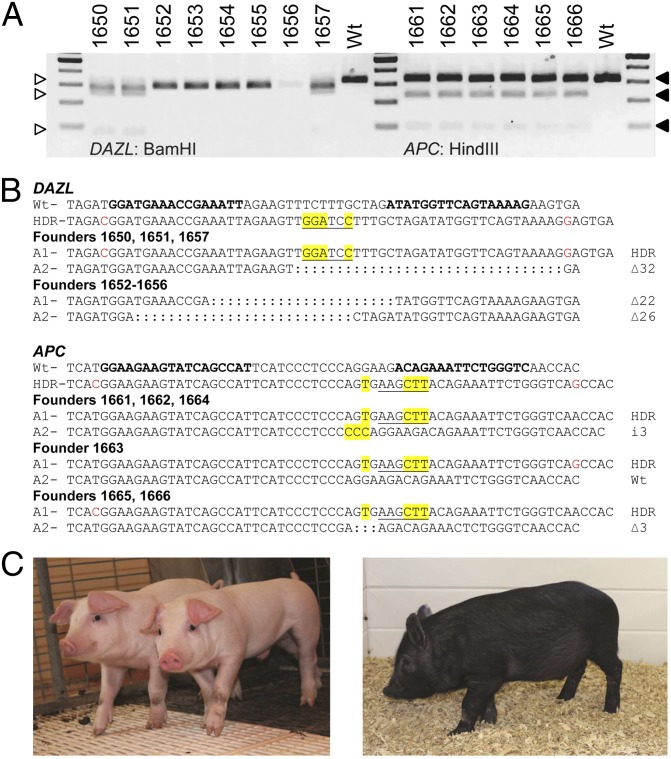
Cloned pigs with HDR alleles of DAZL and APC. (A) RFLP analysis of cloned piglets derived from DAZL- and APC-modified landrace and Ossabaw fibroblasts, respectively. Expected RFLP products for DAZL founders are 312, 242, and 70 bp (open triangles), and those for APC are 310, 221, and 89 bp (filled triangles). The difference in size of the 312-bp band between WT and DAZL founders reflects the expected deletion alleles. (B) Sequence analysis confirming the presence of the HDR allele in three of eight DAZL founders, and in six of six APC founders. BMs in the donor templates (HDR) are displayed in red, and inserted bases are highlighted in yellow. The bold text in the top WT sequence indicates the TALEN-binding sites. (C) Photographs of DAZL (Left) and APC (Right) founder animals.

Comment in

  • Natural genotypes via genetic engineering.
    Wells KD. Wells KD. Proc Natl Acad Sci U S A. 2013 Oct 8;110(41):16295-6. doi: 10.1073/pnas.1315623110. Epub 2013 Sep 27. Proc Natl Acad Sci U S A. 2013. PMID: 24077259 Free PMC article. No abstract available.

References

    1. Fahrenkrug SC, et al. Precision genetics for complex objectives in animal agriculture. J Anim Sci. 2010;88(7):2530–2539. - PMC - PubMed
    1. Tan W, Carlson DF, Walton MW, Fahrenkrug SC, Hackett PB. Precision editing of large animal genomes. In: Friedmann T, Dunlap JC, Goodwin SF, editors. Advances in Genetics. Vol 80. New York: Academic Press; 2012. pp. 37–97. - PMC - PubMed
    1. Hammer RE, et al. Production of transgenic rabbits, sheep and pigs by microinjection. Nature. 1985;315(6021):680–683. - PubMed
    1. Porteus MH, Carroll D. Gene targeting using zinc finger nucleases. Nat Biotechnol. 2005;23(8):967–973. - PubMed
    1. Bogdanove AJ, Voytas DF. TAL effectors: Customizable proteins for DNA targeting. Science. 2011;333(6051):1843–1846. - PubMed

Publication types