Review
. 2013 Sep 15;191(6):2857-63.
doi: 10.4049/jimmunol.1301539.

Processes of sterile inflammation

Affiliations
Review

Processes of sterile inflammation

Hua Shen et al. J Immunol. .

Abstract

Sterile inflammation occurs in acute conditions, such as ischemia reperfusion injury and crystal-induced arthritis, as well as with chronic diseases, such as particle-induced lung diseases and atherosclerosis. The triggers of sterile inflammation are still being identified, and the pathways that transduce sterile inflammatory signals are not completely clear. Most of the innate immune pathways that sense infection have been implicated in sterile inflammation, although distinct signaling pathways of sterile inflammation exist. Whether immune pathology ensues after sterile inflammation depends on the balance of induced inflammatory and resolution pathways. Further identification of the molecular mechanisms of sterile inflammation will lead to novel therapeutics to treat a range of diseases.


Figures
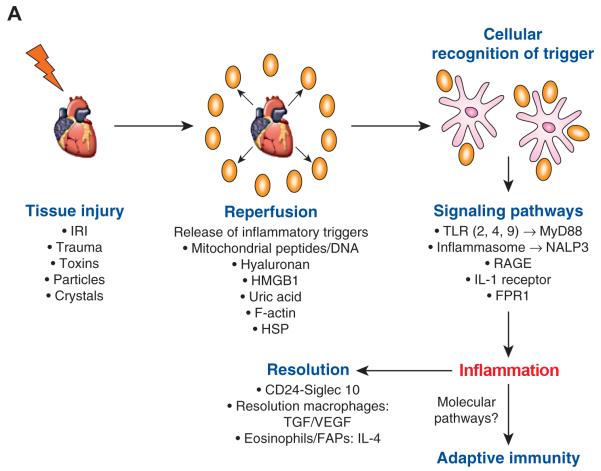
Figure 1A
Figure 1A. Pathways of Sterile Inflammation
A variety of insults induce sterile inflammation. This leads to the release of inflammatory triggers that are sensed by immune (e.g., dendritic cells or macrophages) or non-hematopoietic cells (e.g., endothelial or epithelial cells). These cells respond to the trigger via a variety of pathways, some of which are shared with pathways that respond to microbes and others that are distinct to sterile inflammation (e.g., RAGE and IL-1α). The induction of sterile inflammation leads to repair mechanisms that are mediated by macrophages that clear necrotic or apoptotic neutrophils and produce factors that enhance resolution (e.g., resolvins, TGF-β) or growth of blood vessels into the area (e.g., VEGF). There is evidence that IL-4 produced by eosinophils is sensed by fibro/adipogenic progenitors (FAPs) to mediate repair after acute skeletal muscle necrosis. Activation of sterile inflammation may also enhance adaptive immune responses as in the case of organ transplantation. The molecular pathways by which sterile inflammation enhance adaptive immunity remain to be fully elucidated. HSP=heat shock protein
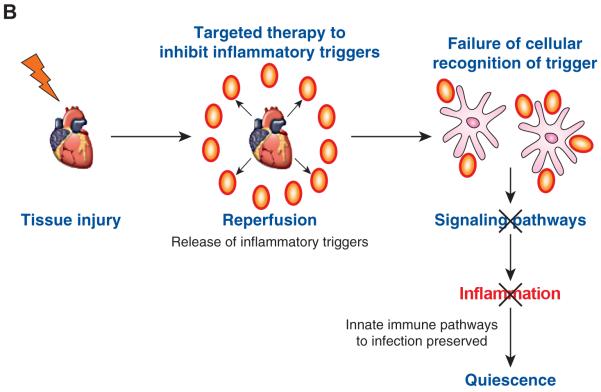
Figure 1B
Figure 1B. Therapeutic paradigm: localized inhibition of inflammatory triggers may reduce inflammation without compromising systemic innate pathways required for protection from infection
As several pathways are shared between sterile inflammation and inflammation sensed by microbes, targeted localized therapy that is aimed at the triggers could reduce inflammation without impairing host defense to infection. Such a strategy may be beneficial for localized sterile inflammation that occurs with organ procurement and implantation. In this instance, the organ could be pretreated prior to implantation.

References

    1. Eltzschig HK, E T. Ischemia and reperfusion--from mechanism to translation. Nat Med. 2011;17(11):1391–1401. - PMC - PubMed
    1. Trinchieri G. Cancer and Inflammation: An Old Intuition with Rapidly Evolving New Concepts. Ann Rev Immunol. 2012;30:677–706. - PubMed
    1. Zheng Y, Gardner SE, Clarke MCH. Cell Death, Damage-Associated Molecular Patterns, and Sterile Inflammation in Cardiovascular Disease. Arterioscler Thromb Vasc Biol. 2011;31:2781–2786. - PubMed
    1. Wright SD, Burton C, Hernandez M, Hassing H, Montenegro J, Mundt S, Patel S, Card DJ, Hermanowski-Vosatka A, Bergstrom JD, Sparrow CP, Detmers PA, Chao Y-S. Infectious Agents Are Not Necessary for Murine Atherogenesis. J Exp Med. 2000;191:1437–1442. - PMC - PubMed
    1. Chen CJ, Kono H, Golenbock D, Reed G, Akira S, Rock KL. Identification of a key pathway required for the sterile inflammatory response triggered by dying cells. Nat Med. 2007;13:851–856. - PubMed

Publication types