


What happened (and what didn't): Discourse constraints on encoding of plausible alternatives
- PMID: 24014934
- PMCID: PMC3763865
- DOI: 10.1016/j.jml.2013.06.003
What happened (and what didn't): Discourse constraints on encoding of plausible alternatives
Abstract
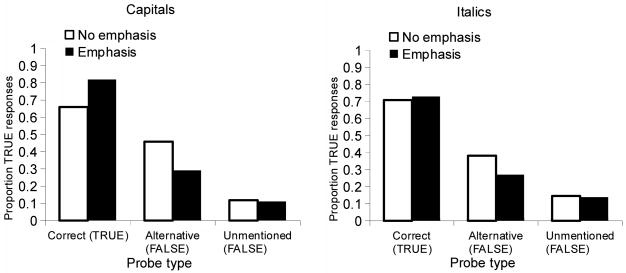
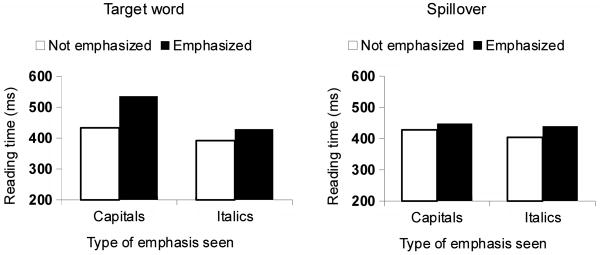
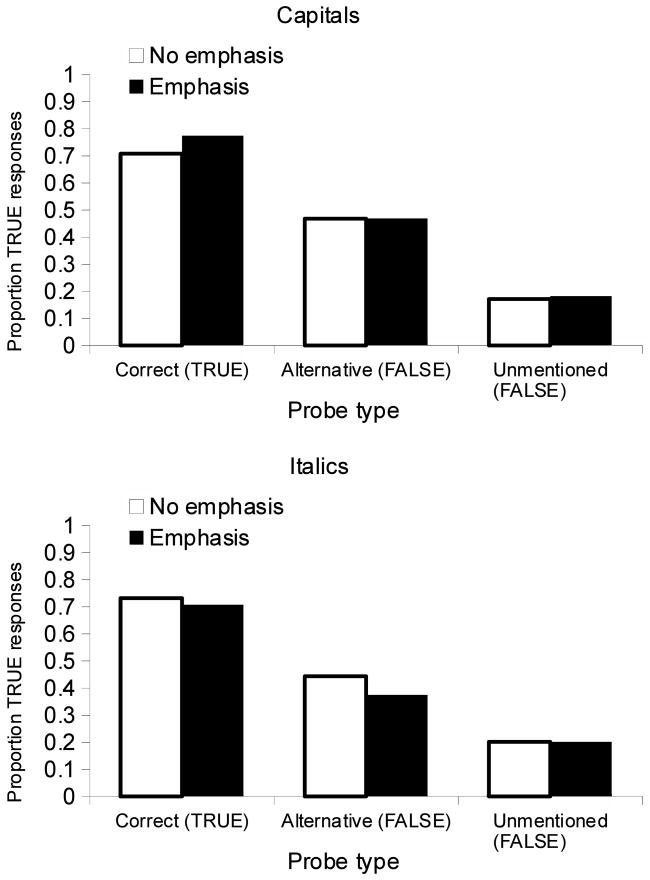
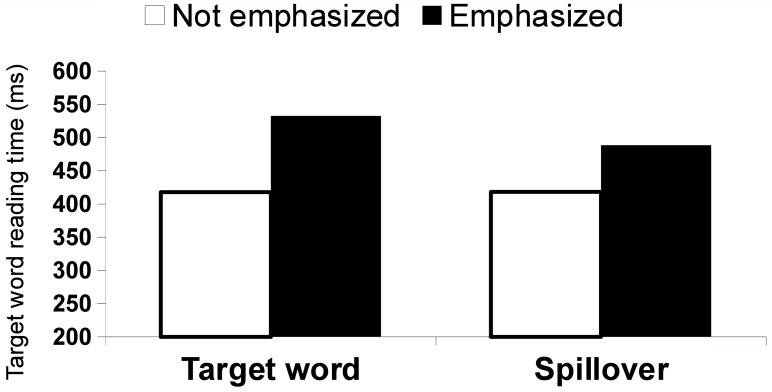
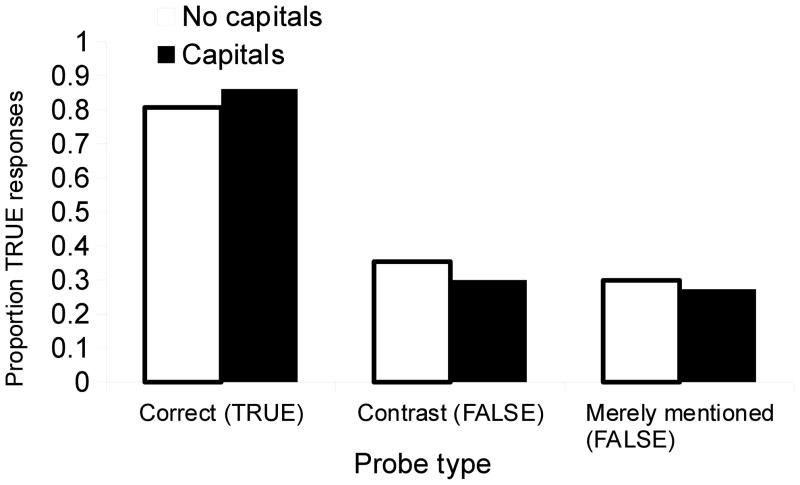
Three experiments investigated how font emphasis influences reading and remembering discourse. Although past work suggests that contrastive pitch contours benefit memory by promoting encoding of salient alternatives, it is unclear both whether this effect generalizes to other forms of linguistic prominence and how the set of alternatives is constrained. Participants read discourses in which some true propositions had salient alternatives (e.g., British scientists found the endangered monkey when the discourse also mentioned French scientists) and completed a recognition memory test. In Experiments 1 and 2, font emphasis in the initial presentation increased participants' ability to later reject false statements about salient alternatives but not about unmentioned items (e.g., Portuguese scientists). In Experiment 3, font emphasis helped reject false statements about plausible alternatives, but not about less plausible alternatives that were nevertheless established in the discourse. These results suggest readers encode a narrow set of only those alternatives plausible in the particular discourse. They also indicate that multiple manipulations of linguistic prominence, not just prosody, can lead to consideration of alternatives.
Keywords: alternative sets; discourse; fonts; reading; recognition memory.
Figures
References
-
- Agresti A. An introduction to categorical data analysis. 2. Hoboken, NJ: John Wiley & Sons; 2007.
-
- Almor A, Eimas PD. Focus and noun phrase anaphors in spoken language comprehension. Language and Cognitive Processes. 2008;23:201–225. doi: 10.1080/01690960701330936. - DOI
-
- Baayen RH. Analyzing linguistic data: A practical introduction to statistics. Cambridge University Press; 2008.
-
- Baayen RH, Davidson DJ, Bates DM. Mixed-effects modeling with crossed random effects for subjects and items. Journal of Memory and Language. 2008;59:390–412. doi: 10.1016/jmla.2007.12.005. - DOI
-
- Bates D, Maechler M, Bolker B. lme4: Linear mixed-effects models using S4 classes. R package version 0.99375-39. 2011 Retrieved from http://CRAN.R-project.org/package-lme4.
Grants and funding
LinkOut - more resources
Full Text Sources
Other Literature Sources
Miscellaneous