First diagnosis and management of incontinence in older people with and without dementia in primary care: a cohort study using The Health Improvement Network primary care database
- PMID: 24015113
- PMCID: PMC3754889
- DOI: 10.1371/journal.pmed.1001505
First diagnosis and management of incontinence in older people with and without dementia in primary care: a cohort study using The Health Improvement Network primary care database
Abstract
Background: Dementia is one of the most disabling and burdensome diseases. Incontinence in people with dementia is distressing, adds to carer burden, and influences decisions to relocate people to care homes. Successful and safe management of incontinence in people with dementia presents additional challenges. The aim of this study was to investigate the rates of first diagnosis in primary care of urinary and faecal incontinence among people aged 60-89 with dementia, and the use of medication or indwelling catheters for urinary incontinence.
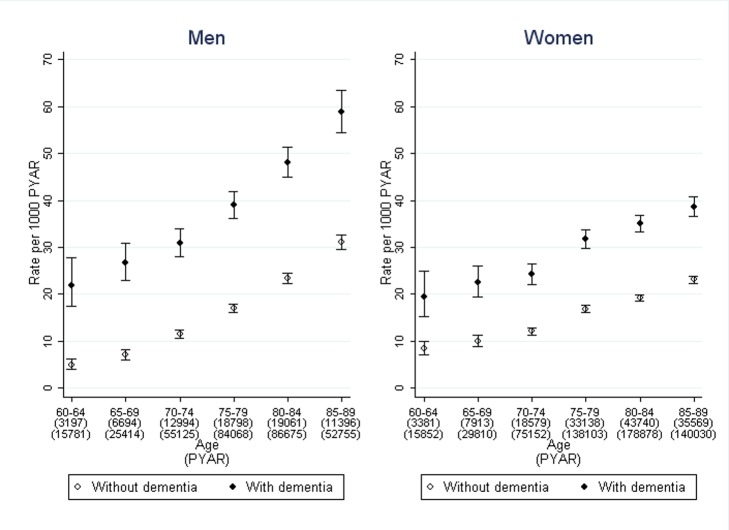
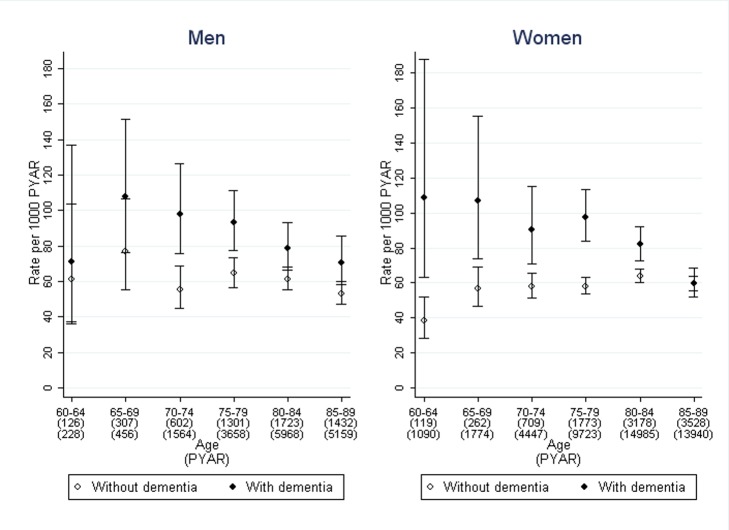
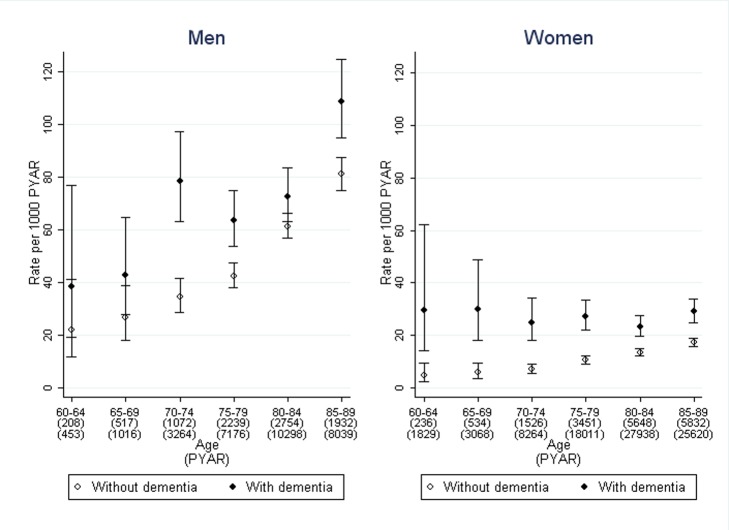
Methods and findings: We extracted data on 54,816 people aged 60-89 with dementia and an age-gender stratified sample of 205,795 people without dementia from 2001 to 2010 from The Health Improvement Network (THIN), a United Kingdom primary care database. THIN includes data on patients and primary care consultations but does not identify care home residents. Rate ratios were adjusted for age, sex, and co-morbidity using multilevel Poisson regression. The rates of first diagnosis per 1,000 person-years at risk (95% confidence interval) for urinary incontinence in the dementia cohort, among men and women, respectively, were 42.3 (40.9-43.8) and 33.5 (32.6-34.5). In the non-dementia cohort, the rates were 19.8 (19.4-20.3) and 18.6 (18.2-18.9). The rates of first diagnosis for faecal incontinence in the dementia cohort were 11.1 (10.4-11.9) and 10.1 (9.6-10.6). In the non-dementia cohort, the rates were 3.1 (2.9-3.3) and 3.6 (3.5-3.8). The adjusted rate ratio for first diagnosis of urinary incontinence was 3.2 (2.7-3.7) in men and 2.7 (2.3-3.2) in women, and for faecal incontinence was 6.0 (5.1-7.0) in men and 4.5 (3.8-5.2) in women. The adjusted rate ratio for pharmacological treatment of urinary incontinence was 2.2 (1.4-3.7) for both genders, and for indwelling urinary catheters was 1.6 (1.3-1.9) in men and 2.3 (1.9-2.8) in women.
Conclusions: Compared with those without a dementia diagnosis, those with a dementia diagnosis have approximately three times the rate of diagnosis of urinary incontinence, and more than four times the rate of faecal incontinence, in UK primary care. The clinical management of urinary incontinence in people with dementia with medication and particularly the increased use of catheters is concerning and requires further investigation. Please see later in the article for the Editors' Summary.
Conflict of interest statement
SI seeks funding for research projects on the diagnosis and management of dementia syndrome. All other authors have declared that no competing interests exist.
Figures
References
-
- Brookmeyer R, Johnson E, Ziegler-Graham K, Arrighi HM (2007) Forecasting the global burden of Alzheimer's disease. Alzheimers Dement 3: 186–191. - PubMed
-
- Ouslander JG, Zarit SH, Orr NK, Muira SA (1990) Incontinence among elderly community-dwelling dementia patients: Characteristics, management, and impact on caregivers. J Am Geriatr Soc 38: 440–445. - PubMed
-
- Hope T, Keene J, Gedling K, Fairburn CG, Jacoby R (1998) Predictors of institutionalization for people with dementia living at home with a carer. Int J Geriatr Psychiatry 13: 682–690. - PubMed
MeSH terms
Grants and funding
LinkOut - more resources
Full Text Sources
Other Literature Sources
Medical