


Two independent contributions to step variability during over-ground human walking
- PMID: 24015308
- PMCID: PMC3756042
- DOI: 10.1371/journal.pone.0073597
Two independent contributions to step variability during over-ground human walking
Abstract
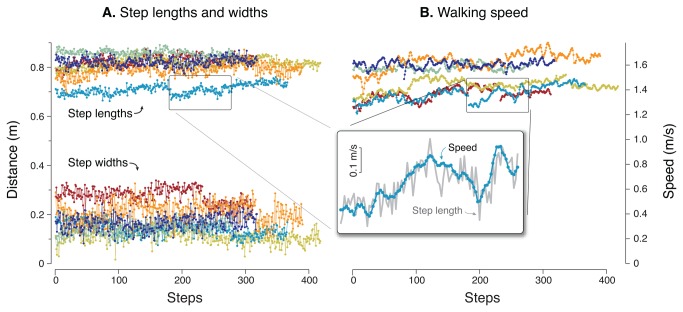
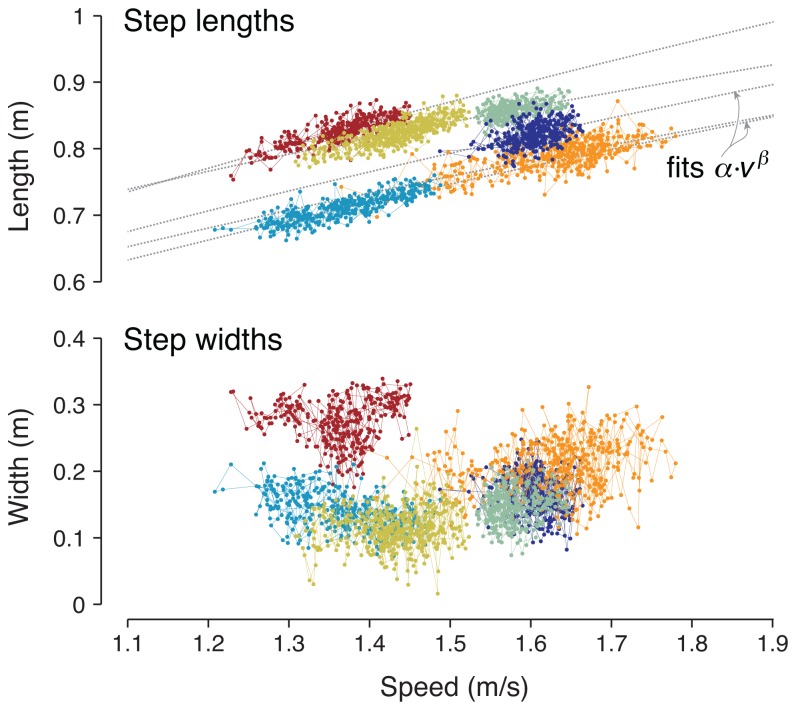
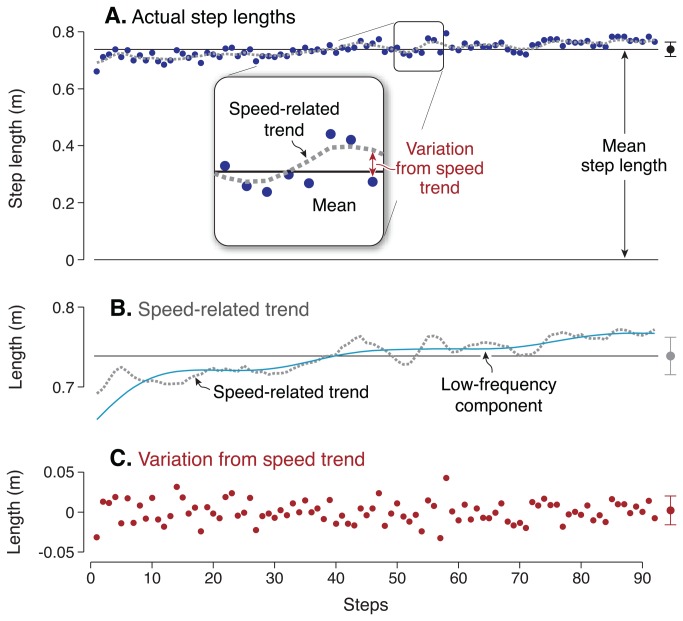
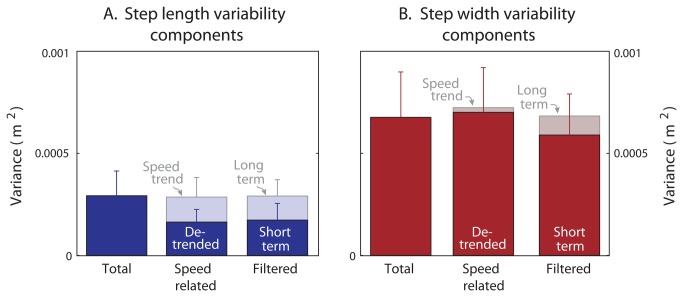
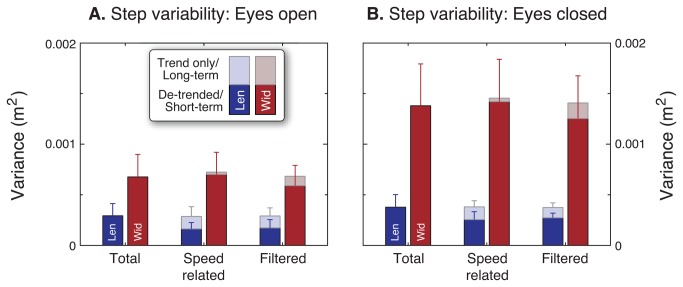
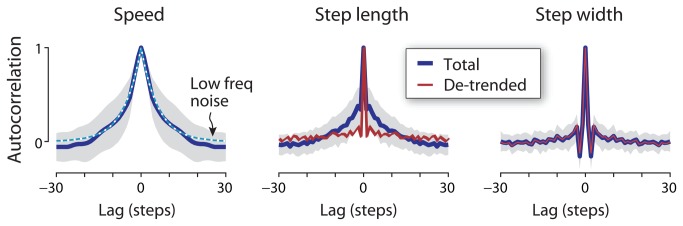
Human walking exhibits small variations in both step length and step width, some of which may be related to active balance control. Lateral balance is thought to require integrative sensorimotor control through adjustment of step width rather than length, contributing to greater variability in step width. Here we propose that step length variations are largely explained by the typical human preference for step length to increase with walking speed, which itself normally exhibits some slow and spontaneous fluctuation. In contrast, step width variations should have little relation to speed if they are produced more for lateral balance. As a test, we examined hundreds of overground walking steps by healthy young adults (N = 14, age < 40 yrs.). We found that slow fluctuations in self-selected walking speed (2.3% coefficient of variation) could explain most of the variance in step length (59%, P < 0.01). The residual variability not explained by speed was small (1.5% coefficient of variation), suggesting that step length is actually quite precise if not for the slow speed fluctuations. Step width varied over faster time scales and was independent of speed fluctuations, with variance 4.3 times greater than that for step length (P < 0.01) after accounting for the speed effect. That difference was further magnified by walking with eyes closed, which appears detrimental to control of lateral balance. Humans appear to modulate fore-aft foot placement in precise accordance with slow fluctuations in walking speed, whereas the variability of lateral foot placement appears more closely related to balance. Step variability is separable in both direction and time scale into balance- and speed-related components. The separation of factors not related to balance may reveal which aspects of walking are most critical for the nervous system to control.
Conflict of interest statement
Figures
References
-
- Hausdorff JM, Rios DA, Edelberg HK (2001) Gait variability and fall risk in community-living older adults: a 1-year prospective study. Arch Phys Med Rehabil 82: 1050–1056. doi:10.1053/apmr.2001.24893. PubMed: 11494184apmr.2001.24893 - DOI - PubMed
-
- Bauby CE, Kuo AD (2000) Active control of lateral balance in human walking. J Biomech 33: 1433–1440. doi:10.1016/S0021-9290(00)00101-9. PubMed: 10940402. - DOI - PubMed
-
- Frenkel-Toledo S, Giladi N, Peretz C, Herman T, Gruendlinger L et al. (2005) Effect of gait speed on gait rhythmicity in Parkinson’s disease: variability of stride time and swing time respond differently. J Neuroengineering Rehabil 2: 23. doi:10.1186/1743-0003-2-23. - DOI - PMC - PubMed
-
- Herman T, Giladi N, Gurevich T, Hausdorff JM (2005) Gait instability and fractal dynamics of older adults with a “cautious” gait: why do certain older adults walk fearfully? Gait Posture 21: 178–185. doi:10.1016/j.gaitpost.2004.01.014. PubMed: 15639397. - DOI - PubMed
Publication types
MeSH terms
Grants and funding
LinkOut - more resources
Full Text Sources
Other Literature Sources
