


Increased pulmonary artery diameter on chest computed tomography can predict borderline pulmonary hypertension
- PMID: 24015337
- PMCID: PMC3757831
- DOI: 10.4103/2045-8932.113175
Increased pulmonary artery diameter on chest computed tomography can predict borderline pulmonary hypertension
Abstract
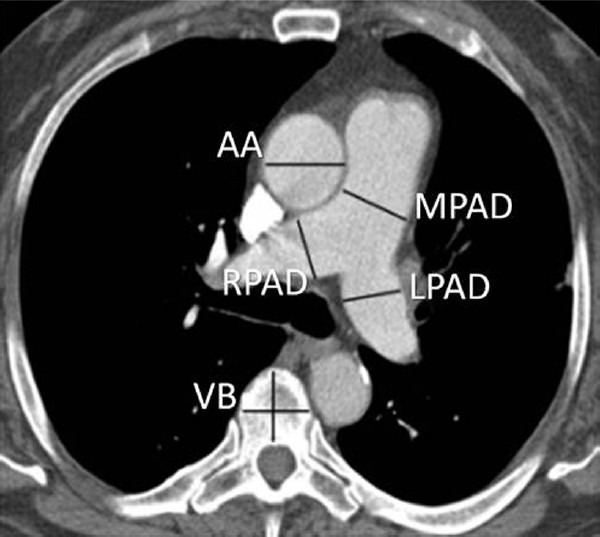
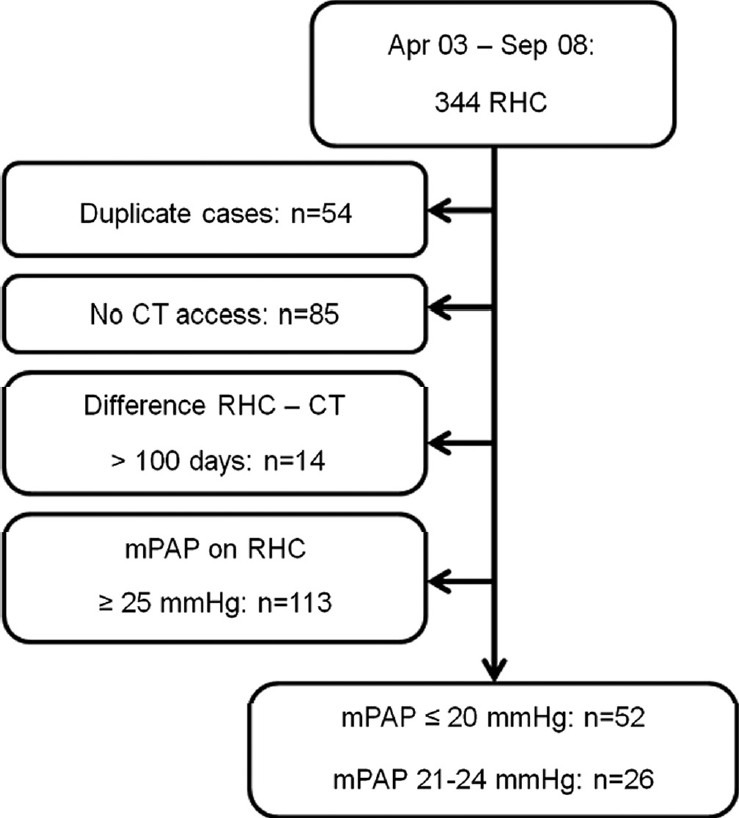
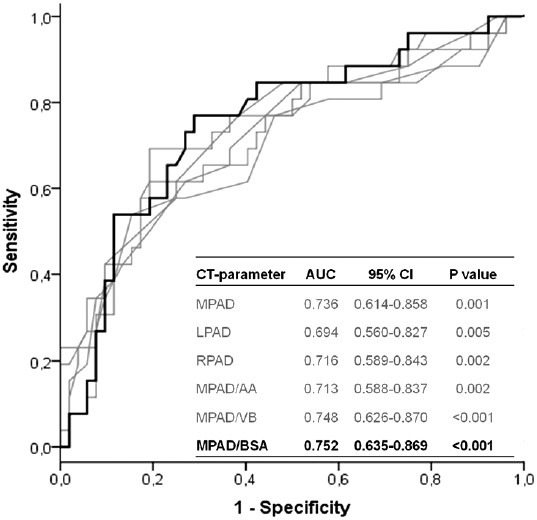
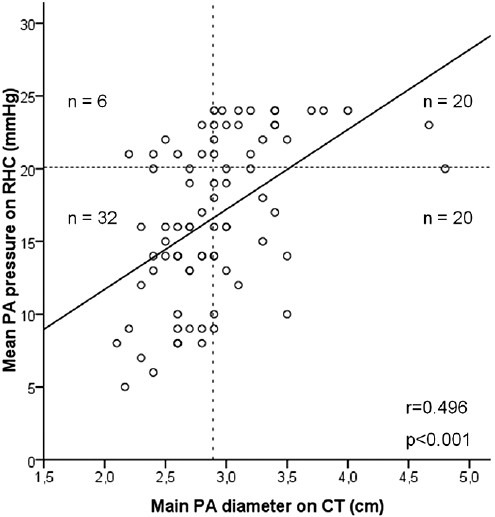
Pulmonary hypertension (PH) often leads to dilatation of the pulmonary artery (PA), which can be measured on chest computed tomography (CT). While the predictive capability of PA dilatation is useful to distinguish PH (mean PA pressure ≥25 mmHg) from normal (mean PA pressure ≤ 20 mmHg), CT characteristics of borderline PH (mean PA pressure 21-24 mmHg) have not been described. We aimed to investigate whether patients with borderline PH already show PA dilatation and to assess the diagnostic accuracy of PA dilatation for borderline PH diagnosis. Between April 2003 and September 2008, consecutive symptomatic patients with a mean PA pressure below 25 mmHg on right heart catheterization who had a chest CT available were retrospectively included. PA diameters from chest CT were correlated with hemodynamic measurements and analyzed with respect to their accuracy of predicting borderline PH. Main PA diameters were significantly larger in 26 patients with borderline PH compared with 52 patients without PH (3.16 ± 0.53 vs. 2.78 ± 0.43 cm, P = 0.001). The main PA diameter on CT correlated with mean PA pressure (r = 0.496, P < 0.001) and pulmonary vascular resistance (r = 0.445, P < 0.001), and predicted borderline PH with sensitivity, specificity, negative and positive predictive values of 77%, 62%, 84%, and 50%, respectively, using a cutoff ≥2.9 cm. This first systematic investigation of CT parameters in symptomatic patients with mean PA pressures less than 25 mmHg could show that, even in patients with borderline PH, significant PA dilatation can be present, which was related to PA pressure and pulmonary vascular resistance. This can be useful for identification of patients with borderline PH for further study and to prompt further diagnostic work-up of possible underlying diseases.
Keywords: borderline pulmonary hypertension; computed tomography; early diagnosis; pulmonary artery dilatation; screening.
Conflict of interest statement
Figures
References
-
- Badesch DB, Champion HC, Gomez Sanchez MA, Hoeper MM, Loyd JE, Manes A, et al. Diagnosis and assessment of pulmonary arterial hypertension. J Am Coll Cardiol. 2009;54:55–66. - PubMed
-
- Oswald-Mammosser M, Weitzenblum E, Quoix E, Moser G, Chaouat A, Charpentier C, et al. Prognostic factors in COPD patients receiving long-term oxygen therapy. Importance of pulmonary artery pressure. Chest. 1995;107:1193–8. - PubMed
-
- Lettieri CJ, Nathan SD, Barnett SD, Ahmad S, Shorr AF. Prevalence and outcomes of pulmonary arterial hypertension in advanced idiopathic pulmonary fibrosis. Chest. 2006;129:746–52. - PubMed
-
- Ghio S, Gavazzi A, Campana C, Inserra C, Klersy C, Sebastiani R, et al. Independent and additive prognostic value of right ventricular systolic function and pulmonary artery pressure in patients with chronic heart failure. J Am Coll Cardiol. 2001;37:183–8. - PubMed
-
- McLaughlin VV, Presberg KW, Doyle RL, Abman SH, McCrory DC, Fortin T, et al. Prognosis of pulmonary arterial hypertension: ACCP evidence-based clinical practice guidelines. Chest. 2004;126:78–92. - PubMed
LinkOut - more resources
Full Text Sources
Other Literature Sources
Miscellaneous
