


Transcriptional control of regulatory T cell development and function
- PMID: 24016547
- PMCID: PMC7106436
- DOI: 10.1016/j.it.2013.08.003
Transcriptional control of regulatory T cell development and function
Abstract
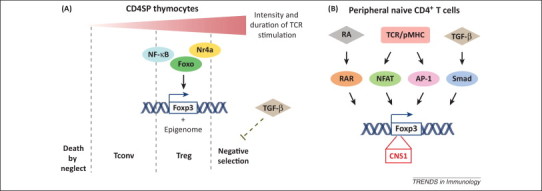
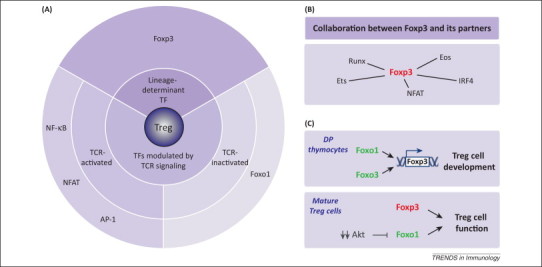
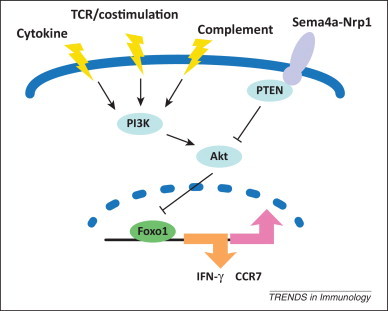
Regulatory T (Treg) cells differentiate from thymocytes or peripheral T cells in response to host and environmental cues, culminating in induction of the transcription factor forkhead box P3 (Foxp3) and the Treg cell-specific epigenome. An intermediate amount of antigen stimulation is required to induce Foxp3 expression by engaging T cell receptor (TCR)-activated [e.g., nuclear factor (NF)-κB] and TCR-inhibited (e.g., Foxo) transcription factors. Furthermore, Treg cell differentiation is associated with attenuated Akt signaling, resulting in enhanced nuclear retention of Foxo1, which is indispensable for Treg cell function. These findings reveal that Treg cell lineage commitment is not only controlled by genetic and epigenetic imprinting, but also modulated by transcriptional programs responding to extracellular signals.
Keywords: Foxo1; Foxp3; cell signaling; transcription factor.
Copyright © 2013 Elsevier Ltd. All rights reserved.
Figures
References
-
- Sakaguchi S. Regulatory T cells and immune tolerance. Cell. 2008;133:775–787. - PubMed
-
- Nishizuka Y. Thymus and reproduction: Sex-linked dysgnesia of the gonad after neonatal thymectomy in mice. Science. 1969;166:753–755. - PubMed
-
- Belkaid Y., Tarbell K. Regulatory T cells in the control of host-microorganism interactions (*) Annu. Rev. Immunol. 2009;27:551–589. - PubMed
Publication types
MeSH terms
Substances
LinkOut - more resources
Full Text Sources
Other Literature Sources
Research Materials
Miscellaneous
