


Gastrin and D1 dopamine receptor interact to induce natriuresis and diuresis
- PMID: 24019399
- PMCID: PMC3915294
- DOI: 10.1161/HYPERTENSIONAHA.113.01094
Gastrin and D1 dopamine receptor interact to induce natriuresis and diuresis
Abstract
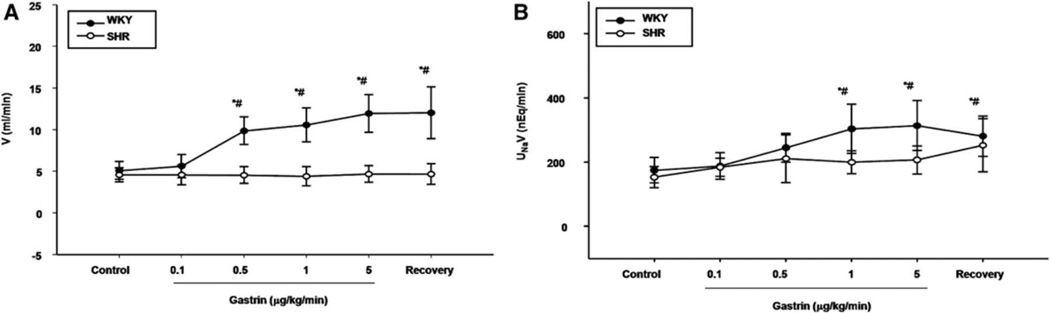
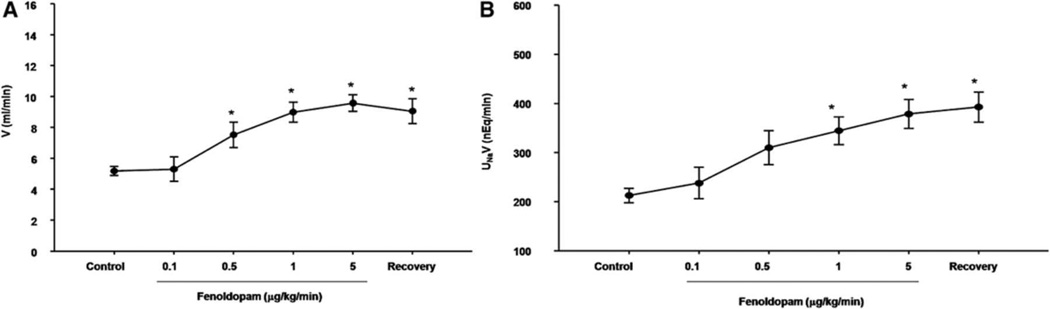
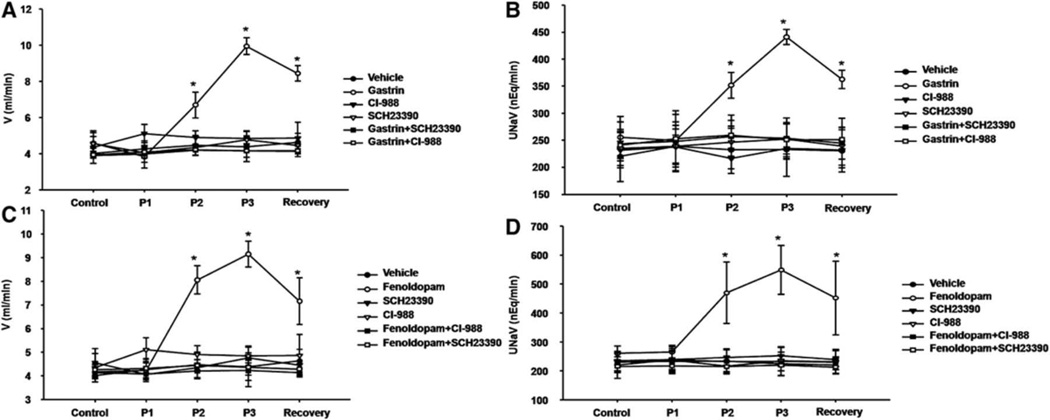
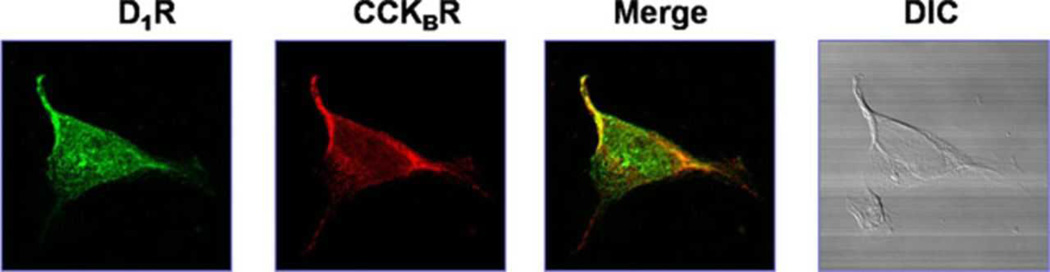
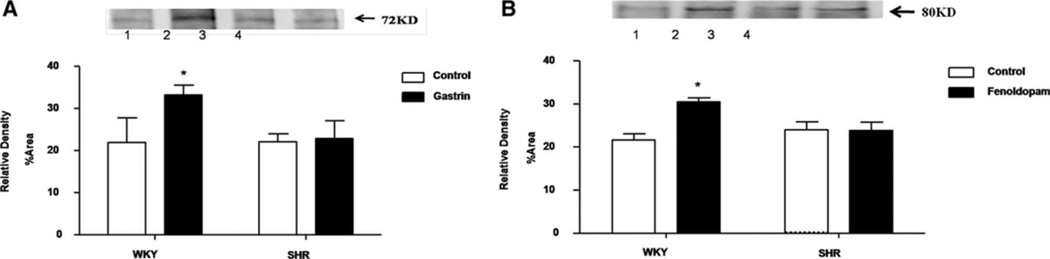
Oral NaCl produces a greater natriuresis and diuresis than the intravenous infusion of the same amount of NaCl. Gastrin is the major gastrointestinal hormone taken up by renal proximal tubule (RPT) cells. We hypothesized that renal gastrin and dopamine receptors interact to synergistically increase sodium excretion, an impaired interaction of which may be involved in the pathogenesis of hypertension. In Wistar-Kyoto rats, infusion of gastrin induced natriuresis and diuresis, which was abrogated in the presence of a gastrin (cholecystokinin B receptor [CCKBR]; CI-988) or a D1-like receptor antagonist (SCH23390). Similarly, the natriuretic and diuretic effects of fenoldopam, a D1-like receptor agonist, were blocked by SCH23390, as well as by CI-988. However, the natriuretic effects of gastrin and fenoldopam were not observed in spontaneously hypertensive rats. The gastrin/D1-like receptor interaction was also confirmed in RPT cells. In RPT cells from Wistar-Kyoto but not spontaneously hypertensive rats, stimulation of either D1-like receptor or gastrin receptor inhibited Na(+)-K(+)-ATPase activity, an effect that was blocked in the presence of SCH23390 or CI-988. In RPT cells from Wistar-Kyoto and spontaneously hypertensive rats, CCKBR and D1 receptor coimmunoprecipitated, which was increased after stimulation of either D1 receptor or CCKBR in RPT cells from Wistar-Kyoto rats; stimulation of one receptor increased the RPT cell membrane expression of the other receptor, effects that were not observed in spontaneously hypertensive rats. These data suggest that there is a synergism between CCKBR and D1-like receptors to increase sodium excretion. An aberrant interaction between the renal CCK BR and D1-like receptors (eg, D1 receptor) may play a role in the pathogenesis of hypertension.
Keywords: hypertension; kidney; kidney tubules, proximal; receptor, cholecystokinin B; receptors, dopamine D1.
Conflict of interest statement
No conflicts of interest, financial or otherwise, are declared by the authors.
Figures
Comment in
-
Novel gastro-renal axis and sodium regulation during hypertension.Hypertension. 2013 Nov;62(5):834-5. doi: 10.1161/HYPERTENSIONAHA.113.01799. Epub 2013 Sep 9. Hypertension. 2013. PMID: 24019398 No abstract available.
References
-
- Cowley AW, Jr, Nadeau JH, Baccarelli A, Berecek K, Fornage M, Gibbons GH, Harrison DG, Liang M, Nathanielsz PW, O'Connor DT, Ordovas J, Peng W, Soares MB, Szyf M, Tolunay HE, Wood KC, Zhao K, Galis ZS. Report of the National Heart, Lung, and Blood Institute Working Group on epigenetics and hypertension. Hypertension. 2012;59:899–905. - PMC - PubMed
-
- Stamler J. The INTERSALT Study: background, methods, findings, and implications. Am J Clin Nutr. 1997;65:626S–642S. - PubMed
-
- Dumler F. Dietary sodium intake and arterial blood pressure. J Ren Nutr. 2009;19:57–60. - PubMed
-
- Dorresteijn JA, van der Graaf Y, Spiering W, Grobbee DE, Bots ML, Visseren FL Secondary Manifestations of Arterial Disease Study Group. Relation between blood pressure and vascular events and mortality in patients with manifest vascular disease: J-curve revisited. Hypertension. 2012;59:14–21. - PubMed
Publication types
MeSH terms
Substances
Grants and funding
LinkOut - more resources
Full Text Sources
Other Literature Sources
