A novel MLL2 gene mutation in a Korean patient with Kabuki syndrome
- PMID: 24019847
- PMCID: PMC3764261
- DOI: 10.3345/kjp.2013.56.8.355
A novel MLL2 gene mutation in a Korean patient with Kabuki syndrome
Abstract
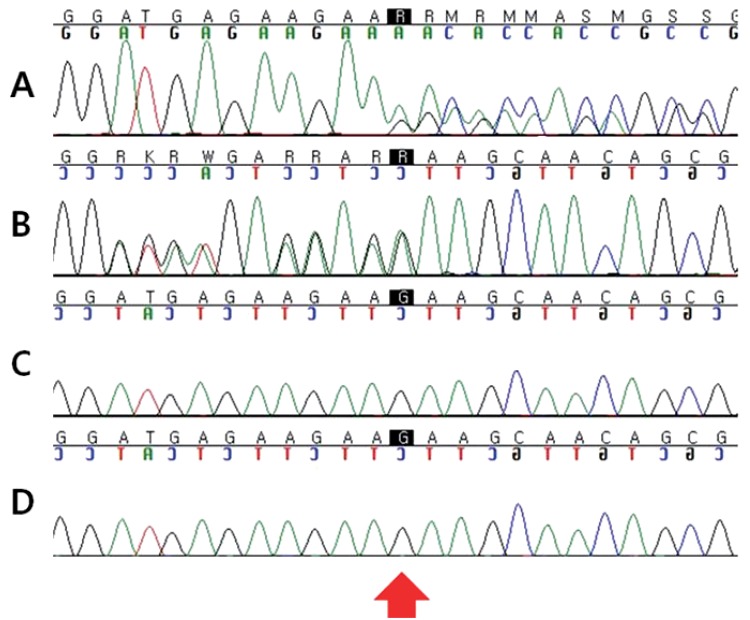
Kabuki syndrome (KS) is a rare genetic disease with a distinctive dysmorphic face, intellectual disability, and multiple congenital abnormalities. KS is inherited in an autosomal dominant manner. As the primary cause of KS, MLL2 mutations have been identified in 56-76% of affected individuals who have been tested, suggesting that there may be additional genes associated with KS. Recently, a few KS individuals have been found to have de novo partial or complete deletions of an X chromosome gene, KDM6A, which encodes a histone demethylase that interacts with MLL2. Nevertheless, mutations in MLL2 are the major cause of KS. Although there are a few reports of KS patients in Korea, none of these had been confirmed by genetic analysis. Here, we report a case of a Korean patient with clinical features of KS. Using direct sequencing, we identified a frameshift heterozygous mutation for MLL2: (c.5256_5257delGA;p.Lys1753Alafs*34). Clinically, the patient presented with typical facial features, and diagnosis of KS was based on the diagnostic criteria. While KS is a rare disease, other malformations that overlap with those found in individuals with KS are common. Hence, the diagnosis of KS by mutational analysis can be a valuable method for patients with KS-like syndromes. Furthermore, in the near future, other genes could be identified in patients with KS without a detectable MLL2 mutation.
Keywords: KDM6; KS-associated genes; Kabuki syndrome; MLL2 mutation.
Conflict of interest statement
No potential conflict of interest relevant to this article was reported.
Figures
References
-
- Niikawa N, Matsuura N, Fukushima Y, Ohsawa T, Kajii T. Kabuki make-up syndrome: a syndrome of mental retardation, unusual facies, large and protruding ears, and postnatal growth deficiency. J Pediatr. 1981;99:565–569. - PubMed
-
- Kuroki Y, Suzuki Y, Chyo H, Hata A, Matsui I. A new malformation syndrome of long palpebral fissures, large ears, depressed nasal tip, and skeletal anomalies associated with postnatal dwarfism and mental retardation. J Pediatr. 1981;99:570–573. - PubMed
-
- Niikawa N, Kuroki Y, Kajii T, Matsuura N, Ishikiriyama S, Tonoki H, et al. Kabuki make-up (Niikawa-Kuroki) syndrome: a study of 62 patients. Am J Med Genet. 1988;31:565–589. - PubMed
-
- Park SK, Park DK, Choung JT, Son CS, Dokgo YC. A case of Kabuki make-up syndrome. J Korean Med Assoc. 1991;34:790–792.
-
- Huh JK, Chung MS, Baek GH, Oh JH, Lee YH, Gong HS. Cleft hand in Kabuki make-up syndrome: case report. J Hand Surg Am. 2011;36:653–657. - PubMed
LinkOut - more resources
Full Text Sources
Other Literature Sources
Research Materials
Miscellaneous