. 2013 Sep 11:10.1007/s00406-013-0442-z.
doi: 10.1007/s00406-013-0442-z. Online ahead of print.

Relational memory and hippocampal function in psychotic bipolar disorder

Affiliations

Relational memory and hippocampal function in psychotic bipolar disorder

Suzanne N Avery et al. Eur Arch Psychiatry Clin Neurosci. .

Abstract

Recent cognitive, genetic, and histological studies have highlighted significant overlap between psychotic bipolar disorder and schizophrenia. Specifically, both bipolar disorder and schizophrenia are characterized by interneuron dysfunction within the hippocampus, an essential structure for relational memory. Relational memory impairments are a common feature of schizophrenia, but have yet to be investigated in psychotic bipolar disorder. Here, we tested the hypothesis that psychotic bipolar disorder is characterized by relational memory deficits. We used a transitive inference (TI) paradigm, previously employed to quantify relational memory deficits in schizophrenia, to assess relational memory performance in 17 patients with psychotic bipolar disorder and 22 demographically matched control participants. Functional magnetic resonance imaging was used to examine hippocampal activity during recognition memory in patients and controls. Hippocampal volumes were assessed by manual segmentation. In contrast to our hypothesis, we found similar TI performance, hippocampal volume, and hippocampal recruitment during recognition memory in both groups. Both psychotic bipolar disorder patients and controls exhibited a positive correlation between hippocampal volume and relational memory performance. These data indicate that relational memory impairments are not a shared feature of non-affective and affective psychosis.


Conflict of interest statement

Conflict of interest None.

Figures

Fig. 1
Fig. 1
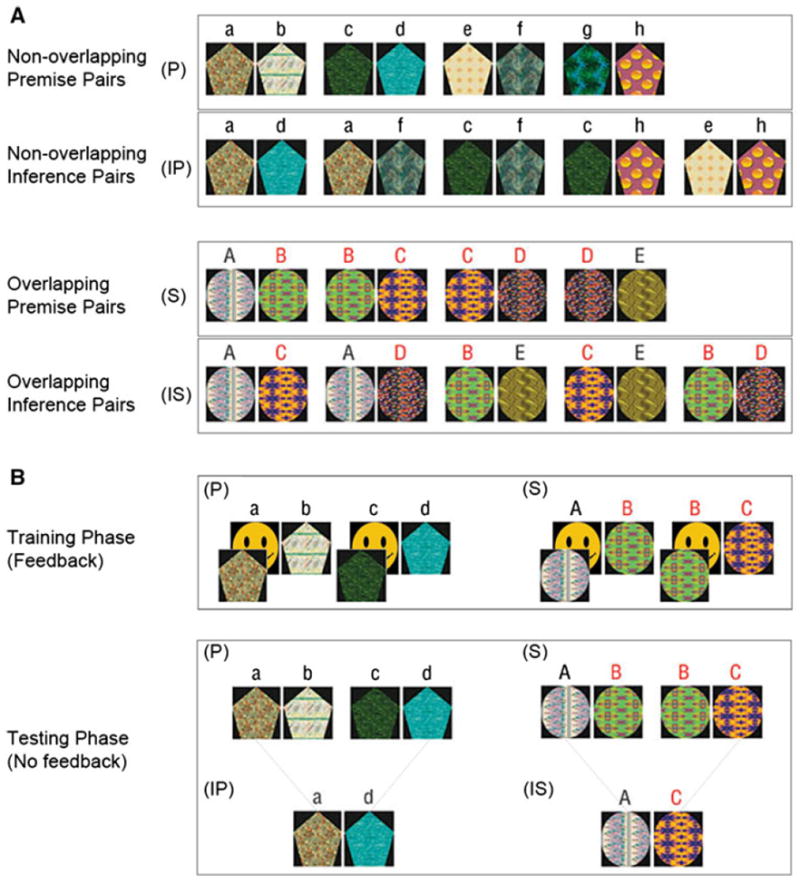
Stimulus set and experimental conditions. a The TI paradigm was comprised of four stimulus conditions: non-overlapping premise pairs (P); non-overlapping inference pairs (IP); overlapping premise pairs (S); and overlapping inference pairs (IS). The reinforced item within each pair is shown on the left (e.g., a > b, c > d, etc.). b During the training phase, premise pairs from the non-overlapping stimulus set (P) were trained first, followed by training of premise pairs from the overlapping stimulus set. Participants were presented with a stimulus pair in the middle of the screen and instructed to select the item from the pair hiding the smiling face (no letters were shown in the experiment, and items within each pair were presented an equal number of times on the left and right side of the screen). Participants received feedback during the training phase—a correct guess during training caused the item to reveal a smiling face underneath, while an incorrect guess did not. During the testing phase, trained premise pairs from the non-overlapping (P) and overlapping (S) conditions were presented and participants were asked to indicate by button press which item was hiding the smiling face. During testing, participants were also asked to make novel judgments about items which had not previously been paired together during training [non-overlapping inference pairs (IP) and overlapping inference pairs (IS)]. Participants did not receive feedback during the testing phase
Fig. 2
Fig. 2
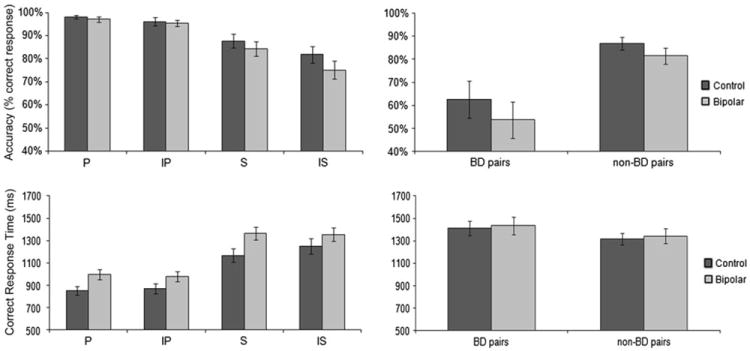
Performance accuracy (percentage of correct responses) and correct response times (ms) across psychotic bipolar disorder patients and controls. Both groups had similar accuracy across all conditions, indicating normal TI performance in psychotic bipolar disorder patients. Controls required more time to correctly identify novel pairs (IP and IS) compared to previously learned pairs (P and S), while psychotic bipolar disorder patients required a similar amount of time to correctly identify novel and previously learned pairs
Fig. 3
Fig. 3
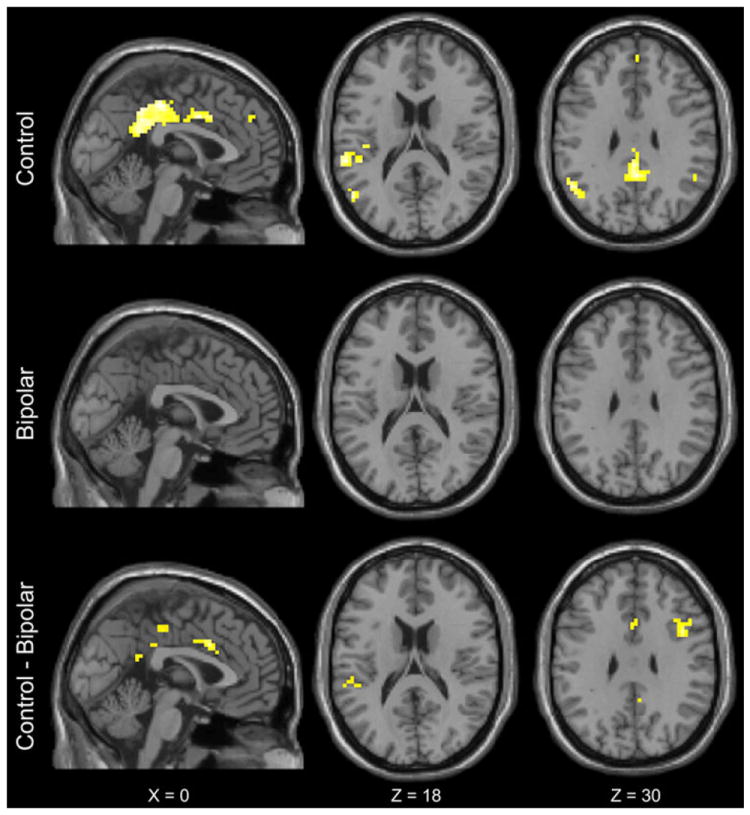
Significant activations during TI judgments (sequence × inference interaction, ([IS − S] − [IP − P])), p < .05 corrected for multiple comparisons. TI was associated with activations in the bilateral cingulate cortex, right dorsolateral prefrontal cortex, left insula, left superior temporal gyrus, right inferior parietal cortex, and right thalamus in controls (top row). There were no significant activations in psychotic bipolar disorder patients (middle row). Between-group comparison revealed significantly greater activations in the control group within bilateral cingulate cortex, right dorsolateral prefrontal cortex, and left insula (bottom row). Significant activations are shown in flame scale (p value map) where lighter-colored voxels represent the smallest p values
Fig. 4
Fig. 4
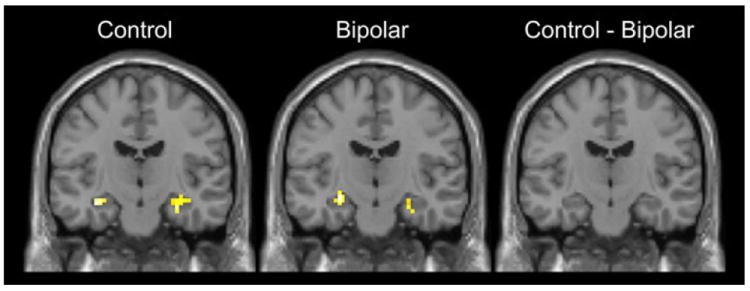
Hippocampal ROI analysis revealed bilateral hippocampal activation in healthy controls and psychotic bipolar disorder during discrimination of nonoverlapping pairs [(P + IP) − (S + IS)] (shown in coronal view, y = − 15)

References

    1. Keck PE, Jr, McElroy SL, Havens JR, Altshuler LL, Nolen WA, Frye MA, Suppes T, Denicoff KD, Kupka R, Leverich GS, Rush AJ, Post RM. Psychosis in bipolar disorder: phenomenology and impact on morbidity and course of illness. Compr Psychiatry. 2003;44(4):263–269. - PubMed
    1. Goodwin FK, Jamison KR. Manic-depressive Illness. Oxford University Press; New York, NY: 1990.
    1. Bora E, Yucel M, Fornito A, Berk M, Pantelis C. Major psychoses with mixed psychotic and mood symptoms: are mixed psychoses associated with different neurobiological markers? Acta Psychiatr Scand. 2008;118(3):172–187. - PubMed
    1. Rosen LN, Rosenthal NE, Dunner DL, Fieve RR. Social outcome compared in psychotic and nonpsychotic bipolar I patients. J Nerv Ment Dis. 1983;171(5):272–275. - PubMed
    1. Rosenthal NE, Rosenthal LN, Stallone F, Fleiss J, Dunner DL, Fieve RR. Psychosis as a predictor of response to lithium maintenance treatment in bipolar affective disorder. J Affect Disord. 1979;1(4):237–245. - PubMed

LinkOut - more resources