


Vascular aspects of cognitive impairment and dementia
- PMID: 24022624
- PMCID: PMC3824191
- DOI: 10.1038/jcbfm.2013.159
Vascular aspects of cognitive impairment and dementia
Abstract
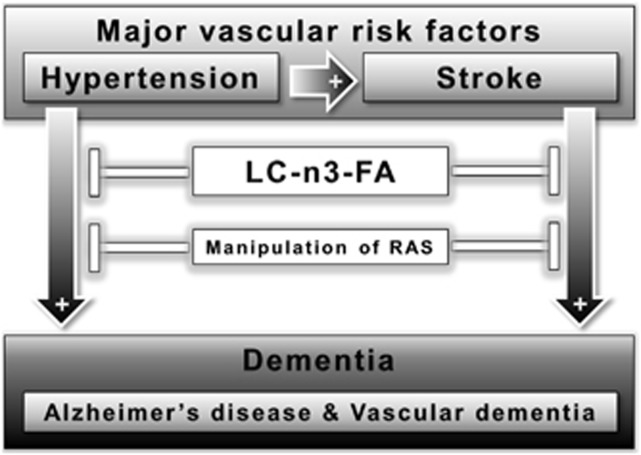
Hypertension and stroke are highly prevalent risk factors for cognitive impairment and dementia. Alzheimer's disease (AD) and vascular dementia (VaD) are the most common forms of dementia, and both conditions are preceded by a stage of cognitive impairment. Stroke is a major risk factor for the development of vascular cognitive impairment (VCI) and VaD; however, stroke may also predispose to AD. Hypertension is a major risk factor for stroke, thus linking hypertension to VCI and VaD, but hypertension is also an important risk factor for AD. Reducing these two major, but modifiable, risk factors-hypertension and stroke-could be a successful strategy for reducing the public health burden of cognitive impairment and dementia. Intake of long-chain omega-3 polyunsaturated fatty acids (LC-n3-FA) and the manipulation of factors involved in the renin-angiotensin system (e.g. angiotensin II or angiotensin-converting enzyme) have been shown to reduce the risk of developing hypertension and stroke, thereby reducing dementia risk. This paper will review the research conducted on the relationship between hypertension, stroke, and dementia and also on the impact of LC-n3-FA or antihypertensive treatments on risk factors for VCI, VaD, and AD.
Figures
References
-
- Ritchie K, Lovestone S. The dementias. Lancet. 2002;360:1759–1766. - PubMed
-
- Morris JC. The nosology of dementia. Neurol Clin. 2000;18:773–788. - PubMed
-
- Iadecola C, Gorelick PB. Converging pathogenic mechanisms in vascular and neurodegenerative dementia. Stroke. 2003;34:335–337. - PubMed
-
- Roman GC, Tatemichi TK, Erkinjuntti T, Cummings JL, Masdeu JC, Garcia JH, et al. Vascular dementia: diagnostic criteria for research studies. Report of the NINDS-AIREN International Workshop. Neurology. 1993;43:250–260. - PubMed
-
- Chen N, Yang M, Guo J, Zhou M, Zhu C, He L. Cerebrolysin for vascular dementia. Cochrane Database Syst Rev. 2013;1:CD008900. - PubMed
Publication types
MeSH terms
LinkOut - more resources
Full Text Sources
Other Literature Sources
Medical
