


Immune privilege as an intrinsic CNS property: astrocytes protect the CNS against T-cell-mediated neuroinflammation
- PMID: 24023412
- PMCID: PMC3760105
- DOI: 10.1155/2013/320519
Immune privilege as an intrinsic CNS property: astrocytes protect the CNS against T-cell-mediated neuroinflammation
Abstract
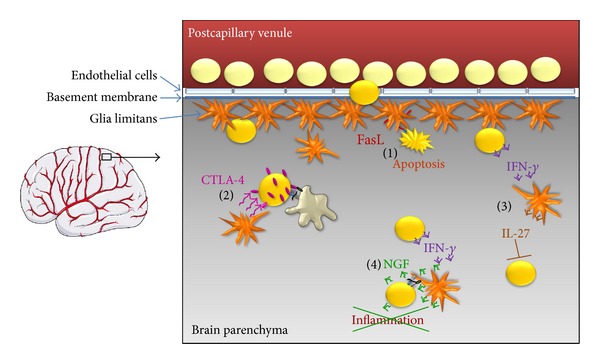
Astrocytes have many functions in the central nervous system (CNS). They support differentiation and homeostasis of neurons and influence synaptic activity. They are responsible for formation of the blood-brain barrier (BBB) and make up the glia limitans. Here, we review their contribution to neuroimmune interactions and in particular to those induced by the invasion of activated T cells. We discuss the mechanisms by which astrocytes regulate pro- and anti-inflammatory aspects of T-cell responses within the CNS. Depending on the microenvironment, they may become potent antigen-presenting cells for T cells and they may contribute to inflammatory processes. They are also able to abrogate or reprogram T-cell responses by inducing apoptosis or secreting inhibitory mediators. We consider apparently contradictory functions of astrocytes in health and disease, particularly in their interaction with lymphocytes, which may either aggravate or suppress neuroinflammation.
Figures
References
-
- Beattie EC, Stellwagen D, Morishita W, et al. Control of synaptic strength by glial TNFα . Science. 2002;295(5563):2282–2285. - PubMed
-
- Haydon PG. Glia: listening and talking to the synapse. Nature Reviews Neuroscience. 2001;2(3):185–193. - PubMed
-
- Araque A, Sanzgiri RP, Parpura V, Haydon PG. Astrocyte-induced modulation of synaptic transmission. Canadian Journal of Physiology and Pharmacology. 1999;77(9):699–706. - PubMed
-
- Seifert G, Schilling K, Steinhäuser C. Astrocyte dysfunction in neurological disorders: a molecular perspective. Nature Reviews Neuroscience. 2006;7(3):194–206. - PubMed
Publication types
MeSH terms
Substances
LinkOut - more resources
Full Text Sources
Other Literature Sources
