


The relationship of sleep with temperature and metabolic rate in a hibernating primate
- PMID: 24023713
- PMCID: PMC3762832
- DOI: 10.1371/journal.pone.0069914
The relationship of sleep with temperature and metabolic rate in a hibernating primate
Abstract
Study objectives: It has long been suspected that sleep is important for regulating body temperature and metabolic-rate. Hibernation, a state of acute hypothermia and reduced metabolic-rate, offers a promising system for investigating those relationships. Prior studies in hibernating ground squirrels report that, although sleep occurs during hibernation, it manifests only as non-REM sleep, and only at relatively high temperatures. In our study, we report data on sleep during hibernation in a lemuriform primate, Cheirogaleus medius. As the only primate known to experience prolonged periods of hibernation and as an inhabitant of more temperate climates than ground squirrels, this animal serves as an alternative model for exploring sleep temperature/metabolism relationships that may be uniquely relevant to understanding human physiology.
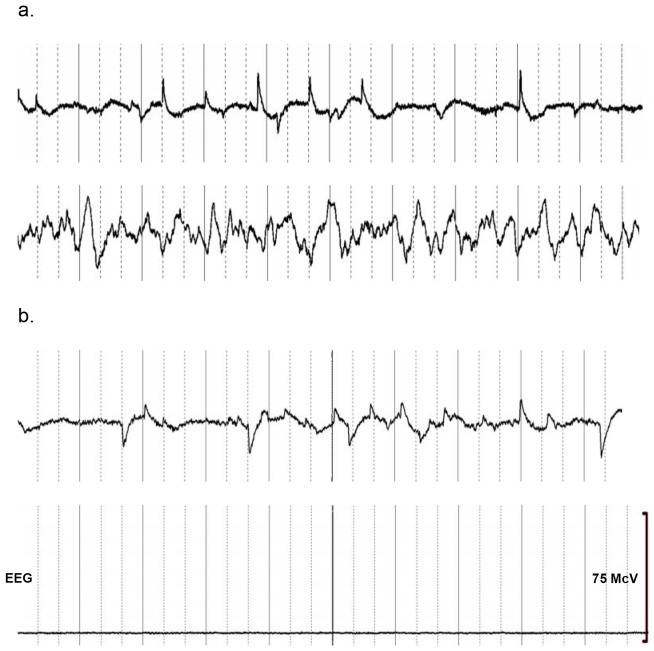
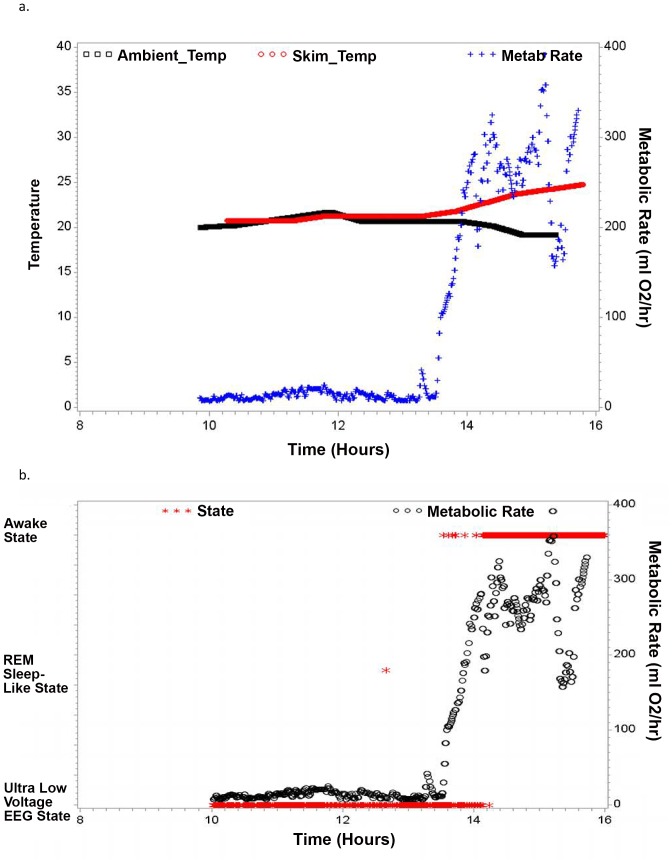
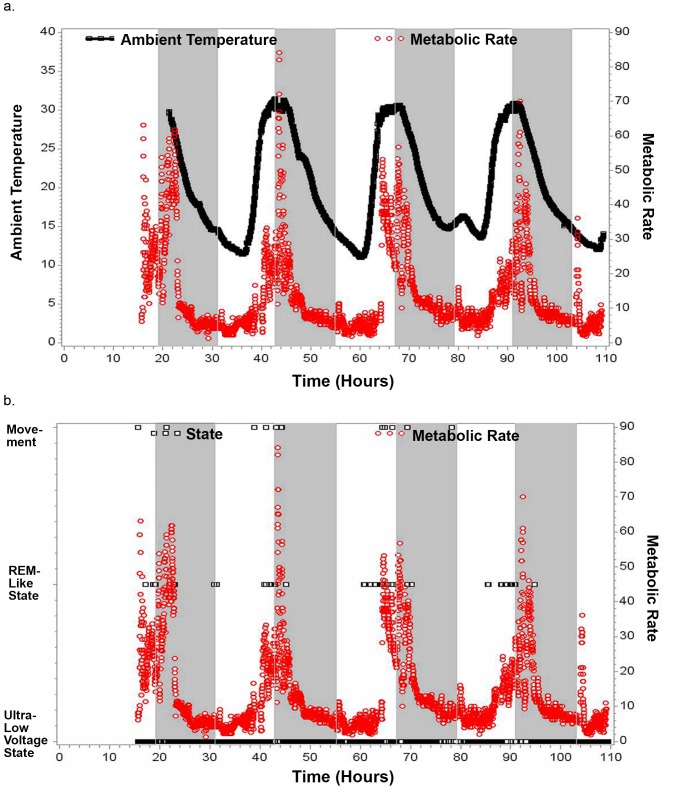
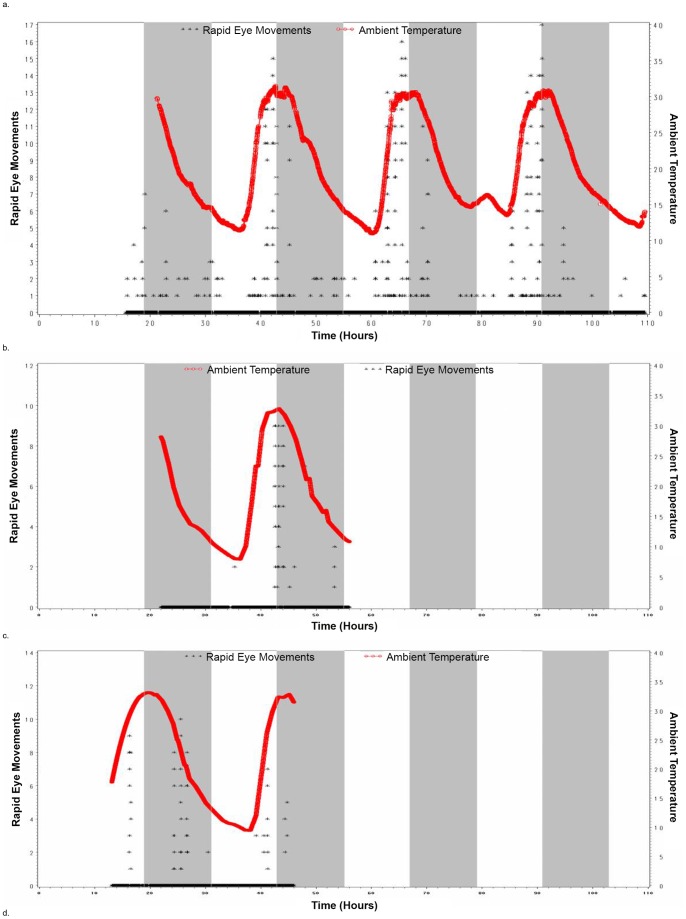
Measurements and results: We find that during hibernation, non-REM sleep is absent in Cheirogaleus. Rather, periods of REM sleep occur during periods of relatively high ambient temperature, a pattern opposite of that observed in ground squirrels. Like ground squirrels, however, EEG is marked by ultra-low voltage activity at relatively low metabolic-rates.
Conclusions: These findings confirm a sleep-temperature/metabolism link, though they also suggest that the relationship of sleep stage with temperature/metabolism is flexible and may differ across species or mammalian orders. The absence of non-REM sleep suggests that during hibernation in Cheirogaleus, like in the ground squirrel, the otherwise universal non-REM sleep homeostatic response is greatly curtailed or absent. Lastly, ultra-low voltage EEG appears to be a cross-species marker for extremely low metabolic-rate, and, as such, may be an attractive target for research on hibernation induction.
Conflict of interest statement
Figures
References
-
- Rechtschaffen A, Bergmann BM, Everson CA, Kushida CA, Gilliland MA (2002) Sleep deprivation in the rat: X. Integration and discussion of the findings. Sleep 25: 68–87. - PubMed
-
- Swinson KL (2005) Chronic REM-sleep deprivation of rats elevates metabolic rate and increases UCP1 gene expression in brown adipose tissue. Am J Physiol Endocrinol Metab. 289(1): E68–74. - PubMed
-
- Vaara J, Kyröläinen H, Koivu M, Tulppo M, Finni T (2009) The effect of 60-h sleep deprivation on cardiovascular regulation and body temperature. Eur J Appl Physiol. 105(3): 439–44. - PubMed
-
- Schmid SM, Hallschmid M, Jauch-Chara K, Born J, Schultes B (2008) A single night of sleep deprivation increases ghrelin levels and feelings of hunger in normal-weight healthy men. J Sleep Res. 17(3): 331–4. - PubMed
Publication types
MeSH terms
LinkOut - more resources
Full Text Sources
Other Literature Sources
