


Does diabetes appear in distinct phenotypes in young people? Results of the diabetes mellitus incidence Cohort Registry (DiMelli)
- PMID: 24023937
- PMCID: PMC3762796
- DOI: 10.1371/journal.pone.0074339
Does diabetes appear in distinct phenotypes in young people? Results of the diabetes mellitus incidence Cohort Registry (DiMelli)
Abstract
Introduction: The diabetes mellitus Incidence Cohort Registry (DiMelli) aims to characterize diabetes phenotypes by immunologic, metabolic, and genetic markers. We classified patients into three groups according to islet autoantibody status and examined whether patients with multiple diabetes-associated autoantibodies, one autoantibody, or without autoantibodies differed with respect to clinical, metabolic, and genetic parameters, including an insulin sensitivity (IS) score based on waist, HbA1c, and triglycerides. We also assessed whether metabolic markers predicted the immune status.
Materials and methods: As of June 2012, 630 patients in Bavaria, Germany, aged <20 years diagnosed with any type of diabetes within the preceding 6 months were registered in DiMelli. We compared the clinical and laboratory parameters between islet autoantibody status defined patient groups. Parameters showing the strongest associations were included in principal component analysis. Receiver operating characteristic curves were used to assess the ability of the IS Score to predict islet autoantibody status.
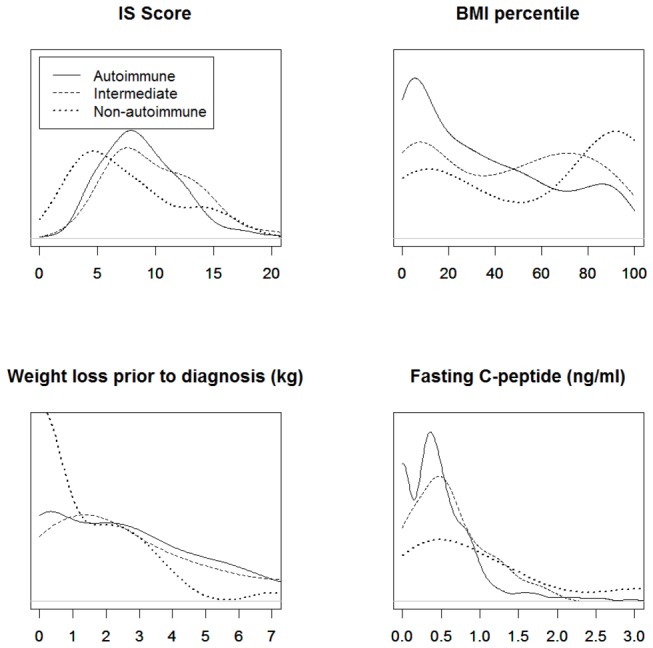
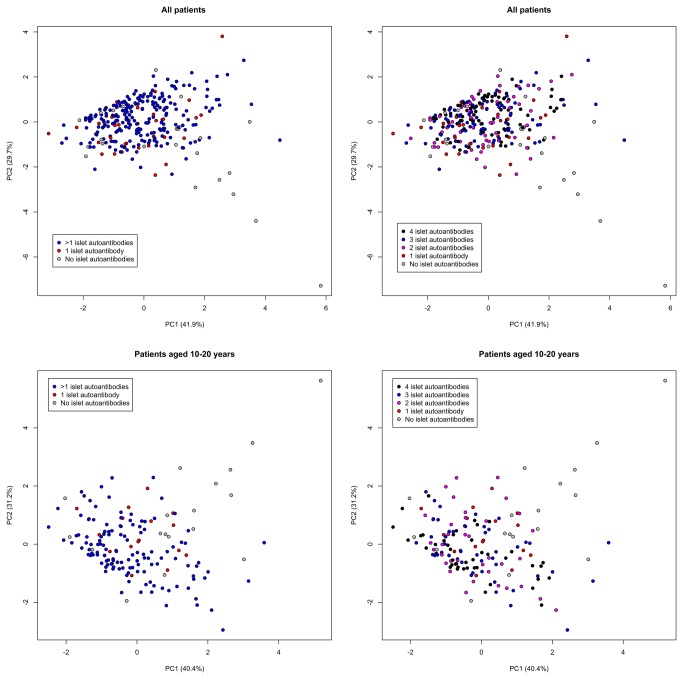
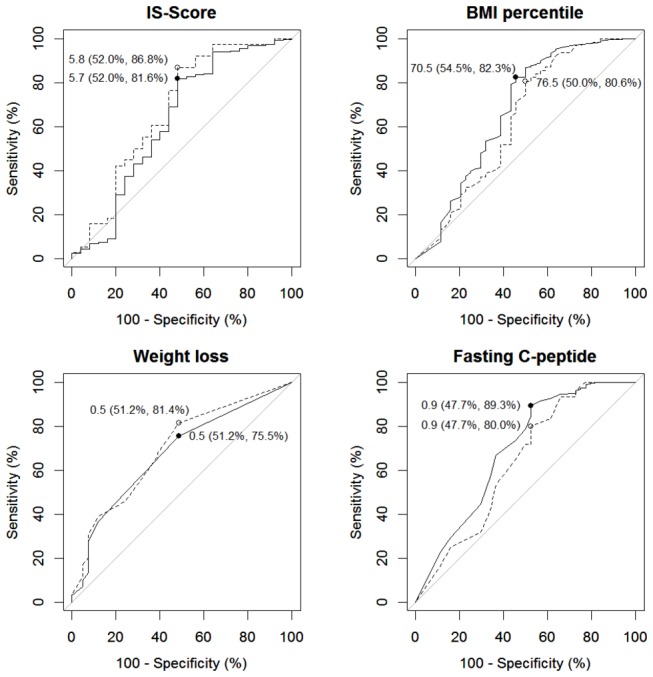
Results: Patients with multiple islet autoantibodies, one autoantibody, or without autoantibodies were significantly different in terms of BMI percentile, weight loss before diagnosis, fasting C-peptide (all, P<0.001), and IS Score (P=0.034). However, principal component analysis revealed no distinct patterns according to autoantibody status. At the optimal IS Score cut-off for predicting islet autoantibody positivity (single compared to none), the specificity was 52.0% and the sensitivity was 86.8%. With respect to prediction of multiple autoantibodies (compared to none), specificity and sensitivity were slightly lower and in combination inferior to those obtained using the BMI percentile and fasting C-peptide.
Discussion: The DiMelli study indicated that patients with and without islet autoantibodies differed with respect to metabolic and genetic markers but there was considerable overlap of phenotypes, and autoantibody status could not be predicted by these parameters. Thus, our results suggest that refined diabetes classification may require both immune and metabolic phenotyping.
Conflict of interest statement
Figures
References
-
- Patterson CC, Gyürüs E, Rosenbauer J, Cinek O, Neu A et al. (2012) Trends in childhood type 1 diabetes incidence in Europe during 1989-2008: evidence of non-uniformity over time in rates of increase. Diabetologia 55: 2142-2147. doi:10.1007/s00125-012-2571-8. PubMed: 22638547. - DOI - PubMed
-
- Imperatore G, Boyle JP, Thompson TJ, Case D, Dabelea D et al. (2012) Projections of type 1 and type 2 diabetes burden in the U.S. population aged <20 years through 2050: dynamic modeling of incidence, mortality, and population growth. Diabetes Care 35: 2515-2520. doi:10.2337/dc12-0669. PubMed: 23173134. - DOI - PMC - PubMed
-
- Schober E, Holl RW, Grabert M, Thon A, Rami B et al. (2005) Diabetes mellitus type 2 in childhood and adolescence in Germany and parts of Austria. Eur J Pediatr 164: 705-707. doi:10.1007/s00431-005-1709-9. PubMed: 16012857. - DOI - PubMed
-
- Dabelea D, Bell RA, D’Agostino RB Jr., Imperatore G, Johansen JM et al. (2007) Incidence of diabetes in youth in the United States. JAMA 297: 2716-2724. doi:10.1001/jama.297.24.2716. PubMed: 17595272. - DOI - PubMed
-
- Goran MI, Ball GD, Cruz ML (2003) Obesity and risk of type 2 diabetes and cardiovascular disease in children and adolescents. J Clin Endocrinol Metab 88: 1417-1427. doi:10.1210/jc.2002-021442. PubMed: 12679416. - DOI - PubMed
Publication types
MeSH terms
Substances
LinkOut - more resources
Full Text Sources
Other Literature Sources
Medical
Research Materials
