


Genome-wide association analyses for carcass quality in crossbred beef cattle
- PMID: 24024930
- PMCID: PMC3827924
- DOI: 10.1186/1471-2156-14-80
Genome-wide association analyses for carcass quality in crossbred beef cattle
Abstract
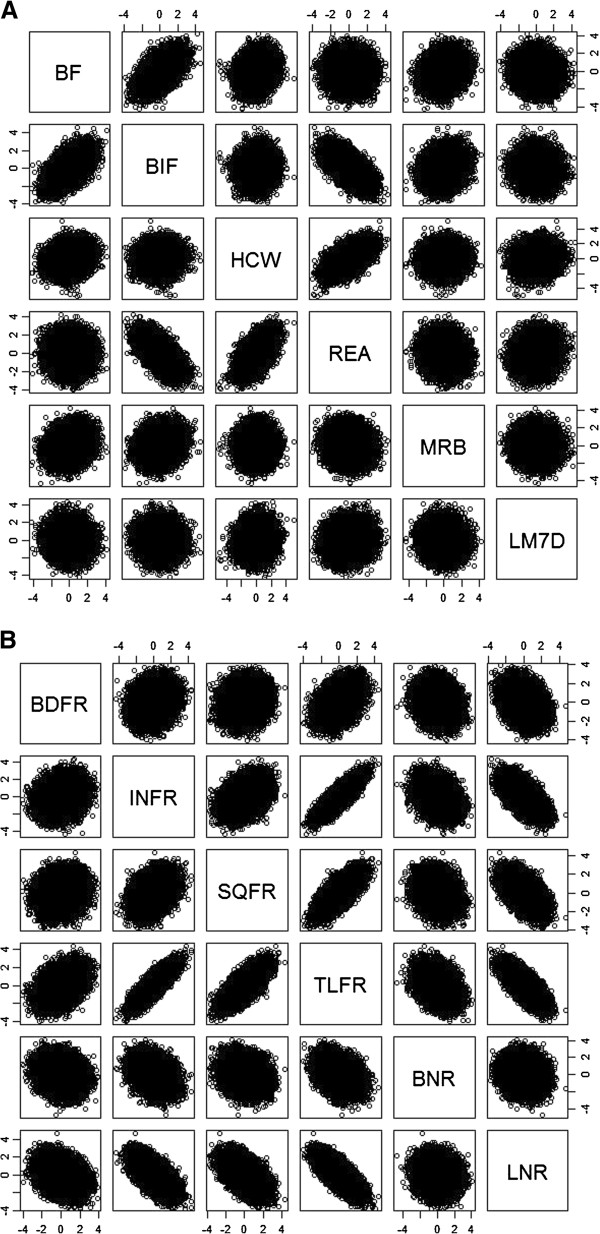
Background: Genetic improvement of beef quality will benefit both producers and consumers, and can be achieved by selecting animals that carry desired quantitative trait nucleotides (QTN), which result from intensive searches using genetic markers. This paper presents a genome-wide association approach utilizing single nucleotide polymorphisms (SNP) in the Illumina BovineSNP50 BeadChip to seek genomic regions that potentially harbor genes or QTN underlying variation in carcass quality of beef cattle.This study used 747 genotyped animals, mainly crossbred, with phenotypes on twelve carcass quality traits, including hot carcass weight (HCW), back fat thickness (BF), Longissimus dorsi muscle area or ribeye area (REA), marbling scores (MRB), lean yield grade by Beef Improvement Federation formulae (BIFYLD), steak tenderness by Warner-Bratzler shear force 7-day post-mortem (LM7D) as well as body composition as determined by partial rib (IMPS 103) dissection presented as a percentage of total rib weight including body cavity fat (BDFR), lean (LNR), bone (BNR), intermuscular fat (INFR), subcutaneous fat (SQFR), and total fat (TLFR).
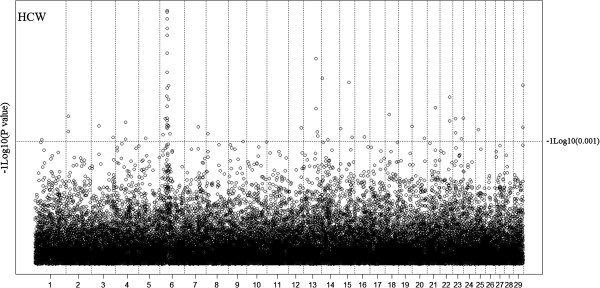
Results: At the genome wide level false discovery rate (FDR < 10%), eight SNP were found significantly associated with HCW. Seven of these SNP were located on Bos taurus autosome (BTA) 6. At a less stringent significance level (P < 0.001), 520 SNP were found significantly associated with mostly individual traits (473 SNP), and multiple traits (47 SNP). Of these significant SNP, 48 were located on BTA6, and 22 of them were in association with hot carcass weight. There were 53 SNP associated with percentage of rib bone, and 12 of them were on BTA20. The rest of the significant SNP were scattered over other chromosomes. They accounted for 1.90 - 5.89% of the phenotypic variance of the traits. A region of approximately 4 Mbp long on BTA6 was found to be a potential area to harbor candidate genes influencing growth. One marker on BTA25 accounting for 2.67% of the variation in LM7D may be worth further investigation for the improvement of beef tenderness.
Conclusion: This study provides useful information to further assist the identification of chromosome regions and subsequently genes affecting carcass quality traits in beef cattle. It also revealed many SNP that acted pleiotropically to affect carcass quality. This knowledge is important in selecting subsets of SNP to improve the performance of beef cattle.
Figures
References
-
- Schroeder TC, Mark DR. How can the beef industry recapture lost consumer demand? J Anim Sci. 2000;77:1–13.
-
- Roeber DL, Mckenna DR, Bates PK, Schmidt TB, Belk KE, Field TG, Scanga PJA, Savell JW, Morgan JB, Montgomery TH, Smith GC. The 2000 national beef quality audits: views of producers, packers, and merchandisers on current quality characteristics of beef. Prof Anim Sci. 2000;18:112–119.
-
- Hocquette JF, Renand G, Leveziel H, Picard B, Cassar-Malek I. The potential benefits of genetics and genomics to improve beef quality – a review. Anim Sci Pap Rep. 2006;24(3):173–189.
-
- Garrick D. The nature and scope of some whole genome analyses in US beef cattle. In Proceedings of the Beef Improvement Federation 41stAnnual Research Symposium: 30 April - 03 May 2009. Sacramento, California, USA: Beef Improvement Federation; 2009. pp. 92–102.
-
- Igenity Profile. http://www.igenity.com/beef/profile/IgenityProfile.aspx.
Publication types
MeSH terms
Substances
LinkOut - more resources
Full Text Sources
Other Literature Sources
Miscellaneous
