


Essential key indicators for disaster medical response suggested to be included in a national uniform protocol for documentation of major incidents: a Delphi study
- PMID: 24025366
- PMCID: PMC3848492
- DOI: 10.1186/1757-7241-21-68
Essential key indicators for disaster medical response suggested to be included in a national uniform protocol for documentation of major incidents: a Delphi study
Abstract
Background: Registration of data from a major incident or disaster serves several purposes such as to record data for evaluation of response as well as for research. Data needed can often be retrieved after an incident while other must be recorded during the incident. There is a need for a consensus on what is essential to record from a disaster response. The aim of this study was to identify key indicators essential for initial disaster medical response registration. By this is meant nationally accepted processes involved, from the time of the emergency call to the emergency medical communication centre until medical care is provided at the emergency department.
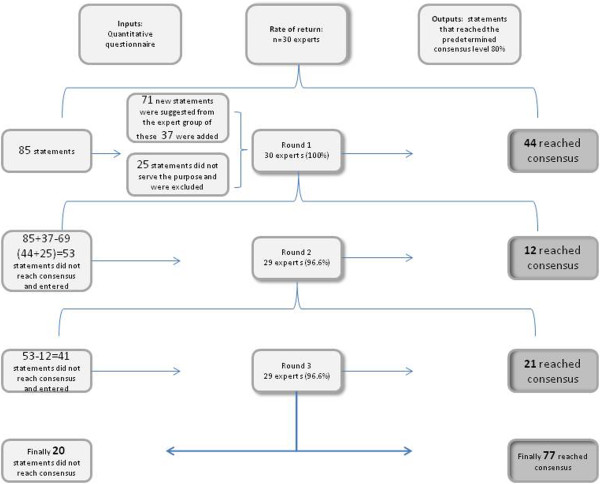
Methods: A three round Delphi study was conducted. Thirty experts with a broad knowledge in disaster and emergency response and medical management were invited. In this study we estimated 30 experts to be approximately one third of the number in Sweden eligible for recruitment. Process, structure and outcome indicators for the initial disaster medical response were identified. These were based on previous research and expressed as statements and were grouped into eight categories, and presented to the panel of experts. The experts were instructed to score each statement, using a five point Likert scale, and were also invited to include additional statements. Statements reaching a predefined consensus level of 80% were considered as essential to register.
Results: In total 97 statements were generated, 77 statements reached consensus. The 77 statements covered parts of all relevant aspects involved in the initial disaster medical response. The 20 indicators that did not reach consensus mostly concerned patient related times in hospital, types of support systems and security for health care staff.
Conclusions: The Delphi technique can be used for reaching consensus of data, comprising process, structure and outcome indicators, identified as essential for recording from major incidents and disasters.
Figures
References
-
- Sundnes KO. Health disaster management: guidelines for evaluation and research in the Utstein style: executive summary. Task force on quality control of disaster management. Prehosp Disaster Med. 1999;14(2):43–52. - PubMed
-
- Sundnes KO, Birnbaum M. Health disaster management: guidelines for evaluation and research in the Utstein Style. Volume I. Conceptual framework of disasters. Prehosp Disaster Med. 2003;17(Suppl 3):1–177. - PubMed
-
- Rüter A, Örtenwall P, Vikström T. Performance indicators for major medical incident management-a possible tool for quality control? Int J Disast Med. 2004;2:52–55. doi: 10.1080/15031430410023355. - DOI
Publication types
MeSH terms
LinkOut - more resources
Full Text Sources
Other Literature Sources
Medical
Miscellaneous
