


Risk for end-stage renal disease over 25 years in the population-based WESDR cohort
- PMID: 24026564
- PMCID: PMC3898749
- DOI: 10.2337/dc13-1287
Risk for end-stage renal disease over 25 years in the population-based WESDR cohort
Abstract
Objective: In the population-based Wisconsin Epidemiologic Study of Diabetic Retinopathy (WESDR) cohort, we sought to examine whether a decline in the prevalence and incidence of end-stage renal disease (ESRD) was evident with increasing calendar year of type 1 diabetes diagnosis among people followed for 25 years. Factors associated with the hazard of incident ESRD that may mediate a decline were also investigated.
Research design and methods: Participants were examined at baseline in 1980 (n = 996) and at 4-25 years of follow-up. ESRD was defined by self-reported renal transplant or dialysis. Cumulative incidence with competing risk of death was determined. Incident ESRD was modeled by period of diagnosis, adjusting for other known risk factors using discrete time hazard models.
Results: When diabetes was diagnosed during 1970-1980, the unadjusted cumulative incidence of ESRD at 25 years was 9.3%. The unadjusted hazard of ESRD was reduced by 70% (P < 0.001), compared with those diagnosed with diabetes in 1922-1969; however, the association was attenuated by glycosylated hemoglobin level (HbA1c), systolic blood pressure, and antihypertensive use (hazard ratio [HR] 0.89 [95% CI 0.55-1.45]). HbA1c, age, and male sex remained associated with ESRD hazard after adjustment for kidney function and proliferative retinopathy.
Conclusions: A lower incidence of ESRD among those more recently diagnosed with type 1 diabetes was explained by improvements in glycemic and blood pressure control over the last several decades. Intensive diabetes management, especially for glycemic control, remains important even in long-standing diabetes as it may delay the development of ESRD.
Figures
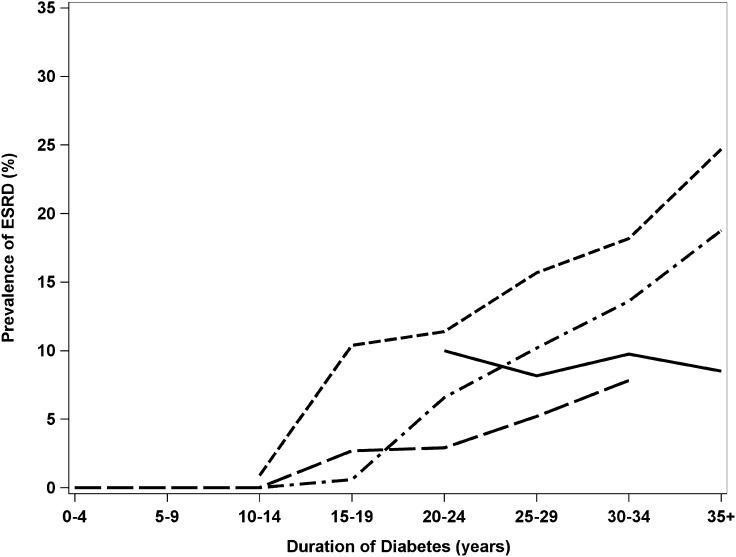
 , 1922–1959;
  , 1960–1969;
  , 1970–1974; and
  , 1975–1980.
References
-
- Gross JL, de Azevedo MJ, Silveiro SP, Canani LH, Caramori ML, Zelmanovitz T. Diabetic nephropathy: diagnosis, prevention, and treatment. Diabetes Care 2005;28:164–176 - PubMed
-
- U.S. Renal Data System USRDS 2012 Annual Data Report: Atlas of Chronic Kidney Disease and End-Stage Renal Disease in the United States. Bethesda, MD, National Institutes of Health, National Institute of Diabetes and Digestive and Kidney Diseases, 2012
-
- Cowie CC, Port FK, Wolfe RA, Savage PJ, Moll PP, Hawthorne VM. Disparities in incidence of diabetic end-stage renal disease according to race and type of diabetes. N Engl J Med 1989;321:1074–1079 - PubMed
-
- Marshall SM. Diabetic nephropathy in type 1 diabetes: has the outlook improved since the 1980s? Diabetologia 2012;55:2301–2306 - PubMed
-
- Finne P, Reunanen A, Stenman S, Groop P-H, Grönhagen-Riska C. Incidence of end-stage renal disease in patients with type 1 diabetes. JAMA 2005;294:1782–1787 - PubMed
Publication types
MeSH terms
Grants and funding
LinkOut - more resources
Full Text Sources
Other Literature Sources
Medical
