


Validation of the auto-inflammatory diseases activity index (AIDAI) for hereditary recurrent fever syndromes
- PMID: 24026675
- PMCID: PMC4251184
- DOI: 10.1136/annrheumdis-2013-203666
Validation of the auto-inflammatory diseases activity index (AIDAI) for hereditary recurrent fever syndromes
Abstract
Objectives: To validate the Auto-Inflammatory Diseases Activity Index (AIDAI) in the four major hereditary recurrent fever syndromes (HRFs): familial Mediterranean fever (FMF), mevalonate kinase deficiency (MKD), tumour necrosis factor receptor-associated periodic syndrome (TRAPS) and cryopyrin-associated periodic syndromes (CAPS).
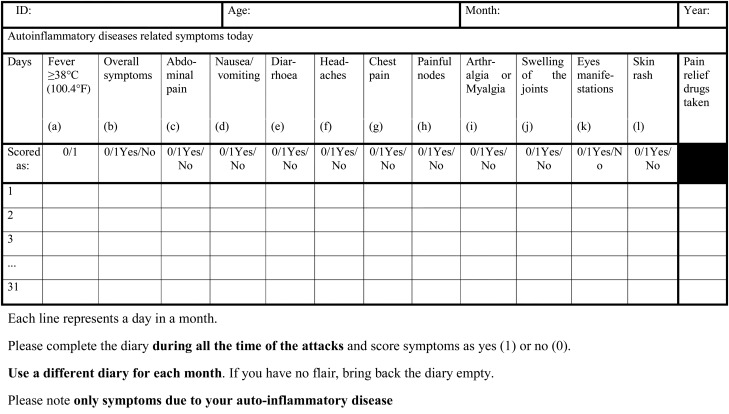
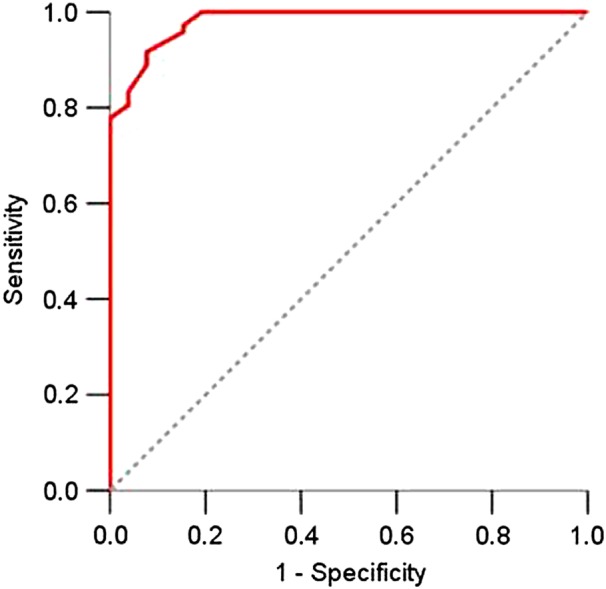
Methods: In 2010, an international collaboration established the content of a disease activity tool for HRFs. Patients completed a 1-month prospective diary with 12 yes/no items before a clinical appointment during which their physician assessed their disease activity by a questionnaire. Eight international experts in auto-inflammatory diseases evaluated the patient's disease activity by a blinded web evaluation and a nominal group technique consensus conference, with their consensus judgement considered the gold standard. Sensitivity/specificity/accuracy measures and the ability of the score to discriminate active from inactive patients via the best cut-off score were calculated by a receiver operating characteristic analysis.
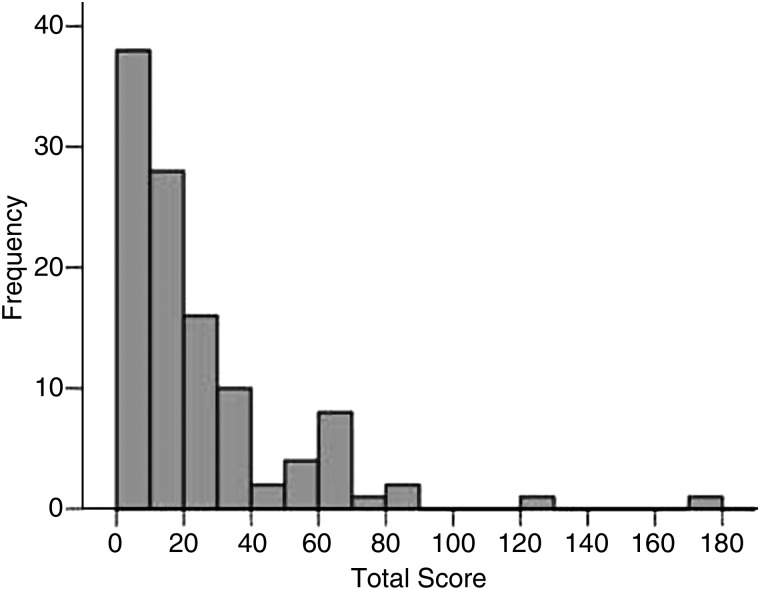
Results: Consensus was achieved for 98/106 (92%) cases (39 FMF, 35 CAPS, 14 TRAPS and 10 MKD), with 26 patients declared as having inactive disease and 72 as having active disease. The median total AIDAI score was 14 (range=0-175). An AIDAI cut-off score ≥9 discriminated active from inactive patients, with sensitivity/specificity/accuracy of 89%/92%/90%, respectively, and an area under the curve of 98% (95% CI 96% to 100%).
Conclusions: The AIDAI score is a valid and simple tool for assessing disease activity in FMF/MKD/TRAPS/CAPS. This tool is easy to use in clinical practice and has the potential to be used as the standard efficacy measure in future clinical trials.
Keywords: Disease Activity; Familial Mediterranean Fever; Fever Syndromes.
Published by the BMJ Publishing Group Limited. For permission to use (where not already granted under a licence) please go to http://group.bmj.com/group/rights-licensing/permissions.
Figures
References
-
- Touitou I, Kone-Paut I. Autoinflammatory diseases. Best Pract Res Clin Rheumatol 2008;22:811–29. - PubMed
-
- Hashkes PJ, Spalding SJ, Giannini EH, et al. Rilonacept for colchicine-resistant or -intolerant familial mediterranean Fever: a randomized trial. Ann Intern Med 2012;157:533–41. - PubMed
-
- Singh JA, Solomon DH, Dougados M, et al. Development of classification and response criteria for rheumatic diseases. Arthritis Rheum 2006;55:348–52. - PubMed
-
- Hoffman HM, Throne ML, Amar NJ, et al. Efficacy and safety of rilonacept (interleukin-1 Trap) in patients with cryopyrin-associated periodic syndromes: results from two sequential placebo-controlled studies. Arthritis Rheum 2008;58:2443–52. - PubMed
-
- Lachmann HJ, Kone-Paut I, Kuemmerle-Deschner JB, et al. Use of canakinumab in the cryopyrin-associated periodic syndrome. N Engl J Med 2009;360:2416–25. - PubMed
Publication types
MeSH terms
Supplementary concepts
LinkOut - more resources
Full Text Sources
Other Literature Sources
Miscellaneous
