


Abnormal striatal dopaminergic neurotransmission during rest and task production in spasmodic dysphonia
- PMID: 24027271
- PMCID: PMC3771037
- DOI: 10.1523/JNEUROSCI.0407-13.2013
Abnormal striatal dopaminergic neurotransmission during rest and task production in spasmodic dysphonia
Abstract
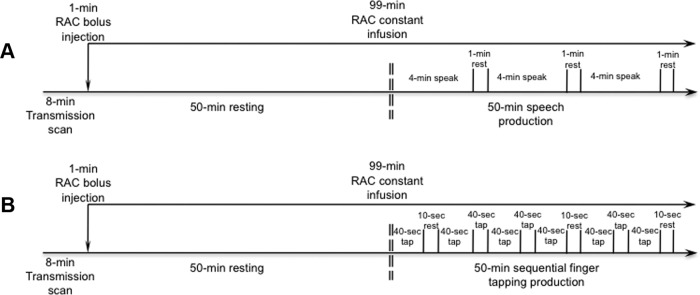
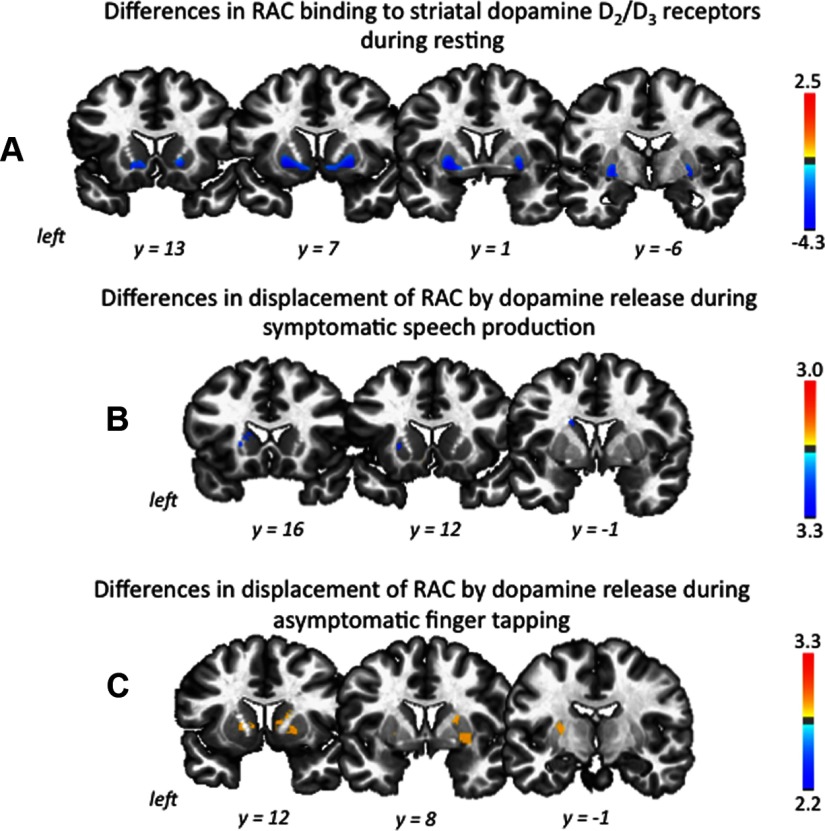
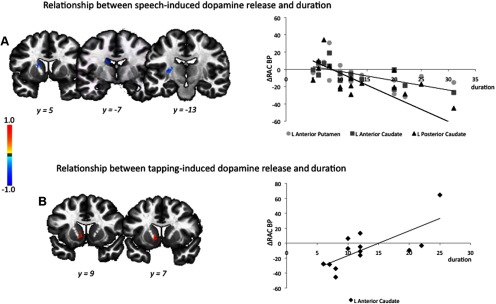
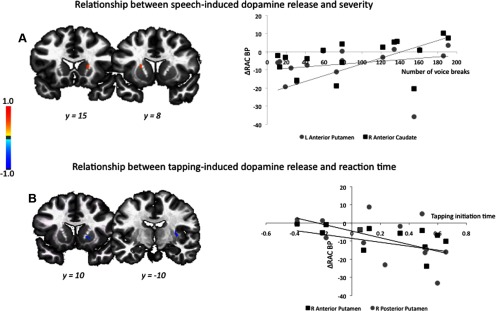
Spasmodic dysphonia is a primary focal dystonia characterized by involuntary spasms in the laryngeal muscles during speech production. The pathophysiology of spasmodic dysphonia is thought to involve structural and functional abnormalities in the basal ganglia-thalamo-cortical circuitry; however, neurochemical correlates underpinning these abnormalities as well as their relations to spasmodic dysphonia symptoms remain unknown. We used positron emission tomography with the radioligand [(11)C]raclopride (RAC) to study striatal dopaminergic neurotransmission at the resting state and during production of symptomatic sentences and asymptomatic finger tapping in spasmodic dysphonia patients. We found that patients, compared to healthy controls, had bilaterally decreased RAC binding potential (BP) to striatal dopamine D2/D3 receptors on average by 29.2%, which was associated with decreased RAC displacement (RAC ΔBP) in the left striatum during symptomatic speaking (group average difference 10.2%), but increased RAC ΔBP in the bilateral striatum during asymptomatic tapping (group average difference 10.1%). Patients with more severe voice symptoms and subclinically longer reaction time to initiate the tapping sequence had greater RAC ΔBP measures, while longer duration of spasmodic dysphonia was associated with a decrease in task-induced RAC ΔBP. Decreased dopaminergic transmission during symptomatic speech production may represent a disorder-specific pathophysiological trait involved in symptom generation, whereas increased dopaminergic function during unaffected task performance may be explained by a compensatory adaptation of the nigrostriatal dopaminergic system possibly due to decreased striatal D2/D3 receptor availability. These changes can be linked to the clinical and subclinical features of spasmodic dysphonia and may represent the neurochemical basis of basal ganglia alterations in this disorder.
Figures
References
-
- Aronson A. Clinical voice disorders: an interdisciplinary approach. Ed 3. New York: Thieme; 1990.
-
- Asanuma K, Ma Y, Okulski J, Dhawan V, Chaly T, Carbon M, Bressman SB, Eidelberg D. Decreased striatal D2 receptor binding in non-manifesting carriers of the DYT1 dystonia mutation. Neurology. 2005;64:347–349. doi: 10.1212/01.WNL.0000149764.34953.BF. - DOI - PubMed
Publication types
MeSH terms
Substances
Grants and funding
LinkOut - more resources
Full Text Sources
Other Literature Sources
Miscellaneous
