


Age and clinical outcomes in patients presenting with acute coronary syndromes
- PMID: 24027372
- PMCID: PMC3770118
- DOI: 10.1016/j.jcdr.2012.08.005
Age and clinical outcomes in patients presenting with acute coronary syndromes
Abstract
Context: Elderly patients have more cardiovascular risk factors and a greater burden of ischemic disease than younger patients.
Aims: To examine the impact of age on clinical presentation and outcomes in patients presenting with acute coronary syndrome (ACS).
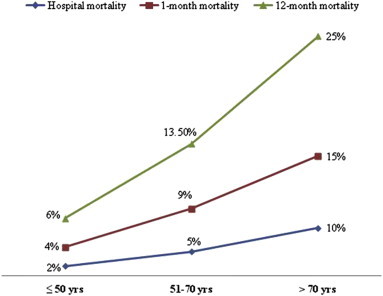
Methods and material: Collected data from the 2nd Gulf Registry of Acute Coronary Events (Gulf RACE-2), which is a prospective multicenter study from six adjacent Arab Middle Eastern Gulf countries. Patients were divided into 3 groups according to their age: ≤50 years, 51-70 years and >70 years and their clinical characteristics and outcomes were analyzed. Mortality was assessed at one and 12 months.
Statistical analysis used: One-way ANOVA test for continuous variables, Pearson chi-square (X (2)) test for categorical variables and multivariate logistic regression analysis for predictors were performed.
Results: Among 7930 consecutive ACS patients; 2755 (35%) were ≤50 years, 4110 (52%) were 51-70 years and 1065 (13%) >70 years old. The proportion of women increased with increasing age (13% among patients ≤50 years to 31% among patients > 70 years). The risk factor pattern varied with age; younger patients were more often obese, smokers and had a positive family history of CAD, whereas older patients more likely to have diabetes mellitus, hypertension, and dyslipidemia. Advancing age was associated with under-treatment evidence-based therapies. Multivariate logistic regression analysis after adjusting for relevant covariates showed that old age was independent predictors for re-ischemia (OR 1.29; 95% CI 1.03-1.60), heart failure (OR 2.8; 95% CI 2.17-3.52) and major bleeding (OR 4.02; 95% CI 1.37-11.77) and in-hospital mortality (age 51-70: OR 2.67; 95% CI 1.86-3.85, and age >70: OR 4.71; 95% CI 3.11-7.14).
Conclusion: Despite being higher risk group, elderly are less likely to receive evidence-based therapies and had worse outcomes. Guidelines adherence is highly recommended in elderly.
Keywords: Acute coronary syndrome; Age; Elderly.
Figures
References
-
- Lopez A.D., Mathers C.D., Ezzati M., Jamison D.T., Murray C.J. Global and regional burden of disease and risk factors, 2001: systematic analysis of population health data. Lancet. 2006;367:1747–1757. - PubMed
-
- Rosengren A., Wallentin L., Simoons M. Age, clinical presentation, and outcome of acute coronary syndromes in the euro heart acute coronary syndrome survey. Eur Heart J. 2006;27:789–795. - PubMed
-
- Rosamond W., Flegal K., Furie K. Heart disease and stroke statistics-2008 update: a report from the American Heart Association Statistics Committee and Stroke Statistics Subcommittee. Circulation. 2008;117:e25–e146. - PubMed
-
- Granger C.B., Goldberg R.J., Dabbous O., Global Registry of Acute Coronary Events Investigators Predictors of hospital mortality in the global registry of acute coronary events. Arch Intern Med. 2003;163:2345–2353. - PubMed
-
- Wright R.S., Anderson J.L., Adams C.D. 2011 ACCF/AHA focused update of the guidelines for the management of patients with unstable Angina/Non-ST-elevation myocardial infarction (updating the 2007 guideline): a report of the American College of Cardiology Foundation/American Heart Association Task Force on Practice guidelines developed in collaboration with the American College of Emergency physicians, Society for Cardiovascular Angiography and Interventions, and Society of Thoracic Surgeons. J Am Coll Cardiol. 2011;57:1920–1959. - PubMed
LinkOut - more resources
Full Text Sources
Other Literature Sources
Miscellaneous