Trends in racial and ethnic disparities in infant mortality rates in the United States, 1989-2006
- PMID: 24028239
- PMCID: PMC4103228
- DOI: 10.2105/AJPH.2013.301272
Trends in racial and ethnic disparities in infant mortality rates in the United States, 1989-2006
Abstract
Objectives: We sought to measure overall disparities in pregnancy outcome, incorporating data from the many race and ethnic groups that compose the US population, to improve understanding of how disparities may have changed over time.
Methods: We used Birth Cohort Linked Birth-Infant Death Data Files from US Vital Statistics from 1989-1990 and 2005-2006 to examine multigroup indices of racial and ethnic disparities in the overall infant mortality rate (IMR), preterm birth rate, and gestational age-specific IMRs. We calculated selected absolute and relative multigroup disparity metrics weighting subgroups equally and by population size.
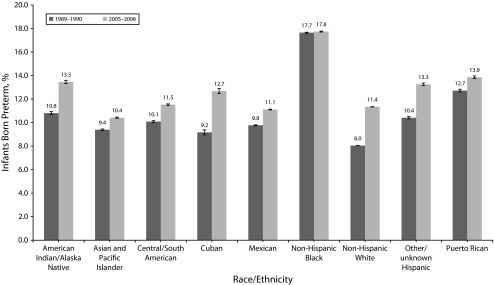
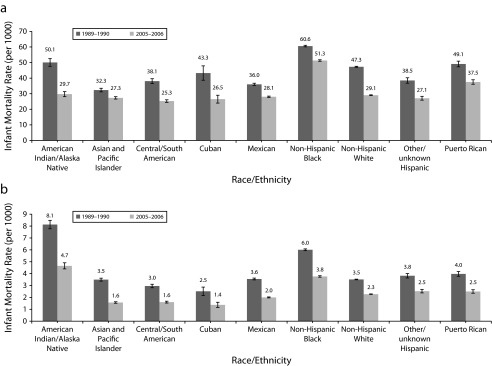
Results: Overall IMR decreased on the absolute scale, but increased on the population-weighted relative scale. Disparities in the preterm birth rate decreased on both the absolute and relative scales, and across equally weighted and population-weighted indices. Disparities in preterm IMR increased on both the absolute and relative scales.
Conclusions: Infant mortality is a common bellwether of general and maternal and child health. Despite significant decreases in disparities in the preterm birth rate, relative disparities in overall and preterm IMRs increased significantly over the past 20 years.
Figures

References
-
- Anachebe NF.Racial and ethnic disparities in infant and maternal mortality Ethn Dis 200616(2 suppl 3)S3-71–S3-76. - PubMed
-
- Centers for Disease Control and Prevention. Racial/ethnic disparities in infant mortality—United States, 1995–2002. MMWR Morb Mortal Wkly Rep. 2005;54(22):553–556. - PubMed
-
- Collins JW, Jr, David RJ. Racial disparity in low birth weight and infant mortality. Clin Perinatol. 2009;36(1):63–73. - PubMed
-
- Hauck FR, Tanabe KO, Moon RY. Racial and ethnic disparities in infant mortality. Semin Perinatol. 2011;35(4):209–220. - PubMed
MeSH terms
Grants and funding
LinkOut - more resources
Full Text Sources
Other Literature Sources
Medical
Miscellaneous