Review
. 2013 Oct;10(4):698-708.
doi: 10.1007/s13311-013-0211-8.

Epigenetic landscape of Parkinson's disease: emerging role in disease mechanisms and therapeutic modalities

Affiliations
Review

Epigenetic landscape of Parkinson's disease: emerging role in disease mechanisms and therapeutic modalities

Navneet Ammal Kaidery et al. Neurotherapeutics. 2013 Oct.

Abstract

Parkinson's disease (PD) is a complex multifactorial disorder marked by extensive system-wide pathology, including a substantial loss of nigrostriatal dopaminergic neurons. The etiology of PD remains elusive, but there is considerable evidence that, in addition to well-defined genetic mechanisms environmental factors play a crucial role in disease pathogenesis. How the environment might influence the genetic factors and contribute to disease development and progression remains unclear. In recent years, epigenetic mechanisms such as DNA methylation, chromatin remodeling and alterations in gene expression via non-coding RNAs have begun to be revealed as potential factors in PD pathogenesis. Epigenetic modulation exists throughout life, beginning in prenatal stages, is dependent on the lifestyle, environmental exposure and genetic makeup of an individual and may serve as a missing link between PD risk factors and development of the disease. This chapter sheds light on the emerging role of epigenetics in disease pathogenesis and on prospective interventional strategies for the therapeutic modulation of PD.


Figures
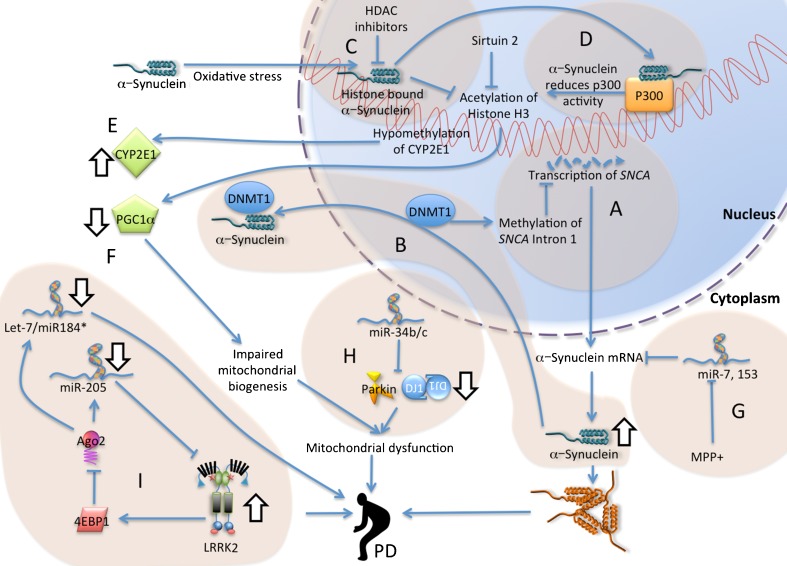
Fig. 1
Fig. 1
Epigenetic processes in familial PD. a Transcription at the SNCA locus is decreased following methylation of its intron 1. α-synuclein enters the nucleus following oxidative stress and (b) sequesters DNA methyl transferase 1 (DNMT1) into the cytoplasm, (c) binds to histones to reduce histone H3 acetylation and (d) binds to p300 to reduce histone acetyl transferase activity. e Hypomethylation of cytochrome P450 2E1 (CYP2E1) increases the transcription of this detoxifying gene. f Histone deacetylation contributes to a decrease in the expression of PGC1-α which controls mitochondrial biogenesis. HDAC inhibition rescues from nuclear α-synuclein toxicity. g miRs-7 and miR-153 targets the 3’UTR of SNCA (miR-7 is in turn suppressed by MPP+). h miR-34b/c downregulates Parkin and DJ-1 and in turn affects mitochondrial activity. i LRRK2 phosphorylate and activate 4EBP1, which through Argonaute-2 (Ago2) of RISC complex downregulates miRs let-7, -184* and −205. Familial PD genes Parkin, DJ-1, LRRK2 and SNCA, as well as mitochondrial dysfunctions are risk factors for PD. Abbreviations: 4EBP1 eukaryotic translation initiation factor 4E-binding protein 1, Ago2 Argonaute RISC Catalytic component 2, CYP2E1 cytochrome P450 2E1, DNMT1 DNA (cytosine-5)-methyltransferase 1, HDAC histone deacetylase, LRRK2 leucine-rich repeat kinase 2, miR miRNA, MPP + 1-methyl-4-phenyl-pyridinium ion, PD Parkinson’s disease, PGC1α- peroxisome proliferator-receptor gamma coactivator-1, SNCA α-synuclein

References

    1. Dorsey ER, Constantinescu R, Thompson JP, Biglan KM, Holloway RG, Kieburtz K, et al. Projected number of people with Parkinson disease in the most populous nations, 2005 through 2030. Neurology. 2007;68(5):384–386. doi: 10.1212/01.wnl.0000247740.47667.03. - DOI - PubMed
    1. Forno LS. Neuropathology of Parkinson’s disease. J Neuropathol Exp Neurol. 1996;55(3):259–272. doi: 10.1097/00005072-199603000-00001. - DOI - PubMed
    1. Jablonka E, Lamb MJ. The changing concept of epigenetics. Ann NY Acad Sci. 2002;981:82–96. doi: 10.1111/j.1749-6632.2002.tb04913.x. - DOI - PubMed
    1. Portela A, Esteller M. Epigenetic modifications and human disease. Nat Biotechnol. 2010;28(10):1057–1068. doi: 10.1038/nbt.1685. - DOI - PubMed
    1. Bird A. Perceptions of epigenetics. Nature. 2007;447(7143):396–398. doi: 10.1038/nature05913. - DOI - PubMed

Publication types
