


Caesarean section versus vaginal delivery for preterm birth in singletons
- PMID: 24030708
- PMCID: PMC7052739
- DOI: 10.1002/14651858.CD000078.pub3
Caesarean section versus vaginal delivery for preterm birth in singletons
Abstract
Background: Planned caesarean delivery for women thought be in preterm labour may be protective for baby, but could also be quite traumatic for both mother and baby. The optimal mode of delivery of preterm babies for both cephalic and breech presentation remains, therefore, controversial.
Objectives: To assess the effects of a policy of planned immediate caesarean delivery versus planned vaginal birth for women in preterm labour.
Search methods: We searched the Cochrane Pregnancy and Childbirth Group's Trials Register (5 August 2013).
Selection criteria: Randomised trials comparing a policy of planned immediate caesarean delivery versus planned vaginal delivery for preterm birth.
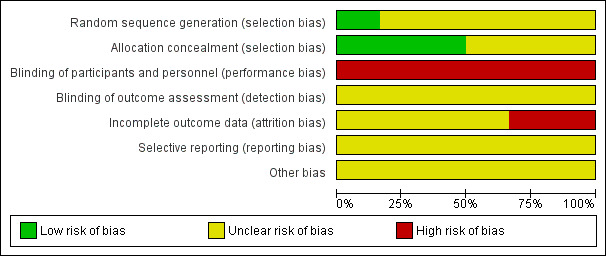
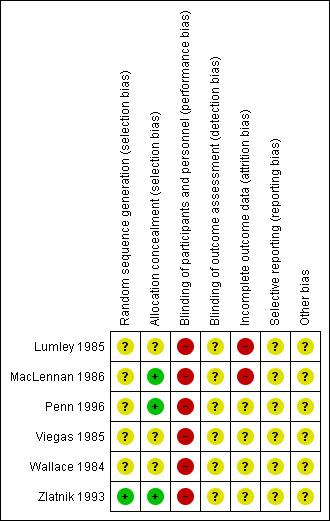
Data collection and analysis: Two review authors independently assessed trials for inclusion. Two review authors independently extracted data and assessed risk of bias. Data were checked for accuracy.
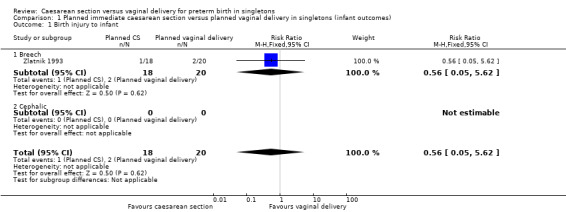
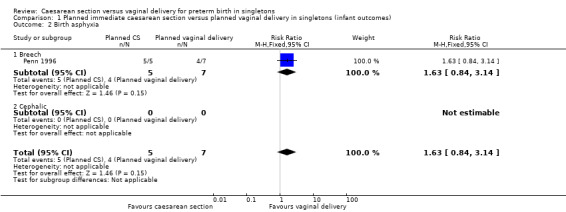
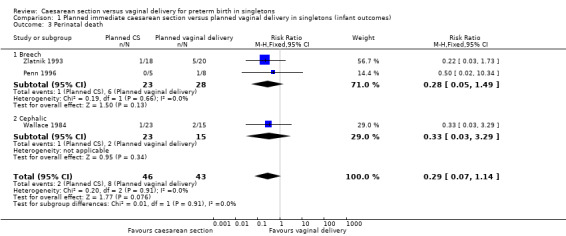
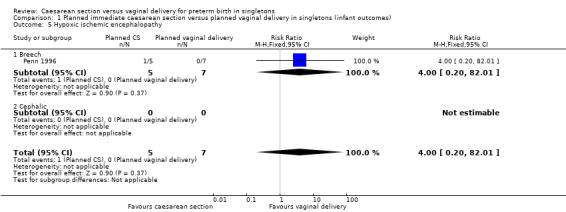
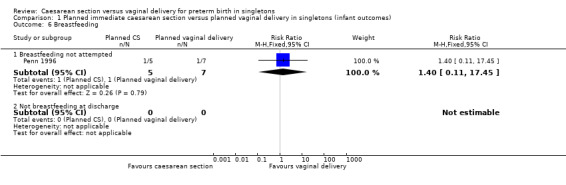
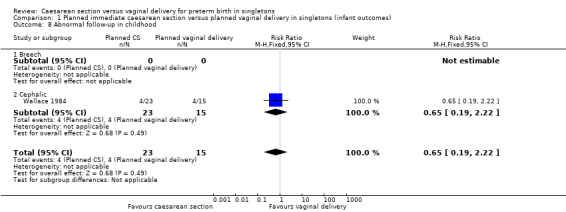
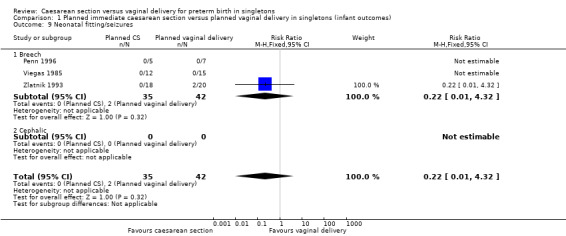
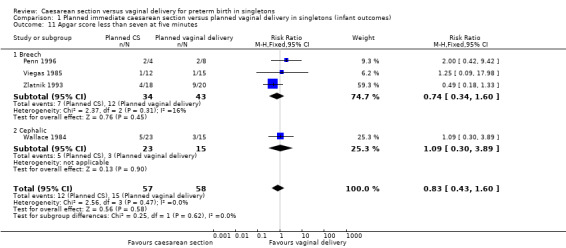
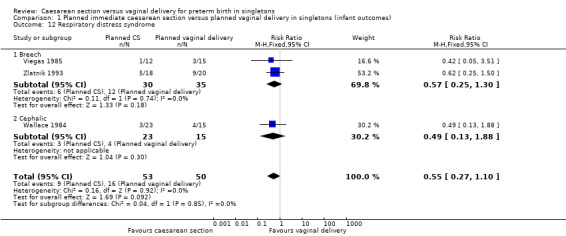
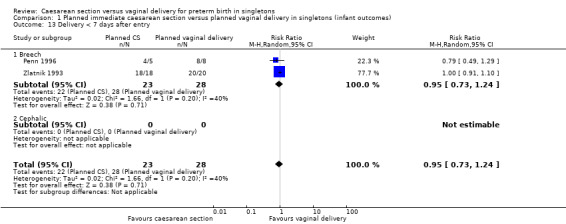
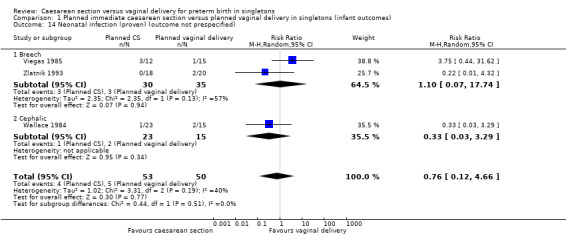
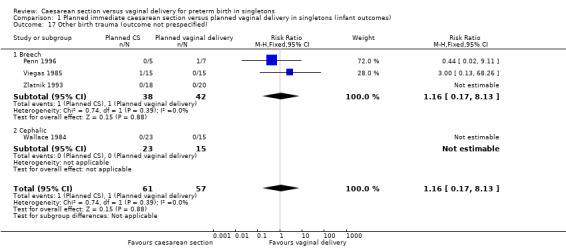
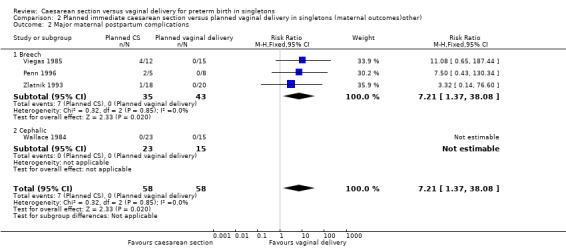
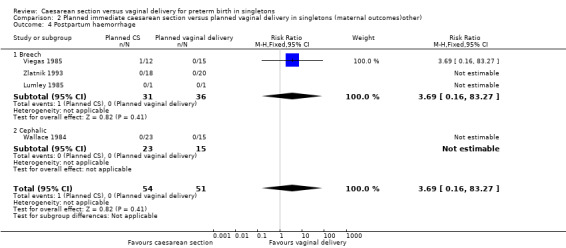
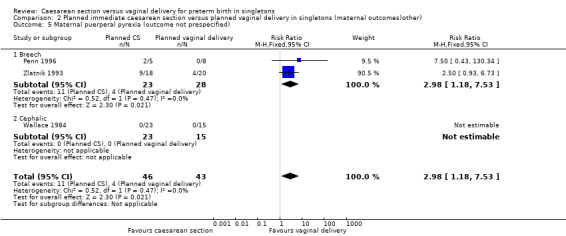
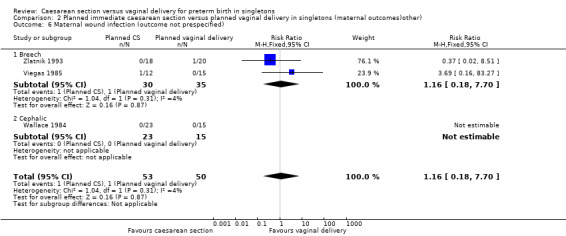
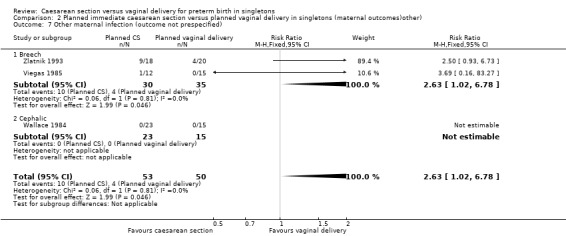
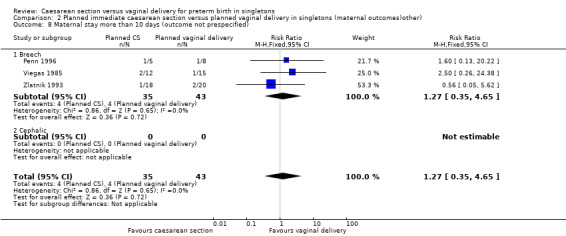
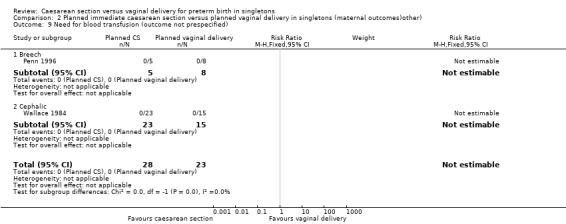
Main results: We included six studies (involving 122 women) but only four studies (involving only 116 women) contributed data to the analyses. INFANT: There were very little data of relevance to the three main (primary) outcomes considered in this review: There was no significant difference between planned immediate caesarean section and planned vaginal delivery with respect to birth injury to infant (risk ratio (RR) 0.56, 95%, confidence interval (CI) 0.05 to 5.62; one trial, 38 women) or birth asphyxia (RR 1.63, 95% CI 0.84 to 3.14; one trial, 12 women). The only cases of birth trauma were a laceration of the buttock in a baby who was delivered by caesarean section and mild bruising in another allocated to the group delivered vaginally.The difference between the two groups with regard to perinatal deaths was not significant (0.29, 95% CI 0.07 to 1.14; three trials, 89 women) and there were no data specifically relating to neonatal admission to special care and/or intensive care unit.There was also no difference between the caesarean or vaginal delivery groups in terms of markers of possible birth asphyxia (RR 1.63, 95% CI 0.84 to 3.14; one trial, 12 women) or Apgar score less than seven at five minutes (RR 0.83, 95% CI 0.43 to 1.60; four trials, 115 women) and no difference in attempts at breastfeeding (RR 1.40, 95% 0.11 to 17.45; one trial, 12 women). There was also no difference in neonatal fitting/seizures (RR 0.22, 95% CI 0.01 to 4.32; three trials, 77 women), hypoxic ischaemic encephalopathy (RR 4.00, 95% CI 0.20 to 82.01;one trial, 12 women) or respiratory distress syndrome (RR 0.55, 95% CI 0.27 to 1.10; three trials, 103 women). There were no data reported in the trials specifically relating to meconium aspiration. There was also no significant difference between the two groups for abnormal follow-up in childhood (RR 0.65, 95% CI 0.19 to 2.22; one trial, 38 women) or delivery less than seven days after entry (RR 0.95, 95% CI 0.73 to 1.24; two trials, 51 women). MOTHER: There were no data reported on maternal admissions to intensive care. However, there were seven cases of major maternal postpartum complications in the group allocated to planned immediate caesarean section and none in the group randomised to vaginal delivery (RR 7.21, 95% CI 1.37 to 38.08; four trials, 116 women).There were no data reported in the trials specifically relating to maternal satisfaction (postnatal). There was no significant difference between the two groups with regard to postpartum haemorrhage. A number of non-prespecified secondary outcomes were also considered in the analyses. There was a significant advantage for women in the vaginal delivery group with respect to maternal puerperal pyrexia (RR 2.98, 95% CI 1.18 to 7.53; three trials, 89 women) and other maternal infection (RR 2.63, 95% CI 1.02 to 6.78; three trials, 103 women), but no significant differences in wound infection (RR 1.16, 95% CI 0.18 to 7.70; three trials, 103 women), maternal stay more than 10 days (RR 1.27, 95% CI 0.35 to 4.65; three trials, 78 women) or the need for blood transfusion (results not estimable).
Authors' conclusions: There is not enough evidence to evaluate the use of a policy of planned immediate caesarean delivery for preterm babies. Further studies are needed in this area, but recruitment is proving difficult.
Conflict of interest statement
None known.
Figures
Update of
-
Caesarean section versus vaginal delivery for preterm birth in singletons.Cochrane Database Syst Rev. 2012 Jun 13;6(6):CD000078. doi: 10.1002/14651858.CD000078.pub2. Cochrane Database Syst Rev. 2012. Update in: Cochrane Database Syst Rev. 2013 Sep 12;(9):CD000078. doi: 10.1002/14651858.CD000078.pub3. PMID: 22696314 Free PMC article. Updated.
References
References to studies included in this review
Lumley 1985 {published and unpublished data}
-
- Lumley J, Lester A, Renou P, Wood C. A failed RCT to determine the best method of delivery for very low birth weight infants. Controlled Clinical Trials 1985;6:120‐7. - PubMed
MacLennan 1986 {unpublished data only}
-
- MacLennan AH. Randomised trial of the mode of delivery of the very premature infant (trial abandoned). Personal communication 28th October 1986.
Penn 1996 {published data only}
-
- Penn ZJ, Steer PJ, Grant AM. A multicentre randomised controlled trial comparing elective and selective caesarean section for the delivery of the preterm breech infant. British Journal of Obstetrics and Gynaecology 1996;103(7):684‐9. - PubMed
Viegas 1985 {published and unpublished data}
-
- Viegas OAC, Ingemarsson I, Sim LP, Singh K, Cheng M, Ratnam SS, et al. Collaborative study on preterm breeches: vaginal delivery versus caesarean section. Asia Oceania Journal of Obstetrics and Gynaecology 1985;11:349‐55. - PubMed
Wallace 1984 {published and unpublished data}
-
- Wallace RL, Schifrin BS, Paul RH. The delivery route for very‐low‐birth‐weight infants. Journal of Reproductive Medicine 1984;29:736‐40. - PubMed
Zlatnik 1993 {published and unpublished data}
-
- Zlatnik FJ. The Iowa premature breech trial. American Journal of Perinatology 1993;10(1):60‐3. - PubMed
References to studies excluded from this review
Dietl 1987 {unpublished data only}
-
- Dietl J. Effect of delivery route on outcome of infants at early gestational age. Personal communication 1987.
McColgin 1990 {unpublished data only}
-
- McColgin S. Delivery of the vertex VLBW infant: vaginal vs Caesarean section delivery. Personal communication 1990.
Additional references
Cohen 1985
-
- Cohen M, Carson BS. Respiratory morbidity benefit of awaiting onset of labor after elective cesarean section. Obstetrics & Gynecology 1985;65(6):818‐24. - PubMed
Crowther 2009
DOH 1996
-
- Department of Health, Welsh Office, Scottish Office Department of Health, Department of Health and Social Services NI. In: Rubery E, Bourdillon P, Hibbard B editor(s). Report on Confidential Enquiries into Maternal Deaths in the United Kingdom. London: HMSO, 1996.
Egger 1997
Gravenhorst 1993
-
- Gravenhorst JB, Schreuder AM, Veen S, Brand R, Verloove‐Vanhorick SP, Verweij RA, et al. Breech delivery in very preterm and very low birthweight infants in The Netherlands. British Journal of Obstetrics and Gynaecology 1993;100(5):411‐5. - PubMed
Hannah 2000
-
- Hannah ME, Hannah WJ, Hewson SA, Hodnett ED, Saigal S, Willan AR. Planned caesarean section versus planned vaginal birth for breech presentation at term: a randomised multicentre trial. Lancet 2000;356:1375‐83. - PubMed
Hannah 2002
-
- Hannah ME, Hannah WJ, Hodnett ED, Chalmers B, Kung R, Willan A, et al. Outcomes at 3 months after planned cesarean vs planned vaginal delivery for breech presentation at term: the international randomized Term Breech Trial. JAMA 2002;287(14):1822‐31. - PubMed
Hannah 2004
-
- Whyte H, Hannah ME, Saigal S, Hannah WJ, Hewson S, Amankwah K, et al. Outcomes of children at 2 years after planned cesarean birth versus planned vaginal birth for breech presentation at term: the International Randomized Term Breech Trial. American Journal of Obstetrics and Gynecology 2004;191(3):864‐71. - PubMed
Hansen 2008
Harbord 2006
-
- Harbord RM, Egger M, Sterne JA. A modified test for small‐study effects in meta‐analyses of controlled trials with binary endpoints. Statistics in Medicine 2006;25(20):3443‐57. - PubMed
Higgins 2011
-
- Higgins JPT, Green S, editors. Cochrane Handbook for Systematic Reviews of Interventions Version 5.1.0 [updated March 2011]. The Cochrane Collaboration, 2011. Available from www.cochrane‐handbook.org.
Malloy 1991
-
- Malloy MH, Onstad L, Wright E. The effect of cesarean delivery on birth outcome in very low birth weight infants. National Institute of Child Health and Human Development Neonatal Research Network. Obstetrics & Gynecology 1991;77(4):498‐503. - PubMed
Malloy 2009
-
- Malloy MH. Impact of cesarean section on intermediate and late preterm births: United States, 2000–2003. Birth 2009;36(1):26‐33. - PubMed
NICE 2011
-
- National Institute for Health and Clinical Excellence. Caesarean Section. NICE clinical guideline 132. http://guidance.nice.org.uk/CG132/NICEGuidance/pdf/English (accessed 24 April 2012) 2011 November. - PubMed
Petitti 1985
-
- Petitti D. Maternal mortality and morbidity in cesarean section. Clinical Obstetrics and Gynecology 1985;28(4):763‐9. - PubMed
RevMan 2012 [Computer program]
-
- The Nordic Cochrane Centre, The Cochrane Collaboration. Review Manager (RevMan). Version 5.2. Copenhagen: The Nordic Cochrane Centre, The Cochrane Collaboration, 2012.
Roberts 2006
Shah 1990
-
- Shah YG, Ronner W, Eckl CJ, Stinson SK. Acute maternal morbidity following classical cesarean delivery of the preterm infant. Obstetrics & Gynecology 1990;76:16‐9. - PubMed
Stock 2012
Villar 2007
Yanq 2007
-
- Yang Q, Wen SW, Oppenheimer L, Chen XK, Black D, Gao J, et al. Association of caesarean delivery for first birth with placenta praevia and placental abruption in second pregnancy. BJOG: an international journal of obstetrics and gynaecology 2007;114(5):609‐13. - PubMed
References to other published versions of this review
Alfirevic 2012
Grant 1996
-
- Grant A. Elective or selective caesarean section of the small baby? A systematic review of the controlled trials. British Journal of Obstetrics and Gynaecology 1996;103(12):1197‐200. - PubMed
Grant 2000
-
- Grant A. Elective versus selective caesarean section for delivery of the small baby. Cochrane Database of Systematic Reviews 2000, Issue 4. - PubMed
Grant 2001
-
- Grant A. Elective versus selective caesarean section for delivery of the small baby. Cochrane Database of Systematic Reviews 2001, Issue 1. - PubMed
Publication types
MeSH terms
Grants and funding
LinkOut - more resources
Full Text Sources
Other Literature Sources
Medical
