


Comparison of plant growth-promotion with Pseudomonas aeruginosa and Bacillus subtilis in three vegetables
- PMID: 24031240
- PMCID: PMC3768429
- DOI: 10.1590/S1517-83822008000300003
Comparison of plant growth-promotion with Pseudomonas aeruginosa and Bacillus subtilis in three vegetables
Abstract
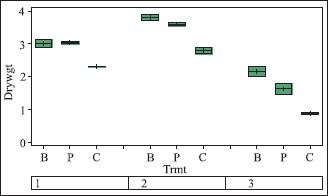
Our objective was to compare some plant growth promoting rhizobacteria (PGPR) properties of Bacillus subtilis and Pseudomonas aeruginosa as representatives of their two genera. Solanum lycopersicum L. (tomato), Abelmoschus esculentus (okra), and Amaranthus sp. (African spinach) were inoculated with the bacterial cultures. At 60 days after planting, dry biomass for plants treated with B. subtilis and P. aeruginosa increased 31% for tomato, 36% and 29% for okra, and 83% and 40% for African spinach respectively over the non-bacterized control. Considering all the parameters tested, there were similarities but no significant difference at P < 0.05 between the overall performances of the two organisms.
Keywords: Bacillus subtilis; PGPR; Pseudomonas aeruginosa; growth promotion.
Figures

References
-
- Adesemoye A.O., Ugoji E.O. Arch. Phytopathol. Plant Protect. Online PrEview. 2006. Evaluating Pseudomonas aeruginosa as plant growth-promoting rhizobacteria (PGPR) in West Africa; pp. 1–13. DOI: 10.1080/03235400601014791.
-
- Anon . Bergey’s manual of determinative bacteriology. In: Holt J.G., Krieg N.R., Sneath P.H.A., Staley J.T., Williams S.T., editors. Baltimore, USA: Williams and Wilkins; 1994.
-
- Bai Y., D’Aoust F., Smith D.L., Driscoll B.T. Isolation of plant-growth-promoting Bacillus strains from soybean root nodules. Can. J. Microbiol. 2002;48:230–238. - PubMed
-
- Bullied W.J., Buss T.J., Vessey J.K. Bacillus cereus UW85 inoculation effects on growth, nodulation and N accumulation in grain legumes: Field studies. Can. J. Plant Sci. 2002;82:291–298.
-
- De Freitas J.R., Germida J.J. Plant growth promoting rhizobacteria for winter wheat. Can. J. Microbiol. 1990;36:265–272.
LinkOut - more resources
Full Text Sources