Review
. 2013 Dec;22(12):1549-68.
doi: 10.1517/13543784.2013.836488. Epub 2013 Sep 14.

Pharmacotherapeutics for substance-use disorders: a focus on dopaminergic medications

Affiliations
Review

Pharmacotherapeutics for substance-use disorders: a focus on dopaminergic medications

Christopher D Verrico et al. Expert Opin Investig Drugs. 2013 Dec.

Erratum in

  • Expert Opin Investig Drugs. 2014 Jun;23(6):885. De La Garza, Richard [corrected to De La Garza, Richard 2nd]

Abstract

Introduction: Illicit substance-use is a substantial public health concern, contributing over $150 billion in costs annually to Americans. A complex disease, a substance-use disorder affects neural circuits involved in reinforcement, motivation, learning and memory, and inhibitory control.

Areas covered: The modulatory influence of dopamine in mesocorticolimbic circuits contributes to encoding the primary reinforcing effects of substances and numerous studies suggest that aberrant signaling within these circuits contributes to the development of a substance-use disorder in some individuals. Decades of research focused on the clinical development of medications that directly target dopamine receptors has led to recent studies of agonist-like dopaminergic treatments for stimulant-use disorders and, more recently, cannabis-use disorder. Human studies evaluating the efficacy of dopaminergic agonist-like medications to reduce reinforcing effects and substance-use provide some insight into the design of future pharmacotherapy trials. A search of PubMed using specific brain regions, medications, and/or the terms 'dopamine', 'cognition', 'reinforcement', 'cocaine', 'methamphetamine', 'amphetamine', 'cannabis', 'treatment/pharmacotherapy', 'addiction/abuse/dependence' identified articles relevant to this review.

Expert opinion: Conceptualization of substance-use disorders and their treatment continues to evolve. Current efforts increasingly focus on a strategy fostering combination pharmacotherapies that target multiple neurotransmitter systems.


Figures
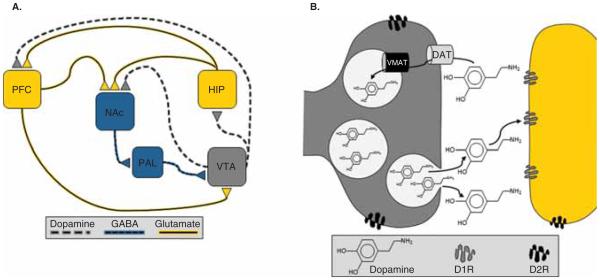
Figure 1
Figure 1
A. Mesocorticolimbic Dopamine System. Simplified diagram of dopaminergic projections from the ventral tegmental area (VTA) to the nucleus accumbens (NAc), hippocampus (HIP), and prefrontal cortex (PFC) that regulate the flow of novelty- and reinforcement-related properties of stimuli. Dopamine (DA) neurons at baseline are either in an inactive state, which is mediated by the inhibitory inputs from the ventral pallidum (PAL) to the VTA, or in an active state characterized by spontaneous or ‘tonic’ firing of action potentials. Tonic firing is thought to mediate a slow and spatially distributed signal that supplies basal levels of extrasynaptic endogenous dopamine. Spontaneously active neurons can be induced to fire in a phasic pattern, which mediates a fast and spatially restricted signal that selectively affects intrasynaptic DA receptors. B. Dopamine release, reuptake, & receptors. Once released, tonic or extrasynaptic DA diffuses away from the synaptic cleft and signals primarily via activation of D2-like receptors (D2R), while phasic or intrasynaptic DA is subject to reuptake by the DA transporter (DAT) and therefore signals primarily via activation of D1-like receptors (D1R).
Figure 2
Figure 2
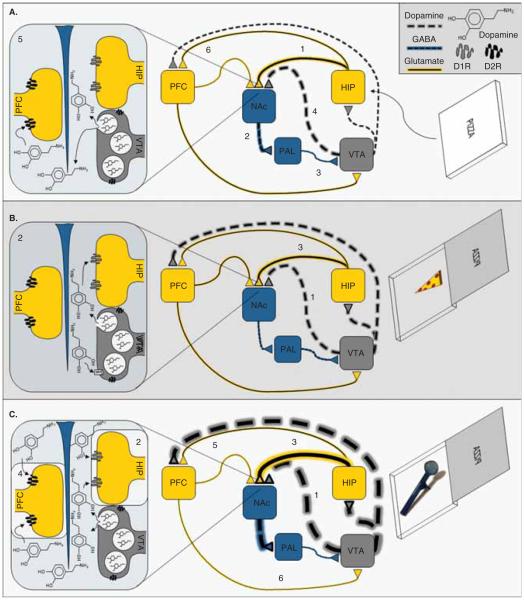
A. Novel Salient StimuliInduced Activation of the VTA. A novel salient stimulus that could potentially lead to positive reinforcement (e.g., a potential food reward) enters the dopaminergic mesocorticolimbic network at the HIP. This causes activation of the excitatory glutamatergic projections from the HIP (1) to the NAc. The subsequent (2) stimulation of inhibitory GABAergic projection neurons from the NAc to the ventral pallidum (PAL) causes (3) disinhibition of the VTA, which (4) increases the number of spontaneously active DA neurons and hence, (5) tonic levels of DA in the NAc. The increased levels of extrasynaptic DA stimulates postsynaptic D2R on PFC inputs, which (6) selectively attenuates the afferent drive of the PFC. In addition, because only those DA neurons that firing in a tonic manner can transition to a phasic firing mode, the above described phenomenon also primes the responsiveness of the dopaminergic system by allowing more neurons to respond phasically based on the appetitive/aversive properties of the stimulus. Therefore, B. Natural Stimulus-Induced Positive Reinforcement if the novel stimulus is associated with positive reinforcement, (1) burst firing and phasic DA release increases. Increased phasic DA in the NAc (2) activates postsynaptic D1R on HIP terminals, which (3) facilitates HIP inputs to the NAc. In contrast, and relative to naturally reinforcing stimuli, addictive substances more strongly and persistently activate the mesocorticolimbic DA system. Therefore, C. Drug-Induced Positive Reinforcement if the novel stimulus is associated with substance reinforcement (e.g., crack cocaine) (1) burst firing and phasic DA release increases in a more robust and prolonged manner. The supraphysiological levels of elevated synaptic DA levels associated with acute substance use would be expected to increase both tonic and phasic DA levels. Increased intrasynaptic DA levels in the NAc would (2) stimulate postsynaptic D1R on HIP terminals to (3) facilitate inputs from the HIP while increased extrasynaptic DA levels would (4) stimulate postsynaptic D2R on PFC terminals to (5) attenuate inputs from the PFC. The net effect would strongly favor HIP inputs and attenuate PFC inputs.
Figure 3
Figure 3
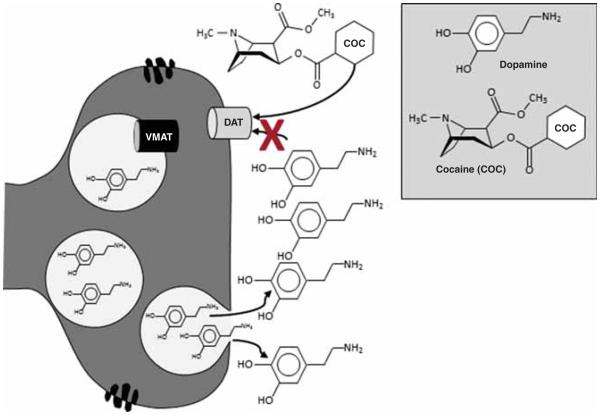
Cocaine-Induced Dopamine Release - Cocaine (COC) increases DA levels by affecting DA reuptake from the synaptic cleft, which prolongs the stimulation of DA receptors. Cocaine inhibits the reuptake of DA, and thus acutely increases synaptic DA levels, by binding to DAT located on presynaptic membranes of DA neurons.
Figure 4
Figure 4
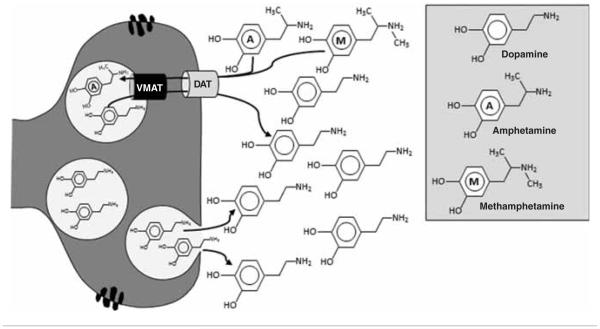
METH/AMPH-Induced Dopamine Release - METH and AMPH are substrates for both the DAT and the VMAT. Both METH and AMPH reverse the transport of DA across the DAT and VMAT and thereby increase cytosolic and synaptic DA levels independent of tonic or phasic release. In contrast to cocaine and amphetamines, cannabis indirectly increases DA release.
Figure 5
Figure 5
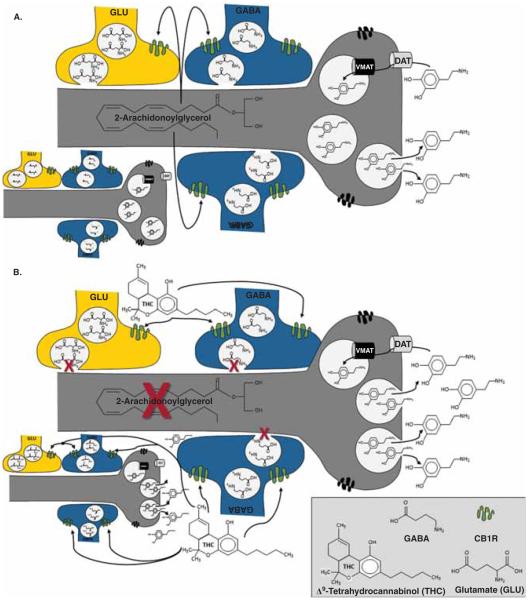
In contrast to cocaine and amphetamines, cannabis indirectly increases DA release. A. Endocannabinoid Regulation of Dopamine Release Under normal physiological conditions, activation of DA neurons promotes the transient synthesis and release of endocannabinoids (e.g., 2-arachidonoylglycerol) that act in a retrograde and spatially restricted manner to activate CB1Rs in GABAergic and glutamatergic terminals, which reduces the subsequent release of GABA and glutamate to facilitate or inhibit the activity of DA neurons, respectively. For example, activation of CB1Rs by 2-AG in the VTA can suppress depolarization-induced excitation of glutamatergic inputs from the PFC and/or depolarization-induced inhibition (DSI) of GABAergic neurons, which either project from the NAc or are intrinsic VTA interneurons, to modulate bursting activity. B. THC-Induced dopamine release. In contrast to normal physiological activation, THC-induced activation of CB1Rs is neither spatially nor temporally restricted. Rather, THC affects all CB1R-positive terminals in a prolonged manner. CB1Rs are predominately expressed on GABAergic neurons; hence, acute administration of cannabis increases DA neuron activity and augments dopaminergic transmission. In addition to presynaptic co-localization, some NAc neurons also co-express CB1Rs and D2Rs; thus, THC may also modulate DA transmission through intracellular heterodimerization.

References

    1. American Psychiatric Association . Diagnostic and statistical manual of mental disorders. 5th American Psychiatric Association; Washington, DC: 2013.
    1. Substance Abuse and Mental Health Services Administration . Results from the 2011 National Survey on drug use and health: summary of national findings. Substance Abuse and Mental Health Services Administration; Rockville, MD: 2012. NSDUH Series H-44, HHS Publication No. (SMA) 12-4713.
    1. Substance Abuse and Mental Health Services Administration . Substance abuse and mental health services administration, center for behavioral health statistics and quality. treatment episode data set (TEDS): 2000-2010. National Admissions to Substance Abuse Treatment Services; Rockville, MD: 2012. DASIS Series S-61, HHS Publication No. (SMA) 12-4701.
    1. Substance Abuse and Mental Health Services Administration, Center for Behavioral Health Statistics and Quality . The DAWN Report: Highlights of the 2010 Drug Abuse Warning Network (DAWN) Findings on Drug-Related Emergency Department Visits; Rockville, MD: (July 2, 2012) - PubMed
    1. Miller T, Hendrie D. Substance abuse prevention dollars and cents: a cost-benefit analysis. Center for Substance Abuse Prevention, Substance Abuse and Mental Health Services Administration; Rockville, MD: 2008. DHHS Pub. No. (SMA) 07-4298.

MeSH terms