


Anal carcinoma: impact of TN category of disease on survival, disease relapse, and colostomy failure in US Gastrointestinal Intergroup RTOG 98-11 phase 3 trial
- PMID: 24035327
- PMCID: PMC3938865
- DOI: 10.1016/j.ijrobp.2013.07.035
Anal carcinoma: impact of TN category of disease on survival, disease relapse, and colostomy failure in US Gastrointestinal Intergroup RTOG 98-11 phase 3 trial
Abstract
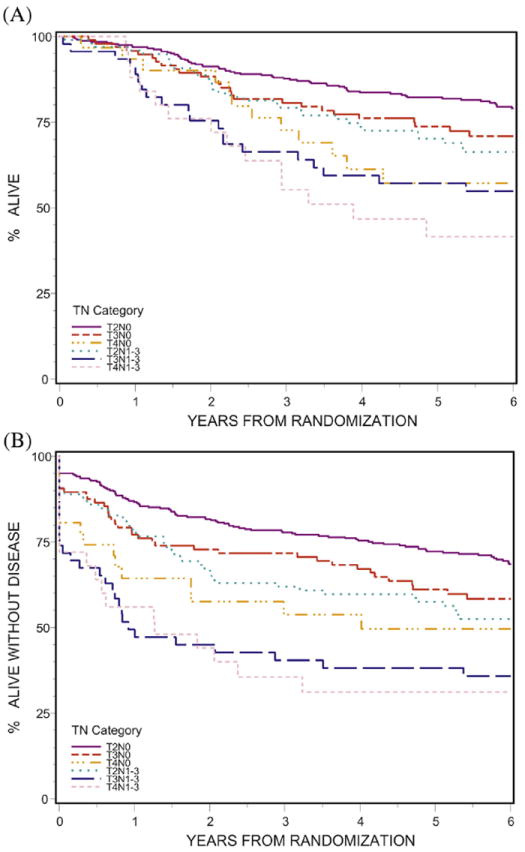
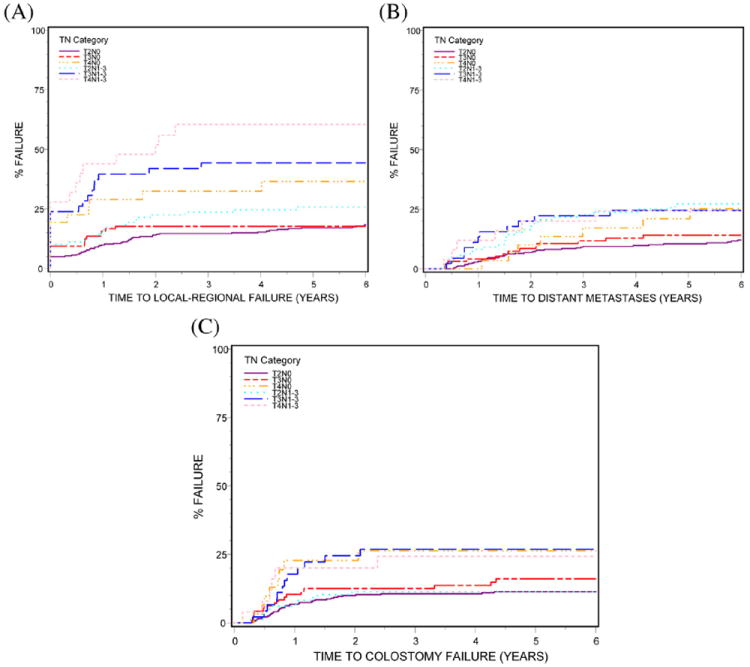
Purpose: The long-term update of US GI Intergroup RTOG 98-11 anal cancer trial found that concurrent chemoradiation (CCRT) with fluorouracil (5-FU) plus mitomycin had a significant impact on disease-free survival (DFS) and overall survival (OS) compared with induction plus concurrent 5-FU plus cisplatin. The intent of the current analysis was to determine the impact of tumor node (TN) category of disease on survival (DFS and OS), colostomy failure (CF), and relapse (local-regional failure [LRF] and distant metastases [DM]) in this patient group.
Methods and materials: DFS and OS were estimated univariately by using the Kaplan-Meier method, and 6 TN categories were compared by the log-rank test (T2N0, T3N0, T4N0, T2N1-3, T3N1-3, and T4N1-3). Time to relapse and colostomy were estimated by the cumulative incidence method, and TN categories were compared using Gray's test.
Results: Of 682 patients, 620 were analyzable for outcomes by TN category. All endpoints showed statistically significant differences among the TN categories of disease (OS, P<.0001; DFS, P<.0001; LRF, P<.0001; DM, P=.0011; CF, P=.01). Patients with the poorest OS, DFS, and LRF outcomes were those with T3-4N-positive (+) disease. CF was lowest for T2N0 and T2N+ (11%, 11%, respectively) and worst for the T4N0, T3N+, and T4N+ categories (26%, 27%, 24%, respectively).
Conclusions: TN category of disease has a statistically significant impact on OS, DFS, LRF, DM, and CF in patients treated with CCRT and provides excellent prognostic information for outcomes in patients with anal carcinoma. Significant challenges remain for patients with T4N0 and T3-4N+ categories of disease with regard to survival, relapse, and CF and lesser challenges for T2-3N0/T2N+ categories.
Copyright © 2013 Elsevier Inc. All rights reserved.
Conflict of interest statement
Conflict of interest: none.
Figures
References
-
- Nigro ND, Seydel HG, Considine B, et al. Combined preoperative radiation and chemotherapy for squamous cell carcinoma of the anal canal. Cancer. 1983;51:1826. - PubMed
-
- Sischy B, Doggett RL, Krall JM, et al. Definitive irradiation and chemotherapy for radiosensitization in management of anal carcinoma: interim report on Radiation Therapy Oncology Group study 8314. J Natl Cancer Inst. 1989;81:850–856. - PubMed
-
- Cummings BJ, Keane TH, O’Sullivan MB, et al. Epidermoid anal cancer: treatment by radiation alone or by radiation and 5-fluorouracil with and without mitomycin C. Int J Radiat Oncol Biol Phys. 1991;21:1115–1125. - PubMed
-
- Flam M, John M, Pajak TF, et al. Role of mitomycin in combination with fluorouracil and radiotherapy, and salvage chemoradiation in the definitive nonsurgical treatment of epidermoid carcinoma of the anal canal: results of a phase III randomized intergroup study. J Clin Oncol. 1996;14:2527–2539. - PubMed
-
- Arnott SJ, Cunningham D, Gallagher J, et al. Epidermoid anal cancer: results from the UKCCCR randomized trial for radiotherapy alone versus radiotherapy, 5-fluorouracil, and mitomycin. Lancet. 1996;348:1049–1054. - PubMed
Publication types
MeSH terms
Substances
Grants and funding
LinkOut - more resources
Full Text Sources
Other Literature Sources
Medical
