. 2015 Feb;25(2):472-81.
doi: 10.1093/cercor/bht245. Epub 2013 Sep 12.

Object-in-place associative recognition memory depends on glutamate receptor neurotransmission within two defined hippocampal-cortical circuits: a critical role for AMPA and NMDA receptors in the hippocampus, perirhinal, and prefrontal cortices

Affiliations

Object-in-place associative recognition memory depends on glutamate receptor neurotransmission within two defined hippocampal-cortical circuits: a critical role for AMPA and NMDA receptors in the hippocampus, perirhinal, and prefrontal cortices

Gareth Robert Issac Barker et al. Cereb Cortex. 2015 Feb.

Abstract

Object-in-place associative recognition memory depends on an interaction between the hippocampus (HPC), perirhinal (PRH), and medial prefrontal (mPFC) cortices, yet the contribution of glutamate receptor neurotransmission to these interactions is unknown. NMDA receptors (NMDAR) in the HPC were critical for encoding of object-in-place memory but not for single-item object recognition. Next, a disconnection procedure was used to examine the importance of "concurrent" glutamate neurotransmission in the HPC-mPFC and HPC-PRH. Contralateral unilateral infusions of NBQX (AMPAR antagonist), into the HPC-mPFC, or HPC-PRH, either before acquisition or test, impaired object-in-place performance. Thus, both circuits are necessary for encoding and retrieval. Crossed unilateral AP5 (NMDAR antagonist) infusions into the HPC-mPFC or HPC-PRH impaired encoding, but not retrieval. Specifically crossed HPC-mPFC infusions impaired both short-term (5 min) and longer term (1 h) memory while HPC-PRH infusions impaired longer term memory only. This delay-dependent effect of AP5 in the HPC-PRH on object-in-place memory, accords with its effects in the PRH, on single item object recognition memory, thereby suggesting that a single PRH synaptic plasticity mechanism underpins different recognition memory processes. Further, blocking excitatory neurotransmission in any pair of structures within the networks impaired "both" encoding and retrieval, thus object-in-place memory clearly requires network interdependency across multiple structures.

Keywords: brain circuits; encoding; glutamate receptors; plasticity; retrieval.


Figures

Figure 1.
Figure 1.
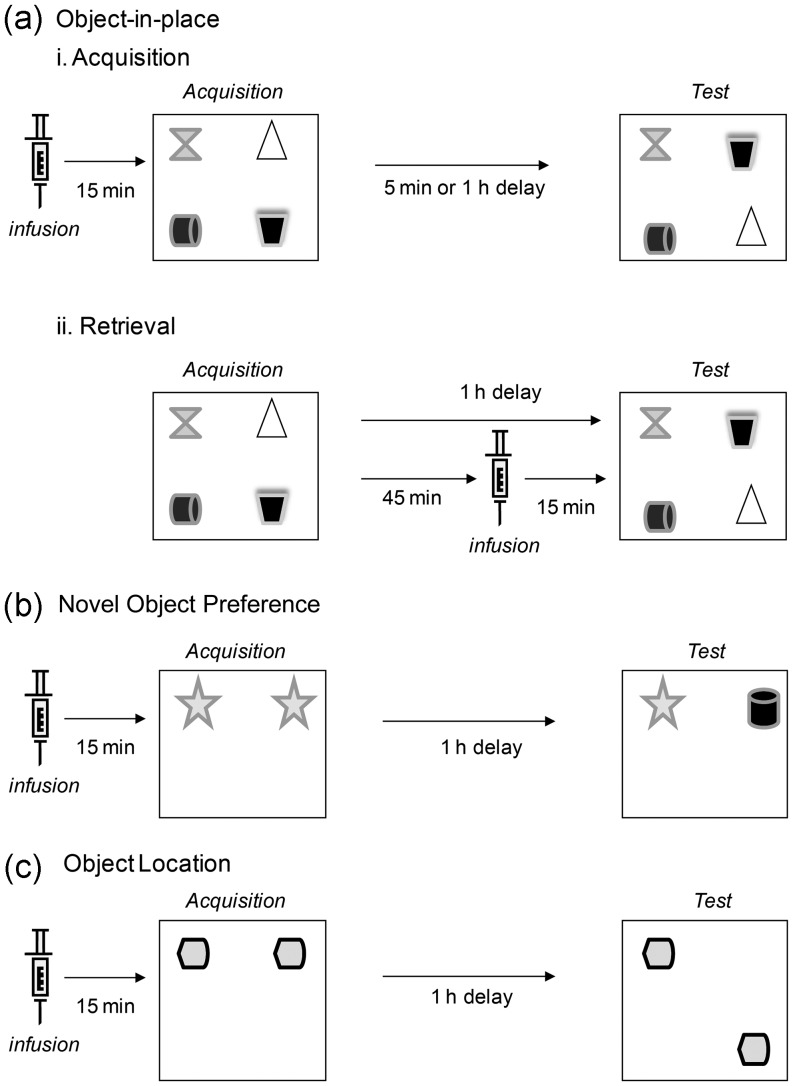
Diagram of the 3 object recognition memory tasks and the delays used. (a) object-in-place task (i) to assess drug effects on encoding, the infusion was give 15 min before the start of the acquisition phase, and (ii) to assess drug effects on retrieval, the infusion was given 15 min before the test phase; (b) novel object preference task; (c) object location task,
Figure 2.
Figure 2.
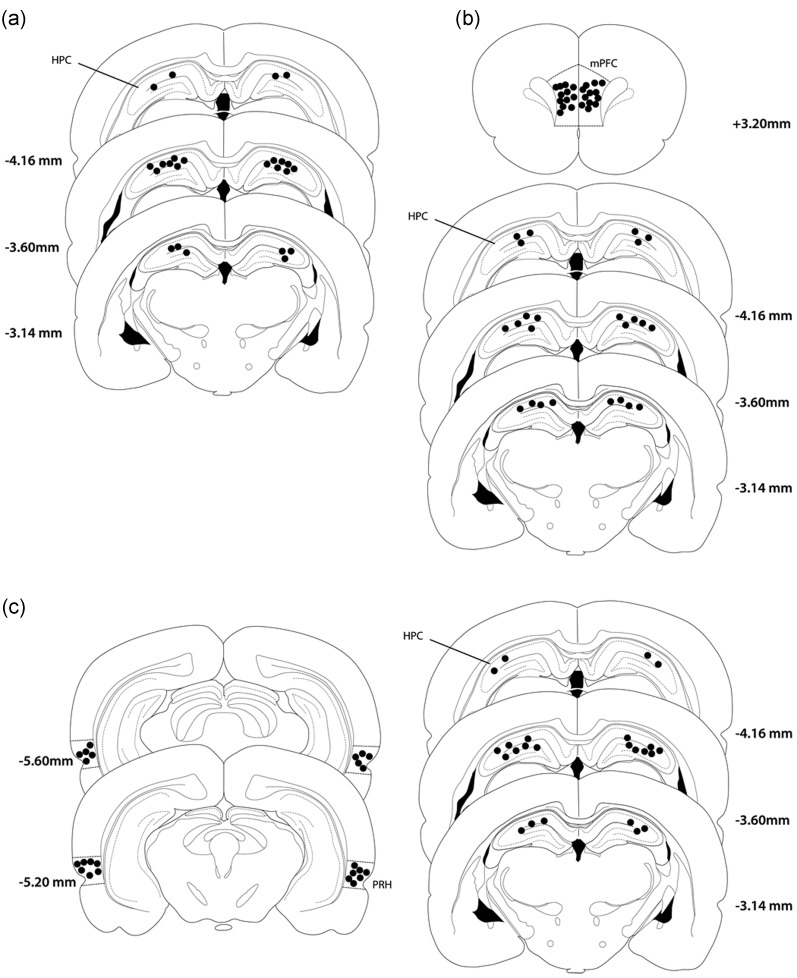
Diagrammatic representation of the individual infusion sites in each animal (a) Bilateral HPC group; (b)HPC-mPFC group; (c) HPC-PRH group. All infusion sites were within the HPC, mPFC, or PRH.
Figure 3.
Figure 3.
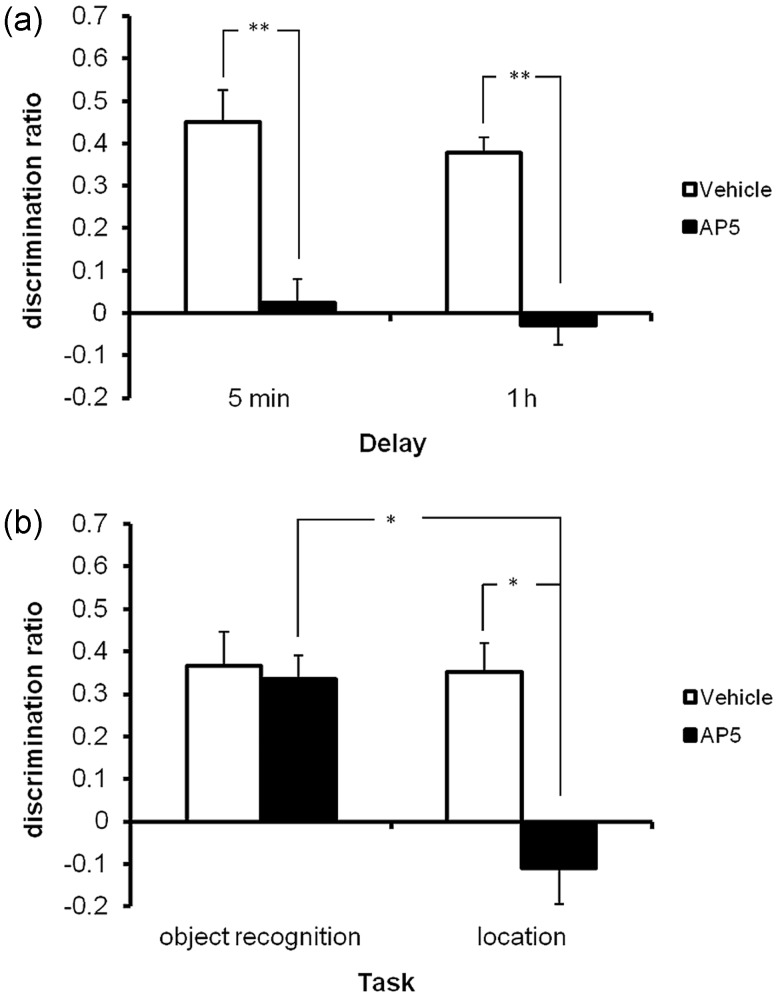
Experiment 1 Bilateral infusions of AP5 into the hippocampus selectively impaired recognition memory depending on the task. Illustrated for each group is the mean (+SEM) discrimination ratio. *P < 0.05, **P < 0.01 difference between groups. (a) AP5 infusions into the HPC before the acquisition phase significantly impaired object-in-place performance after a 5-min or 1-h delay. Analyses also revealed that the vehicle-treated animals discriminated between the rearranged and nonrearranged objects in all conditions (5 min t(6) = 5.51, P < 0.01; 1 h t(6) = 9.16, P < 0.001) while the AP5 animals did not (5 min t(6) = 0.42, P > 0.1; 1 h t(6) = 0.56, P > 0.1). (b) AP5 infusions into the HPC before the acquisition phase had no effect on novel object recognition, task but significantly impaired object location memory.
Figure 4.
Figure 4.
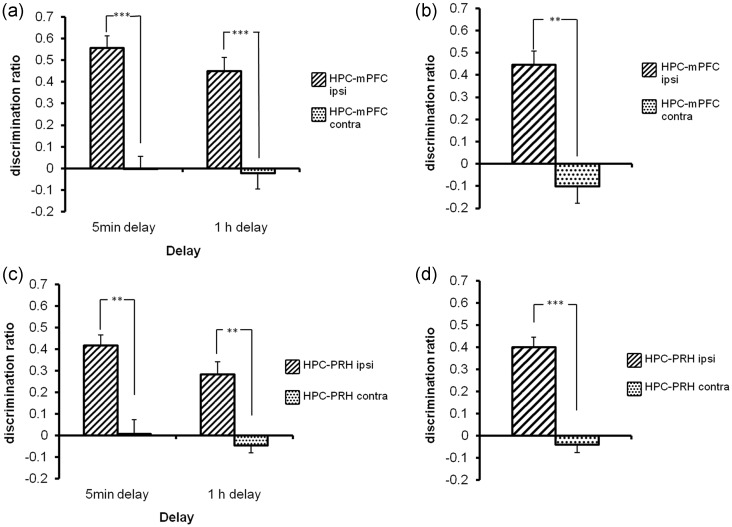
Experiments 2 and 3 NBQX infusion into the HPC-mPFC or HPC-PRH circuits impaired both acquisition and retrieval of object-in-place performance. Illustrated for each group is the mean (+SEM) discrimination ratio. **P < 0.01, ***P < 0.001 difference between groups. (a) Encoding unilateral infusion of NBQX into the HPC-mPFC in opposite hemispheres (HPC-mPFC contra) prior to the acquisition phase, impaired object-in-place performance after a 5-min or a 1-h delay while infusions into the same hemisphere (HPC-mPFC ipsi) had no effect. At both delays, the HPC-mPFC ipsi group showed significant discrimination (5 min delay t(9) = 9.29, P < 0.001; 1 h delay t(8) = 6.68, P < 0.001) while the HPC-mPFC contra group did not (5 min t(9) = −0.01, P > 0.1; 1 h t(8) = −0.28, P > 0.1). (b) Retrieval unilateral infusion of NBQX into the HPC-mPFC in opposite hemispheres (HPC-mPFC contra), but not into the same hemisphere (HPC-mPFC ipsi), prior to the test phase, impaired object-in-place performance. The HPC-mPFC ipsi group significantly discriminated between the rearranged and nonrearranged objects in all conditions (t(9) = 6.79, P < 0.001) while the HPC-mPFC contra animals did not (t(9) = −1.24, P > 0.1). (c) Encoding unilateral infusion of NBQX into the HPC-PRH in opposite hemispheres (HPC-PRH contra) prior to the acquisition phase, impaired object-in-place performance after a 5-min or 1-h delay while infusions into the same hemisphere (HPC-PRH ipsi) had no effect. The HPC-PRH ipsi group showed significant discrimination at both delays (5 min: t(8) = 7.92, P < 0.001; 1 h: t(8) = 3.82, P < 0.01) while the HPC-PRH contra group did not (5 min: t(8) = −0.08, P > 0.1; 1 h: t(8) = −1.12, P > 0.1). (d) Retrieval unilateral infusion of NBQX into the HPC-PRH in opposite hemispheres (HPC-PRH contra) prior to the test phase, but not into the same hemisphere (HPC-PRH ipsi), impaired object-in-place performance. The HPC-PRH ipsi group significantly discriminated between the rearranged and nonrearranged objects (t(8) = 7.20, P < 0.001); while the HPC-PRH contra did not (t(8) = −0.86, P > 0.1).
Figure 5.
Figure 5.
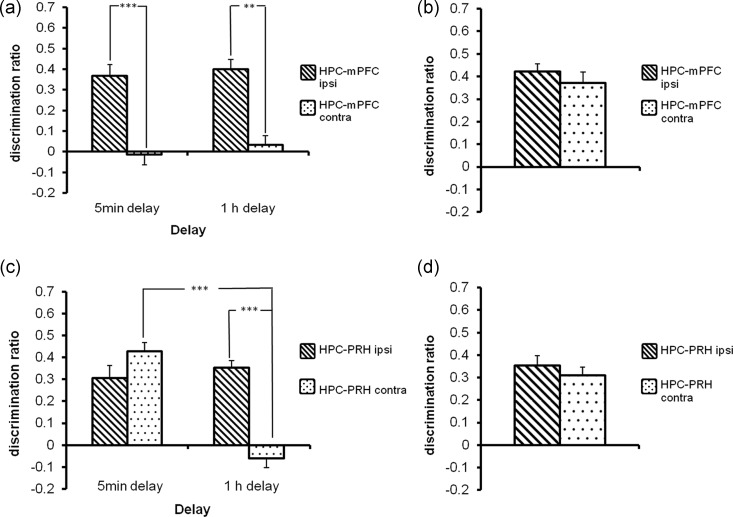
Experiments 4 and 5 AP5 infusion into the HPC-mPFC or HPC-PRH circuits impaired acquisition of the object-in-place task in a delay-dependent manner, but was without effect on retrieval. Illustrated for each group is the mean (+SEM) discrimination ratio. **P < 0.01, ***P < 0.001 difference between groups. (a) Encoding unilateral infusion of AP5 into the HPC-mPFC in opposite hemispheres (HPC-mPFC contra) prior to acquisition impaired object-in-place performance following a 5-min or 1-h delay. The ipsi group significantly discriminated between the rearranged and nonrearranged objects (5 min delay t(11) = 5.60, P < 0.001; 1 h delay t(11) = 6.65, P < 0.001); while the contra group did not (5 min delay t(11) = −0.01, P > 0.1; 1 h delay t(11) = 0.74, P > 0.1). (b) Retrieval unilateral infusion of AP5 into the HPC-mPFC in either the same or opposite hemispheres prior to test had no effect on retrieval of object-in-place memory in either group. Both groups significantly discriminated between the rearranged and nonrearranged objects (ipsi t(11) = 12.03; contra t(11) = 7.06, P < 0.001). (c) Encoding unilateral infusion of AP5 into the HPC-PRH in opposite hemispheres (HPC-PRH contra) prior to the acquisition phase, impaired object-in-place performance following a 1-h delay, but not a 5-min delay. The HPC-PRH ipsi group significantly discriminated between the rearranged and nonrearranged objects at both delays (5 min t(11) = 5.07, P < 0.001; 1 h t(10) = 11.05, P < 0.001) while the HPC-mPFC contra group significantly discriminated at the 5-min delay only (5 min t(11) = 10.30, P < 0.001, 1-h delay (t(10) = −1.32, P > 0.1). (d) Retrieval unilateral infusion of AP5 into the HPC-PRH in either the same or opposite hemispheres prior to test had no effect on retrieval of object-in-place memory in either group. Both groups significantly discriminated between the rearranged and nonrearranged objects (HPC-PRH ipsi (t(8) = 7.60, P < 0.001); HPC-PRH contra (t(8) = 7.70, P < 0.001)).

References

    1. Agster KL, Burwell RD. Cortical efferents of perirhinal, postrhinal, and entorhinal cortices of the rat. Hippocampus. 2009;19:1159–1186. - PMC - PubMed
    1. Akirav I, Maroun M. Ventromedial prefrontal cortex is obligatory for consolidation and reconsolidation of object recognition memory. Cereb Cortex. 2006;16:1759–1765. - PubMed
    1. Attwell PJ, Rahman S, Yeo CH. Acquisition of eyeblink conditioning is critically dependent on normal function in cerebellar cortical lobule HVI. J Neurosci. 2001;27:5715–5722. - PMC - PubMed
    1. Bachevalier J, Nemanic S. Memory for spatial location and object-place associations are differently processed by the hippocampal formation, parahippocampal areas TH/TF and perirhinal cortex. Hippocampus. 2008;18:64–80. - PubMed
    1. Baker KM, Kim JJ. Effects of stress and hippocampal NMDA receptor antagonism on recognition memory in rats. Learn Mem. 2002;9:58–65. - PMC - PubMed

Publication types

MeSH terms

Substances