


Strategies to minimize antibiotic resistance
- PMID: 24036486
- PMCID: PMC3799537
- DOI: 10.3390/ijerph10094274
Strategies to minimize antibiotic resistance
Abstract
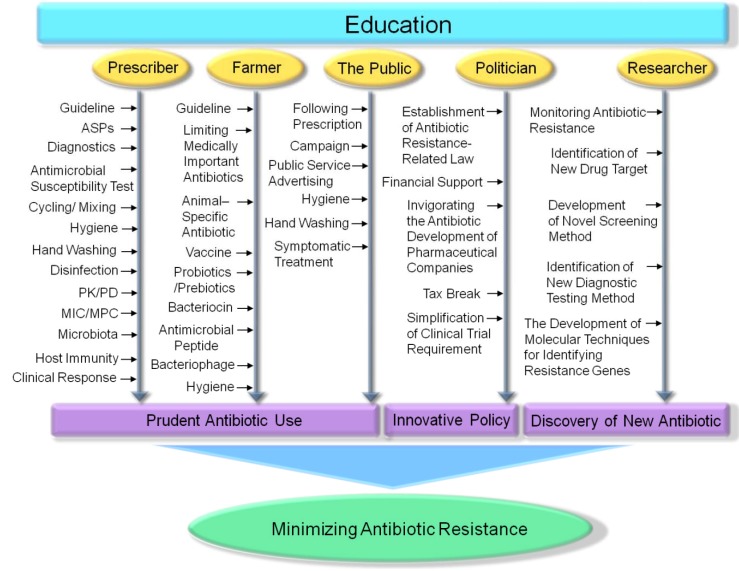
Antibiotic resistance can be reduced by using antibiotics prudently based on guidelines of antimicrobial stewardship programs (ASPs) and various data such as pharmacokinetic (PK) and pharmacodynamic (PD) properties of antibiotics, diagnostic testing, antimicrobial susceptibility testing (AST), clinical response, and effects on the microbiota, as well as by new antibiotic developments. The controlled use of antibiotics in food animals is another cornerstone among efforts to reduce antibiotic resistance. All major resistance-control strategies recommend education for patients, children (e.g., through schools and day care), the public, and relevant healthcare professionals (e.g., primary-care physicians, pharmacists, and medical students) regarding unique features of bacterial infections and antibiotics, prudent antibiotic prescribing as a positive construct, and personal hygiene (e.g., handwashing). The problem of antibiotic resistance can be minimized only by concerted efforts of all members of society for ensuring the continued efficiency of antibiotics.
Figures

References
-
- Rossolini G.M., Mantengoli E., Docquier J.D., Musmanno R.A., Coratza G. Epidemiology of infections caused by multiresistant Gram-negatives: ESBLs, MBLs, panresistant strains. New Microbiol. 2007;30:332–339. - PubMed
-
- Spellberg B., Guidos R., Gilbert D., Bradley J., Boucher H.W., Scheld W.M., Bartlett J.G., Edwards J., Jr., Infectious Diseases Society of America The epidemic of antibiotic-resistant infections: A call to action for the medical community from the infectious diseases society of America. Clin. Infect. Dis. 2008;46:155–164. doi: 10.1086/524891. - DOI - PubMed
-
- Cantas L., Shah S.Q., Cavaco L.M., Manaia C.M., Walsh F., Popowska M., Garelick H., Burgmann H., Sorum H. A brief multi-disciplinary review on antimicrobial resistance in medicine and its linkage to the global environmental microbiota. Front. Microbiol. 2013;4 doi: 10.3389/fmicb.2013.00096. - DOI - PMC - PubMed
Publication types
MeSH terms
Substances
LinkOut - more resources
Full Text Sources
Other Literature Sources
Medical
