. 2013 Oct 15;12(20):3329-35.
doi: 10.4161/cc.26320. Epub 2013 Sep 12.

Targeting an Achilles' heel of cancer with a WRN helicase inhibitor

Affiliations

Targeting an Achilles' heel of cancer with a WRN helicase inhibitor

Monika Aggarwal et al. Cell Cycle. .

Abstract

Our recently published work suggests that DNA helicases such as the Werner syndrome helicase (WRN) represent a novel class of proteins to target for anticancer therapy. Specifically, pharmacological inhibition of WRN helicase activity in human cells defective in the Fanconi anemia (FA) pathway of interstrand cross-link (ICL) repair are sensitized to the DNA cross-linking agent and chemotherapy drug mitomycin C (MMC) by the WRN helicase inhibitor NSC 617145. (1) The mechanistic basis for the synergistic interaction between NSC 617145 and MMC is discussed in this paper and extrapolated to potential implications for genetic or chemically induced synthetic lethality provoked by cellular exposure to the WRN helicase inhibitor under the context of relevant DNA repair deficiencies associated with cancers or induced by small-molecule inhibitors. Experimental data are presented showing that small-molecule inhibition of WRN helicase elevates sensitivity to MMC-induced stress in human cells that are deficient in both FANCD2 and DNA protein kinase catalytic subunit (DNA-PKcs). These findings suggest a model in which drug-mediated inhibition of WRN helicase activity exacerbates the deleterious effects of MMC-induced DNA damage when both the FA and NHEJ pathways are defective. We conclude with a perspective for the FA pathway and synthetic lethality and implications for DNA repair helicase inhibitors that can be developed for anticancer strategies.

Keywords: DNA repair; Fanconi anemia; Werner syndrome; anticancer therapy; helicase; small molecule; synthetic lethality.


Figures
None
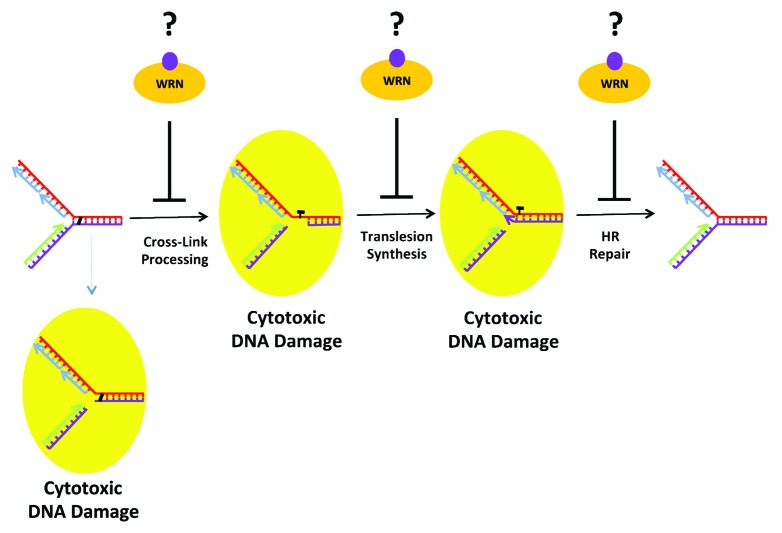
Figure 1. Potential sites of action where the WRN helicase inhibitor interferes with DNA cross-link repair during S phase, resulting in the accumulation of double-strand breaks and chromosomal instability. See text for details.
None
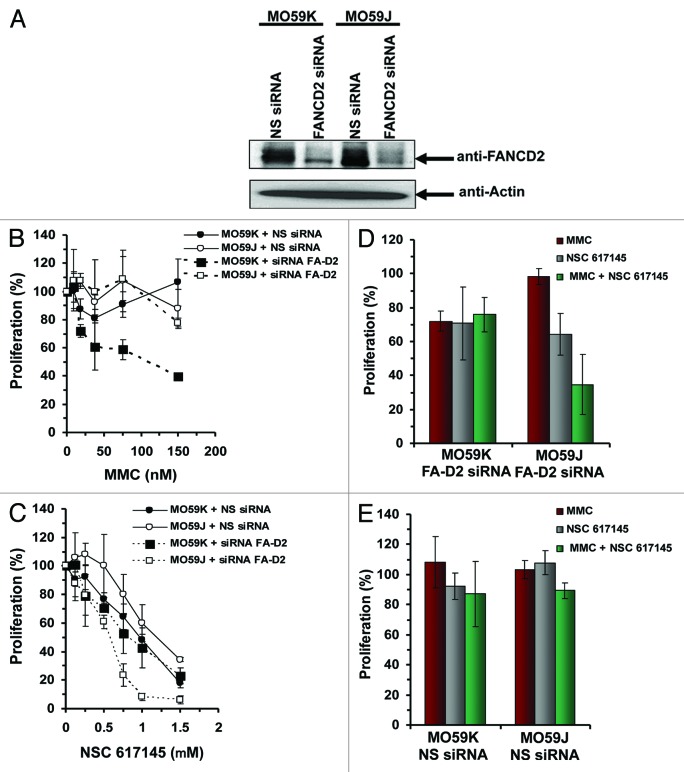
Figure 2. Effect of NSC 617145 exposure on FA-D2 mutant and NHEJ-deficient cells upon co-treatment with MMC. (A) Western blot analysis of FANCD2 knockdown in DNA-PKcs-proficient and -deficient cell lines. DNA-PKcs-proficient (MO59K) and DNA-PKcs-deficient (MO59J) cells were transfected with siRNA targeted specifically against FANCD2 (FANCD2 siRNA) or non-specific siRNA (NS siRNA) for 4 h. Cell lysates were then prepared and analyzed by immunoblotting with anti-FANCD2 antibody. As a control blot was reprobed with anti-actin antibody. The arrow indicates the position of the FANCD2 and actin bands. (B and C) DNA-PKcs-proficient (MO59K) and -deficient (MO59J) cells lines were transfected with FANCD2-specific siRNA (siRNA FA-D2) or non-specific siRNA (NS siRNA). Sensitivity of these cell lines to MMC (B) or NSC 617145 (C) was determined with WST-1 reagent. Percent proliferation was calculated.(D and E) DNA-PKcs-proficient (MO59K) and -deficient (MO59J) cells were transfected with FANCD2-specific siRNA (siRNA FA-D2) (D) or NS siRNA (E). Cells were treated with MMC (19 nM), NSC 617145 (0.5 μM), or both for 3 d. Cell proliferation was determined with WST-1 reagent. Cell proliferation data are mean of at least 2 independent experiments. Error bars represents standard deviations.
None
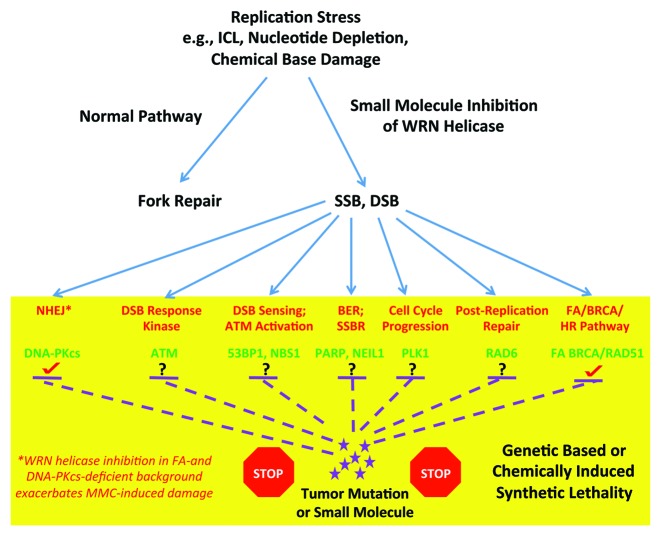
Figure 3. Potential pathways whereby pharmacological inhibition of WRN helicase activity may impose genetic-based or chemically induced synthetic lethality. See text for details.

References

    1. Aggarwal M, Banerjee T, Sommers JA, Iannascoli C, Pichierri P, Shoemaker RH, Brosh RM., Jr. Werner syndrome helicase has a critical role in DNA damage responses in the absence of a functional fanconi anemia pathway. Cancer Res. 2013;73:5497–507. doi: 10.1158/0008-5472.CAN-12-2975. - DOI - PMC - PubMed
    1. Bryant HE, Schultz N, Thomas HD, Parker KM, Flower D, Lopez E, Kyle S, Meuth M, Curtin NJ, Helleday T. Specific killing of BRCA2-deficient tumours with inhibitors of poly(ADP-ribose) polymerase. Nature. 2005;434:913–7. doi: 10.1038/nature03443. - DOI - PubMed
    1. Farmer H, McCabe N, Lord CJ, Tutt AN, Johnson DA, Richardson TB, Santarosa M, Dillon KJ, Hickson I, Knights C, et al. Targeting the DNA repair defect in BRCA mutant cells as a therapeutic strategy. Nature. 2005;434:917–21. doi: 10.1038/nature03445. - DOI - PubMed
    1. Dedes KJ, Wilkerson PM, Wetterskog D, Weigelt B, Ashworth A, Reis-Filho JS. Synthetic lethality of PARP inhibition in cancers lacking BRCA1 and BRCA2 mutations. Cell Cycle. 2011;10:1192–9. doi: 10.4161/cc.10.8.15273. - DOI - PMC - PubMed
    1. Curtin NJ. DNA repair dysregulation from cancer driver to therapeutic target. Nat Rev Cancer. 2012;12:801–17. doi: 10.1038/nrc3399. - DOI - PubMed

Publication types

MeSH terms