Review
. 2013 Nov;15(11):365.
doi: 10.1007/s11883-013-0365-1.

Lipids and the endothelium: bidirectional interactions

Affiliations
Review

Lipids and the endothelium: bidirectional interactions

Ira J Goldberg et al. Curr Atheroscler Rep. 2013 Nov.

Abstract

The endothelium is often viewed solely as the barrier that prevents the penetration of circulating lipoproteins into the arterial wall. However, recent research has demonstrated that the endothelium has an important part in regulating circulating fatty acids and lipoproteins, and is in turn affected by these lipids/lipoproteins in ways that appear to have important repercussions for atherosclerosis. Thus, a number of potentially toxic lipids are produced during lipolysis of lipoproteins at the endothelial cell surface. Catabolism of triglyceride-rich lipoproteins creates free fatty acids that are readily taken up by endothelial cells, and, likely through the action of acyl-CoA synthetases, exacerbate inflammatory processes. In this article, we review how the endothelium participates in lipoprotein metabolism, how lipids alter endothelial functions, and how lipids are internalized, processed, and transported into the subendothelial space. Finally, we address the many endothelial changes that might promote atherogenesis, especially in the setting of diabetes.


Conflict of interest statement

Conflict of Interest

Ira J. Goldberg and Karin E. Bornfeldt declare that they have no conflict of interest.

Figures
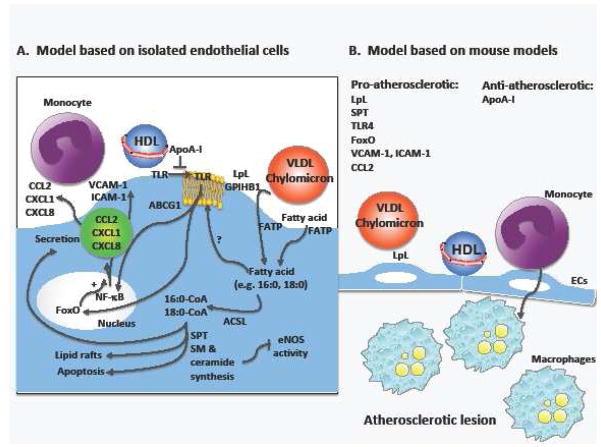
Figure 1
Figure 1. Effects of lipoprotein lipolysis and fatty acids in endothelial cells in relation to atherosclerosis
Fatty acids are liberated from triglyceride-rich lipoproteins, such as VLDL or remnants, by the action of lipoprotein lipase (LpL) tethered to the luminal endothelial surface by proteoglycans and a specific LpL binding protein, glycosyl inositol HDL binding protein 1 (GPIHBP1). Fatty acids also circulate in blood bound to albumin. The fatty acids are taken up by endothelial cells through transport proteins, including the fatty acid transport proteins (FATP) FATP3 and FATP4. Some uptake is believed to occur through diffusion through the plasma membrane and through the scavenger receptor CD36. Once fatty acids enter the cell, they are bound to intracellular fatty acid binding proteins or are converted into hydrophilic acyl-CoAs by a group of enzymes with acyl-CoA synthetase activity. All members of the long-chain acyl-CoA synthetase (ACSL) family are expressed in endothelial cells, with the exception of ACSL6. The acyl-CoAs are used by the cell for membrane phospholipid synthesis and re-acylation, ceramide synthesis, beta-oxidation, protein modification, and several other processes. An unanswered question is whether saturated fatty acids have to be converted to acyl-CoAs in order to promote TLR4 movement to lipid rafts, whereas the pro-apoptotic effects of saturated fatty acids are dependent on ceramide synthesis and acyl-CoA formation. Ceramides have also been implicated in eNOS inhibition. Saturated fatty acid-mediated activation of TLR4 results in NF-kB activation and production of pro-atherosclerotic cytokines and chemokines, as well as adhesion molecules, which increase monocyte binding and recruitment into the artery wall. Finally, ApoA-I and recombinant HDL have the ability to inhibit palmitate-induced TLR4 translocation into lipid rafts in endothelial cells. Although much of this model is based on studies on cultured endothelial cells and addition of single fatty acids to these cells (A), mouse models of atherosclerosis are starting to provide a picture of important roles of several of the enzymes and proteins involved in fatty acid handling in atherosclerosis (B).

References

    1. Sarwar N, Gao P, et al. Emerging Risk Factors Collaboration. Diabetes mellitus, fasting blood glucose concentration, and risk of vascular disease: a collaborative meta-analysis of 102 prospective studies. Lancet. 2010;375(9733):2215–22. - PMC - PubMed
    1. Cornier MA, Dabelea D, Hernandez TL, et al. The metabolic syndrome. Endocr Rev. 2008;29(7):777–822. - PMC - PubMed
    1. Renard CB, Kramer F, Johansson F, et al. Diabetes and diabetes-associated lipid abnormalities have distinct effects on initiation and progression of atherosclerotic lesions. J Clin Invest. 2004;114(5):659–68. - PMC - PubMed
    1. Vikramadithyan RK, Hu Y, Noh HL, et al. Human aldose reductase expression accelerates diabetic atherosclerosis in transgenic mice. J Clin Invest. 2005;115(9):2434–43. - PMC - PubMed
    1. Johansson F, Kramer F, Barnhart S, et al. Type 1 diabetes promotes disruption of advanced atherosclerotic lesions in LDL receptor-deficient mice. Proc Natl Acad Sci U S A. 2008;105(6):2082–7. - PMC - PubMed

Publication types

LinkOut - more resources
