


Circulating concentrations of insulin-like growth factor-I, insulin-like growth factor-binding protein-3, genetic polymorphisms and mammographic density in premenopausal Mexican women: results from the ESMaestras cohort
- PMID: 24037648
- PMCID: PMC4487637
- DOI: 10.1002/ijc.28469
Circulating concentrations of insulin-like growth factor-I, insulin-like growth factor-binding protein-3, genetic polymorphisms and mammographic density in premenopausal Mexican women: results from the ESMaestras cohort
Erratum in
-
Erratum.Int J Cancer. 2016 Sep 15;139(6):E10. doi: 10.1002/ijc.30112. Int J Cancer. 2016. PMID: 27392813 No abstract available.
Abstract
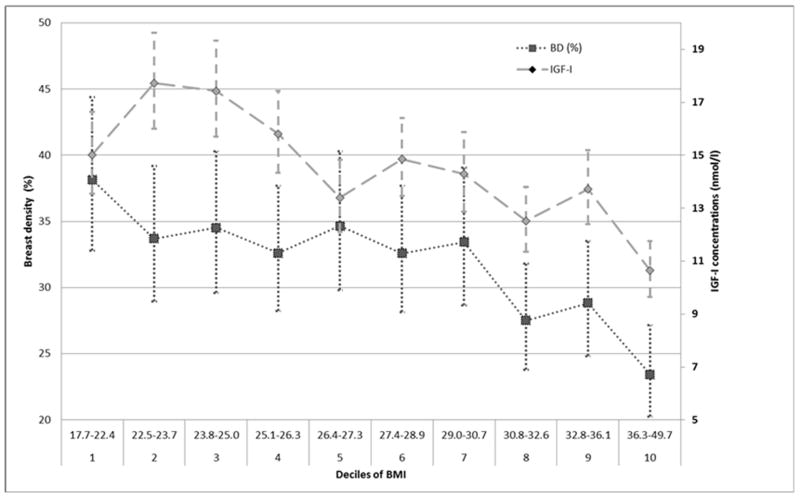
The insulin-like growth factor (IGF) axis plays an essential role in the development of the mammary gland. High circulating levels of IGF-I and of its major binding protein IGFBP3 have been related with increased mammographic density in Caucasian premenopausal women. Some common single nucleotide polymorphisms (SNPs) in genes of the IGF pathway have also been suggested to play a role in mammographic density. We conducted a cross-sectional study nested within the large Mexican ESMaestras cohort to investigate the relation between circulating levels of IGF-I, IGFBP-3, the IGF-I/IGFBP-3 ratio, five common SNPs in the IGF-1, IGFBP-3 and IGF-1R genes and mammographic density in 593 premenopausal Mexican women. Mean age at mammogram was 43.1 (standard deviation, SD = 3.7) years, and average body mass index (BMI) at recruitment was 28.5 kg/m(2). Mean percent mammographic density was 36.5% (SD: 17.1), with mean dense tissue area of 48.3 (SD: 33.3) cm(2) . Mean IGF-I and IGFBP-3 concentrations were 15.33 (SD: 5.52) nmol/l and 114.96 (SD: 21.34) nmol/l, respectively. No significant associations were seen between percent density and biomarker concentrations, but women with higher IGF-I and IGF-I/IGFBP-3 concentrations had lower absolute dense (p(trend) = 0.03 and 0.09, respectively) and nondense tissue areas (p(trend) < 0.001 for both parameters). However, these associations were null after adjustment by BMI. SNPs in specific genes were associated with circulating levels of growth factors, but not with mammographic density features. These results do not support the hypothesis of a strong association between circulating levels of growth hormones and mammographic density in Mexican premenopausal women.
Keywords: IGF; Mexican premenopausal women; genetic polymorphisms; mammographic density.
© 2013 UICC.
Conflict of interest statement
Figures
References
-
- McCormack VA, dos-Santos-Silva I. Breast density and parenchymal patterns as markers of breast cancer risk: a meta-analysis. Cancer Epidemiol Biomarkers Prev. 2006;15(6):1159–69. - PubMed
-
- Becker S, Kaaks R. Exogenous and endogenous hormones, mammographic density and breast cancer risk: can mammographic density be considered an intermediate marker of risk? Recent Results Cancer Res. 2009;181:135–57. - PubMed
-
- Stone J, Dite GS, Gunasekara A, English DR, McCredie MR, Giles GG, Cawson JN, Hegele RA, Chiarelli AM, Yaffe MJ, Boyd NF, Hopper JL. The heritability of mammographically dense and nondense breast tissue. Cancer Epidemiol Biomarkers Prev. 2006;15(4):612–7. - PubMed
-
- Boyd NF, Dite GS, Stone J, Gunasekara A, English DR, McCredie MR, Giles GG, Tritchler D, Chiarelli A, Yaffe MJ, Hopper JL. Heritability of mammographic density, a risk factor for breast cancer. N Engl J Med. 2002;347(12):886–94. - PubMed
-
- Biong M, Gram IT, Brill I, Johansen F, Solvang HK, Alnaes GI, Fagerheim T, Bremnes Y, Chanock SJ, Burdett L, Yeager M, Ursin G, et al. Genotypes and haplotypes in the insulin-like growth factors, their receptors and binding proteins in relation to plasma metabolic levels and mammographic density. BMC Med Genomics. 2010;3:9. - PMC - PubMed
Publication types
MeSH terms
Substances
Grants and funding
LinkOut - more resources
Full Text Sources
Other Literature Sources
Medical
Miscellaneous
