


Effect of baseline cannabis use and working-memory network function on changes in cannabis use in heavy cannabis users: a prospective fMRI study
- PMID: 24038570
- PMCID: PMC6869744
- DOI: 10.1002/hbm.22342
Effect of baseline cannabis use and working-memory network function on changes in cannabis use in heavy cannabis users: a prospective fMRI study
Abstract
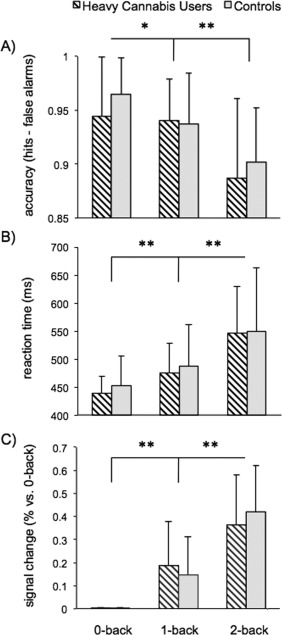
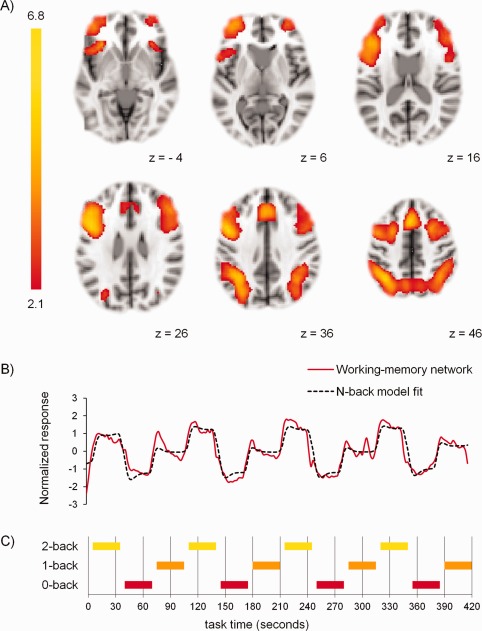
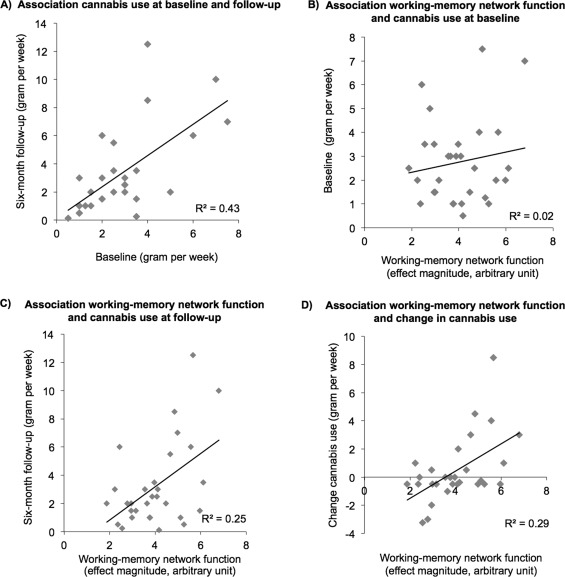
Theoretical models of addiction suggest that a substance use disorder represents an imbalance between hypersensitive motivational processes and deficient regulatory executive functions. Working-memory (a central executive function) may be a powerful predictor of the course of drug use and drug-related problems. Goal of the current functional magnetic resonance imaging study was to assess the predictive power of working-memory network function for future cannabis use and cannabis-related problem severity in heavy cannabis users. Tensor independent component analysis was used to investigate differences in working-memory network function between 32 heavy cannabis users and 41 nonusing controls during an N-back working-memory task. In addition, associations were examined between working-memory network function and cannabis use and problem severity at baseline and at 6-month follow-up. Behavioral performance and working-memory network function did not significantly differ between heavy cannabis users and controls. However, among heavy cannabis users, individual differences in working-memory network response had an independent effect on change in weekly cannabis use 6 months later (ΔR(2) = 0.11, P = 0.006, f(2) = 0.37) beyond baseline cannabis use (ΔR(2) = 0.41) and a behavioral measure of approach bias (ΔR(2) = 0.18): a stronger network response during the N-back task was related to an increase in weekly cannabis use. These findings imply that heavy cannabis users requiring greater effort to accurately complete an N-back working-memory task have a higher probability of escalating cannabis use. Working-memory network function may be a biomarker for the prediction of course and treatment outcome in cannabis users.
Keywords: N-back; cannabis; cannabis use disorder; fMRI; working-memory.
Copyright © 2013 Wiley Periodicals, Inc.
Figures
References
-
- Adamson SJ, Sellman JD. (2003): A prototype screening instrument for cannabis use disorder: The Cannabis Use Disorders Identification Test (CUDIT) in an alcohol‐dependent clinical sample. Drug Alcohol Rev 22:309–315. - PubMed
-
- Baddeley A. (2010): Working memory. Curr Biol 20:R136–R140. - PubMed
-
- Beck AT, Ward CH, Mendelson M, Mock J, Erbaugh J. (1961): An inventory for measuring depression. Arch Gen Psychiatry 4:561–571. - PubMed
-
- Becker B, Wagner D, Gouzoulis‐Mayfrank E, Spuentrup E, Daumann J. (2010): The impact of early‐onset cannabis use on functional brain correlates of working memory. Prog Neuropsychopharmacol Biol Psychiatry 34:837–845. - PubMed
-
- Beckmann CF, Smith SM. (2005): Tensorial extensions of independent component analysis for multisubject fMRI analysis. Neuroimage 25:294–311. - PubMed
Publication types
MeSH terms
Substances
LinkOut - more resources
Full Text Sources
Other Literature Sources
Medical
Miscellaneous
