


Detection of Achromobacter xylosoxidans in hospital, domestic, and outdoor environmental samples and comparison with human clinical isolates
- PMID: 24038696
- PMCID: PMC3837737
- DOI: 10.1128/AEM.02293-13
Detection of Achromobacter xylosoxidans in hospital, domestic, and outdoor environmental samples and comparison with human clinical isolates
Abstract
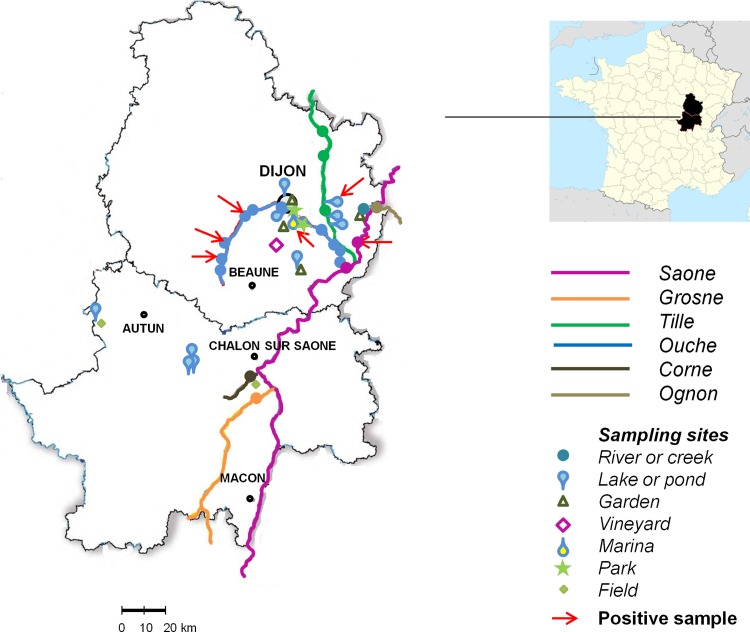
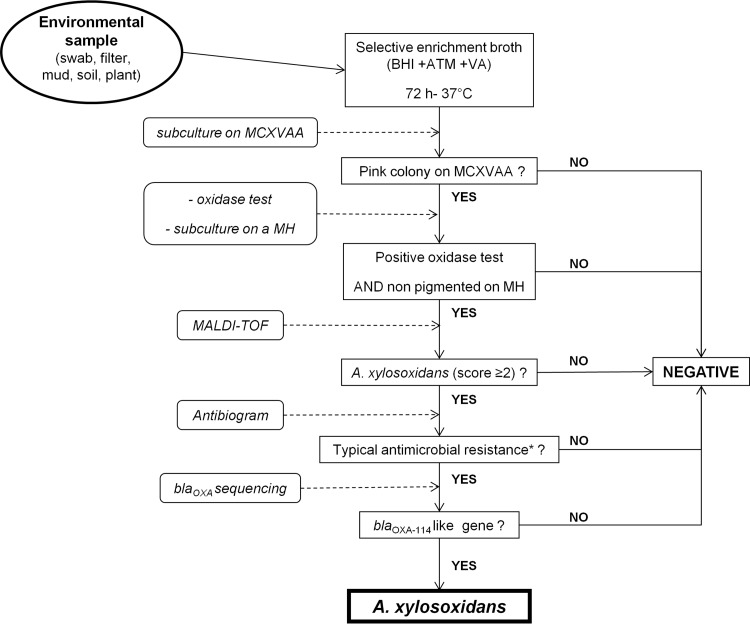
Achromobacter xylosoxidans is an aerobic nonfermentative Gram-negative rod considered an important emerging pathogen among cystic fibrosis (CF) patients worldwide and among immunocompromised patients. This increased prevalence remains unexplained, and to date no environmental reservoir has been identified. The aim of this study was to identify potential reservoirs of A. xylosoxidans in hospital, domestic, and outdoor environments and to compare the isolates with clinical ones. From 2011 to 2012, 339 samples were collected in Dijon's university hospital, in healthy volunteers' homes in the Dijon area, and in the outdoor environment in Burgundy (soil, water, mud, and plants). We designed a protocol to detect A. xylosoxidans in environmental samples based on a selective medium: MCXVAA (MacConkey agar supplemented with xylose, vancomycin, aztreonam, and amphotericin B). Susceptibility testing, genotypic analysis by pulsed-field gel electrophoresis, and blaOXA-114 sequencing were performed on the isolates. A total of 50 strains of A. xylosoxidans were detected in hospital (33 isolates), domestic (9 isolates), and outdoor (8 isolates) samples, mainly in hand washing sinks, showers, and water. Most of them were resistant to ciprofloxacin (49 strains). Genotypic analysis and blaOXA-114 sequencing revealed a wide diversity among the isolates, with 35 pulsotypes and 18 variants of oxacillinases. Interestingly, 10 isolates from hospital environment were clonally related to clinical isolates previously recovered from hospitalized patients, and one domestic isolate was identical to one recovered from a CF patient. These results indicate that A. xylosoxidans is commonly distributed in various environments and therefore that CF patients or immunocompromised patients are surrounded by these reservoirs.
Figures
References
-
- Ciofu O, Hansen CR, Hoiby N. 2013. Respiratory bacterial infections in cystic fibrosis. Curr. Opin. Pulm. Med. 19:251–258 - PubMed
-
- Razvi S, Quittell L, Sewall A, Quinton H, Marshall B, Saiman L. 2009. Respiratory microbiology of patients with cystic fibrosis in the United States, 1995 to 2005. Chest 136:1554–1560 - PubMed
-
- Salvatore D, Buzzetti R, Baldo E, Furnari ML, Lucidi V, Manunza D, Marinelli I, Messore B, Neri AS, Raia V, Mastella G. 2012. An overview of international literature from cystic fibrosis registries. Part 4: update 2011. J. Cyst. Fibros. 11:480–493 - PubMed
-
- Waters V. 2012. New treatments for emerging cystic fibrosis pathogens other than Pseudomonas. Curr. Pharm. Des. 18:696–725 - PubMed
MeSH terms
Substances
Associated data
- Actions
- Actions
- Actions
- Actions
- Actions
- Actions
- Actions
- Actions
LinkOut - more resources
Full Text Sources
Other Literature Sources
Molecular Biology Databases
