. 2013;9(5):960-973.
doi: 10.1007/s11306-013-0517-x. Epub 2013 Mar 20.

Metabolomic approach to evaluating adriamycin pharmacodynamics and resistance in breast cancer cells

Affiliations

Metabolomic approach to evaluating adriamycin pharmacodynamics and resistance in breast cancer cells

Bei Cao et al. Metabolomics. 2013.

Abstract

Continuous exposure of breast cancer cells to adriamycin induces high expression of P-gp and multiple drug resistance. However, the biochemical process and the underlying mechanisms for the gradually induced resistance are not clear. To explore the underlying mechanism and evaluate the anti-tumor effect and resistance of adriamycin, the drug-sensitive MCF-7S and the drug-resistant MCF-7Adr breast cancer cells were used and treated with adriamycin, and the intracellular metabolites were profiled using gas chromatography mass spectrometry. Principal components analysis of the data revealed that the two cell lines showed distinctly different metabolic responses to adriamycin. Adriamycin exposure significantly altered metabolic pattern of MCF-7S cells, which gradually became similar to the pattern of MCF-7Adr, indicating that metabolic shifts were involved in adriamycin resistance. Many intracellular metabolites involved in various metabolic pathways were significantly modulated by adriamycin treatment in the drug-sensitive MCF-7S cells, but were much less affected in the drug-resistant MCF-7Adr cells. Adriamycin treatment markedly depressed the biosynthesis of proteins, purines, pyrimidines and glutathione, and glycolysis, while it enhanced glycerol metabolism of MCF-7S cells. The elevated glycerol metabolism and down-regulated glutathione biosynthesis suggested an increased reactive oxygen species (ROS) generation and a weakened ability to balance ROS, respectively. Further studies revealed that adriamycin increased ROS and up-regulated P-gp in MCF-7S cells, which could be reversed by N-acetylcysteine treatment. It is suggested that adriamycin resistance is involved in slowed metabolism and aggravated oxidative stress. Assessment of cellular metabolomics and metabolic markers may be used to evaluate anti-tumor effects and to screen for candidate anti-tumor agents.

Keywords: Adriamycin; Biomarkers; Breast cancer MCF-7 cell line; Cellular metabolomics; Drug resistance; Reactive oxygen species.


Conflict of interest statement

The authors declare no conflict of interest.

Figures
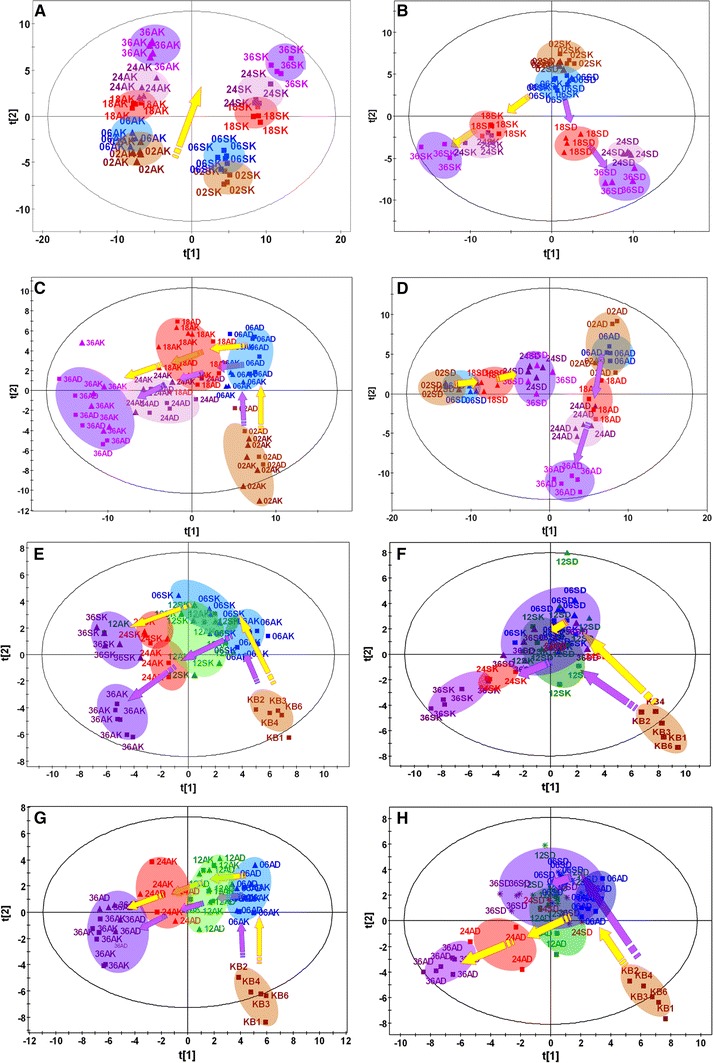
Fig. 1
Fig. 1
Metabolic patterns of intracellular metabolites and culture media metabolites in adriamycin-treated or untreated MCF-7S and MCF-7Adr cells. a Time-dependent metabolic patterns of metabolites in MCF-7S and MCF-7Adr cell lines without adriamycin. b Time-dependent metabolic patterns of metabolites in MCF-7S cells with or without adriamycin. c Time-dependent metabolic patterns of metabolites in MCF-7Adr cells with or without adriamycin. d Time-dependent metabolic patterns of metabolites in MCF-7S and MCF-7Adr cell lines with adriamycin. e Time-dependent metabolic patterns of culture media metabolites in untreated MCF-7S and MCF-7Adr cell lines. f Time-dependent metabolic patterns of metabolites in untreated or adriamycin-treated MCF-7S cell culture media. g Time-dependent metabolic patterns of metabolites in untreated or adriamycin-treated MCF-7Adr cell culture media. h Time-dependent metabolic patterns of metabolites in adriamycin-treated MCF-7S and MCF-7Adr cell culture media. SK sensitive MCF-7S cells, AK resistant MCF-7Adr cells, SD adriamycin-treated MCF-7S cells, AD adriamycin-treated MCF-7Adr cells, KB original culture media. The numbers 02, 06, 18, 24, and 36 indicated that the cells were treated with adriamycin for 2, 6, 18, 24, or 36 h, respectively. Parameters of each model were summarized in Electronic Supplementary Material, Table S-6
Fig. 2
Fig. 2
The impact of adriamycin on MCF-7S cell metabolic pathways. a Intracellular metabolite-based metabolic pathway analysis of MCF-7S cells. b Overview of metabolites that were enriched in MCF-7S cells based on MCF-7S cell intracellular metabolites. c Metabolic pathway analysis of MCF-7S cells based on the MCF-7S cell culture media metabolites. d Overview of metabolites that were enriched in MCF-7S cells based on the MCF-7S cell culture media metabolites
Fig. 3
Fig. 3
Metabolic effect of adriamycin on the relative abundance of intracellular and culture media metabolites. KB original culture media, SK sensitive MCF-7S cells, AK resistant MCF-7Adr cells, SD adriamycin-treated MCF-7S cells, AD adriamycin-treated MCF-7Adr cells treated with adriamycin, KB original culture media. The numbers 02, 06, 12, 18, 24, and 36 indicated that the cells were treated with adriamycin for 2, 6, 12, 18, 24, or 36 h, respectively. A1A9, B1B9, C1C9 and D1D9 represents intracellular metabolites in MCF-7S cells, intracellular metabolites in MCF-7Adr cells, extracellular substance in MCF-7S cells, extracellular substance in MCF-7Adr cells, Data are presented as mean ± SE *p ≤ 0.05; **p ≤ 0.01 versus control
Fig. 4
Fig. 4
The effect of adriamycin on typical metabolite levels in the sensitive MCF-7S and resistant MCF-7Adr cells. SK sensitive MCF-7S cells, AK resistant MCF-7Adr cells, SD adriamycin-treated MCF-7S cells, AD adriamycin-treated MCF-7Adr cells. The numbers 02, 06, 18, 24, and 36 indicated that the cells were treated with adriamycin for 2, 6, 18, 24, or 36 h, respectively. A1A10 and B1B10, represents intracellular metabolites in MCF-7S cells and MCF-7Adr cells respectively. Data are presented as mean ± SE *p ≤ 0.05; **p ≤ 0.01 versus control
Fig. 5
Fig. 5
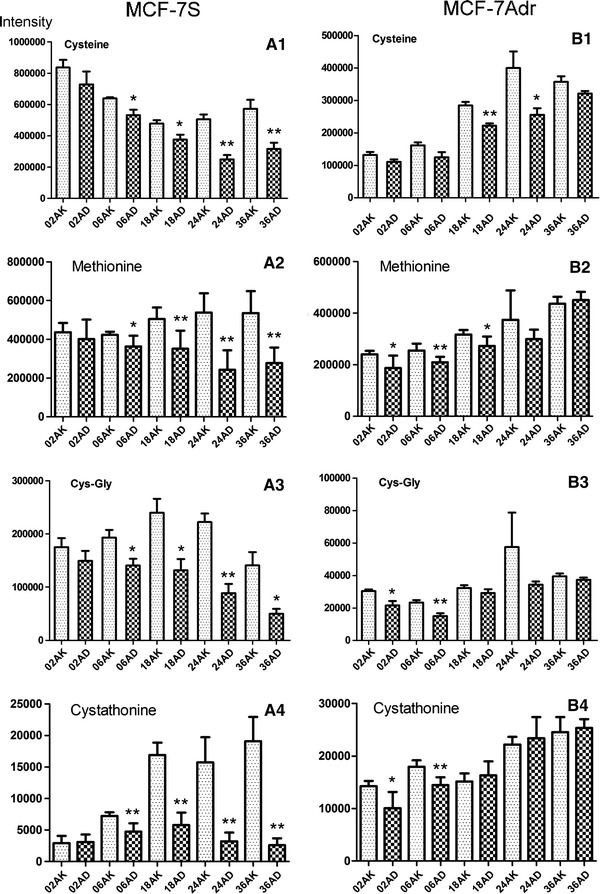
The effect of adriamycin on intracellular glutathione biosynthesis metabolite levels. SK sensitive MCF-7S cells, AK resistant MCF-7Adr cells, SD adriamycin-treated MCF-7S cells, AD adriamycin-treated MCF-7Adr cells. The numbers 02, 06, 18, 24, and 36 indicated that the cells were treated with adriamycin for 2, 6, 18, 24, or 36 h, respectively. A1A4 and B1B4, represents intracellular metabolites in MCF-7S cells and MCF-7Adr cells respectively. Data are presented as mean ± SE *p ≤ 0.05; **p ≤ 0.01 versus control
Fig. 6
Fig. 6
Adriamycin-induced P-gp expression and ROS production in MCF-7S cell line. a The effect of adriamycin and N-acetylcysteine treatment on P-gp mRNA expression (24 h), b time-dependent effect of adriamycin (1 μM) on ROS, c the effect of adriamycin and N-acetylcysteine treatment on P-gp expression (24 h), d concentration-dependent effect of adriamycin on P-gp expression (24 h). Data are presented as mean ± SD. *p ≤ 0.05; **p ≤ 0.01 versus control

References

    1. A J, Qian S, Wang G, et al. Chronic myeloid leukemia patients sensitive and resistant to imatinib treatment show different metabolic responses. PLoS ONE. 2010;5:e13186. doi: 10.1371/journal.pone.0013186. - DOI - PMC - PubMed
    1. A J, Trygg J, Gullberg J, et al. Extraction and GC/MS analysis of the human blood plasma metabolome. Analytical Chemistry. 2005;77:8086–8094. doi: 10.1021/ac051211v. - DOI - PubMed
    1. Aa J, Shao F, Wang G, et al. Gas chromatography time-of-flight mass spectrometry based metabolomic approach to evaluating toxicity of triptolide metabolomics. 2011;7:217–225.
    1. Broxterman HJ, Pinedo HM, Kuiper CM, et al. Glycolysis in P-glycoprotein-overexpressing human tumor cell lines. Effects of resistance-modifying agents. FEBS Letters. 1989;247:405–410. doi: 10.1016/0014-5793(89)81380-8. - DOI - PubMed
    1. Budczies J, Denkert C, Muller BM, et al. Remodeling of central metabolism in invasive breast cancer compared to normal breast tissue—a GC-TOFMS based metabolomics study. BMC Genomics. 2012;13:334. doi: 10.1186/1471-2164-13-334. - DOI - PMC - PubMed