


Development and validation of a questionnaire to detect behavior change in multiple advance care planning behaviors
- PMID: 24039772
- PMCID: PMC3764010
- DOI: 10.1371/journal.pone.0072465
Development and validation of a questionnaire to detect behavior change in multiple advance care planning behaviors
Abstract
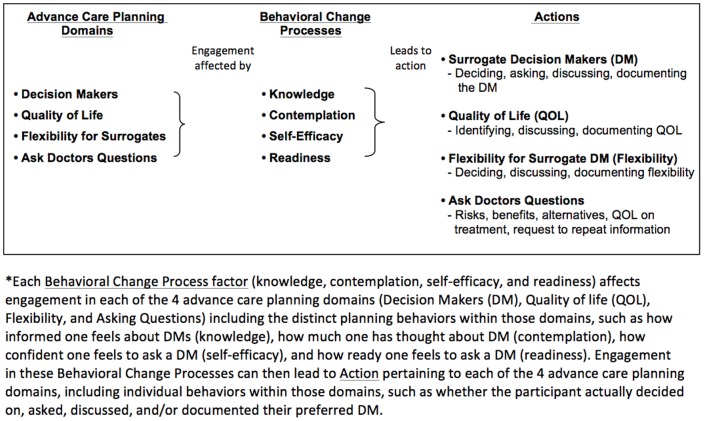
Introduction: Advance directives have traditionally been considered the gold standard for advance care planning. However, recent evidence suggests that advance care planning involves a series of multiple discrete behaviors for which people are in varying stages of behavior change. The goal of our study was to develop and validate a survey to measure the full advance care planning process.
Methods: The Advance Care Planning Engagement Survey assesses "Process Measures" of factors known from Behavior Change Theory to affect behavior (knowledge, contemplation, self-efficacy, and readiness, using 5-point Likert scales) and "Action Measures" (yes/no) of multiple behaviors related to surrogate decision makers, values and quality of life, flexibility for surrogate decision making, and informed decision making. We administered surveys at baseline and 1 week later to 50 diverse, older adults from San Francisco hospitals. Internal consistency reliability of Process Measures was assessed using Cronbach's alpha (only continuous variables) and test-retest reliability of Process and Action Measures was examined using intraclass correlations. For discriminant validity, we compared Process and Action Measure scores between this cohort and 20 healthy college students (mean age 23.2 years, SD 2.7).
Results: Mean age was 69.3 (SD 10.5) and 42% were non-White. The survey took a mean of 21.4 minutes (±6.2) to administer. The survey had good internal consistency (Process Measures Cronbach's alpha, 0.94) and test-retest reliability (Process Measures intraclass correlation, 0.70; Action Measures, 0.87). Both Process and Action Measure scores were higher in the older than younger group, p<.001.
Conclusion: A new Advance Care Planning Engagement Survey that measures behavior change (knowledge, contemplation, self-efficacy, and readiness) and multiple advance care planning actions demonstrates good reliability and validity. Further research is needed to assess whether survey scores improve in response to advance care planning interventions and whether scores are associated with receipt of care consistent with one's wishes.
Conflict of interest statement
Figures
References
Publication types
MeSH terms
Grants and funding
LinkOut - more resources
Full Text Sources
Other Literature Sources
Medical
