. 2013 Sep 5;8(9):e73429.
doi: 10.1371/journal.pone.0073429. eCollection 2013.

In vitro infection of pupae with Israeli acute paralysis virus suggests disturbance of transcriptional homeostasis in honey bees (Apis mellifera)

Affiliations

In vitro infection of pupae with Israeli acute paralysis virus suggests disturbance of transcriptional homeostasis in honey bees (Apis mellifera)

Humberto F Boncristiani et al. PLoS One. .

Abstract

The ongoing decline of honey bee health worldwide is a serious economic and ecological concern. One major contributor to the decline are pathogens, including several honey bee viruses. However, information is limited on the biology of bee viruses and molecular interactions with their hosts. An experimental protocol to test these systems was developed, using injections of Israeli Acute Paralysis Virus (IAPV) into honey bee pupae reared ex-situ under laboratory conditions. The infected pupae developed pronounced but variable patterns of disease. Symptoms varied from complete cessation of development with no visual evidence of disease to rapid darkening of a part or the entire body. Considerable differences in IAPV titer dynamics were observed, suggesting significant variation in resistance to IAPV among and possibly within honey bee colonies. Thus, selective breeding for virus resistance should be possible. Gene expression analyses of three separate experiments suggest IAPV disruption of transcriptional homeostasis of several fundamental cellular functions, including an up-regulation of the ribosomal biogenesis pathway. These results provide first insights into the mechanisms of IAPV pathogenicity. They mirror a transcriptional survey of honey bees afflicted with Colony Collapse Disorder and thus support the hypothesis that viruses play a critical role in declining honey bee health.


Conflict of interest statement

Competing Interests: The authors have declared that no competing interests exist.

Figures

Figure 1
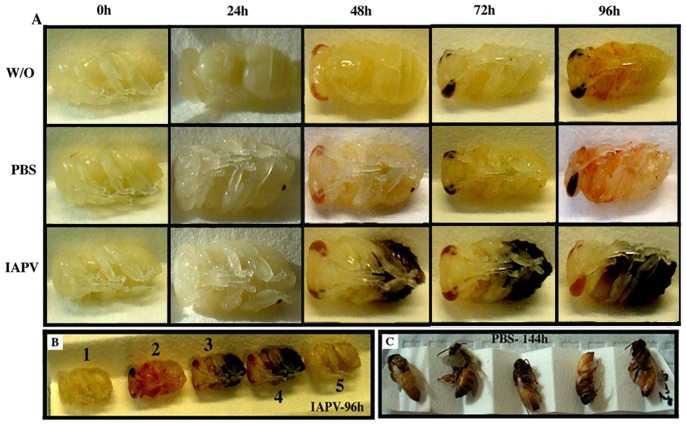
Figure 1. Experimental study system to follow virus pathogenicity during honey bee pupal development in the laboratory.
[A] Development of IAPV-inoculated (IAPV), PBS-injected (PBS), and negative control (W/O) individuals. The IAPV group shows progressive symptoms of disease, compared to the normally developing PBS and control group. [B] Close-up of the variable symptoms of IAPV replication in white eye honey bee pupae: Complete cessation of development with no visual evidence of disease (1), Apparently normal development (2), Rapid darkening of different body parts (3,4), Darkening and hindered development combined (5). [C] Control bees are completing metamorphosis.
Figure 2
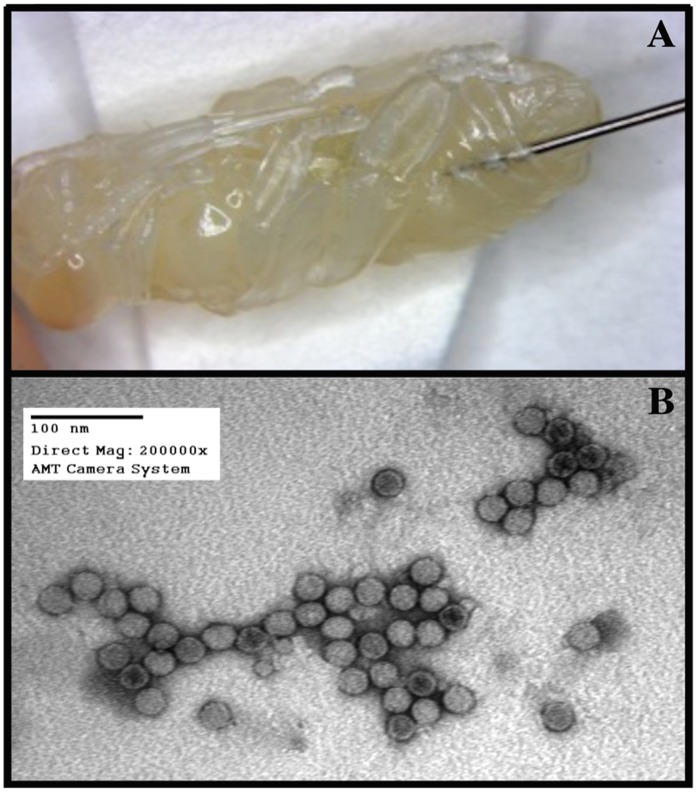
Figure 2. To enrich for IAPV from honey bees of typically mixed infections, repeated cycles of pupal inoculations and later virus purification from the inoculated pupae were performed.
The preferential replication of IAPV during this procedure resulted in virus purifications with negligible levels of contamination from other viruses. [A] Inoculation of honey bee pupae with IAPV. Even though the injection apparatus varied among experiments (see main text), the basic injection site and methodology shown were identical. [B] Electron microscope image of purified IAPV sample, showing clean and uniform virus particles (full and empty particles) around 27 nm.
Figure 3
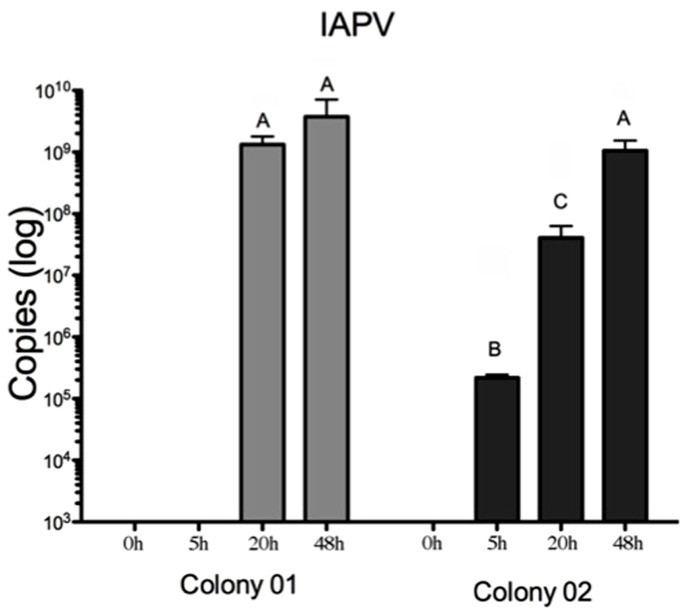
Figure 3. IAPV titer increases in IAPV-inoculated bees from the two studied colonies suggest that the colony source influences the IAPV replication kinetic.
From initially undetectable levels, IAPV increases more gradually in the second colony, resulting in significantly lower titers 20 hours after inoculation than in the first colony. Each bar represents an experimental group of individually assessed bees. The bars with different letters are significantly different (ANOVA post-hoc tests, p<0.001).
Figure 4
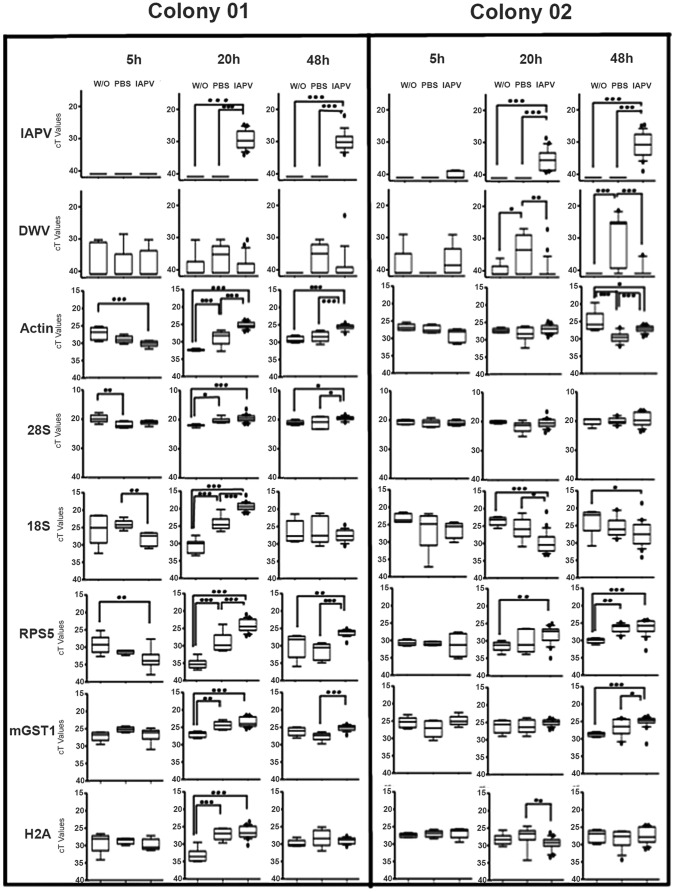
Figure 4. Transcript levels showed colony, time, and treatment effects.
The observed expression patterns indicate that IAPV infection disturbs ribosomal biogenesis and other cellular functions. IAPV-injected bees of colony 01 suffered a fast build-up of IAPV and showed an almost ubiquitous up-regulation of genes. The overall pattern is more complicated in colony 02, possibly due to a more gradual IAPV build-up and confounding effects of DWV infection. The median bar shows the median value, and the boxes are the 25–75 percentiles; error bars are the 10–90 percentiles, and outliers are indicated as dots. Significance of post-hoc comparisons are indicated by * (<0.05), ** (<0.01), or *** (<0.001).

References

    1. vanEngelsdorp D, Hayes Jr J, Underwood RM, Pettis J (2008) A survey of honey bee colony losses in the U.S., Fall 2007 to Spring 2008. PLoS ONE 3: e4071. - PMC - PubMed
    1. Ellis JD, Evans JD, Pettis JS (2010) Colony losses, managed colony population decline and colony collapse disorder in the United States. Journal of Apicultural Research 49: 134–136.
    1. Evans JD, Schwarz RS (2011) Bees brought to their knees: microbes affecting honey bee health. Trends Microbiol 19: 614–620. - PubMed
    1. Cornman RS, Tarpy DR, Chen Y, Jeffreys L, Lopez D, et al. (2012) Pathogen webs in collapsing honey bee colonies. PLoS One 7: e43562. - PMC - PubMed
    1. Neumann P, Carreck NL (2010) Honey bee colony losses. Journal of Apicultural Research 49: 1–6.

Publication types