


Previous exposure to an RNA virus does not protect against subsequent infection in Drosophila melanogaster
- PMID: 24040086
- PMCID: PMC3770682
- DOI: 10.1371/journal.pone.0073833
Previous exposure to an RNA virus does not protect against subsequent infection in Drosophila melanogaster
Abstract
Background: Immune priming has been shown to occur in a wide array of invertebrate taxa, with individuals exposed to a pathogen showing increased protection upon subsequent exposure. However, the mechanisms underlying immune priming are poorly understood. The antiviral RNAi response in Drosophila melanogaster is an ideal candidate for providing a specific and acquired response to subsequent infection. We exposed D. melanogaster to two challenges of a virus known to produce an antiviral RNAi response, to examine whether any protective effects of prior exposure on survival were observed.
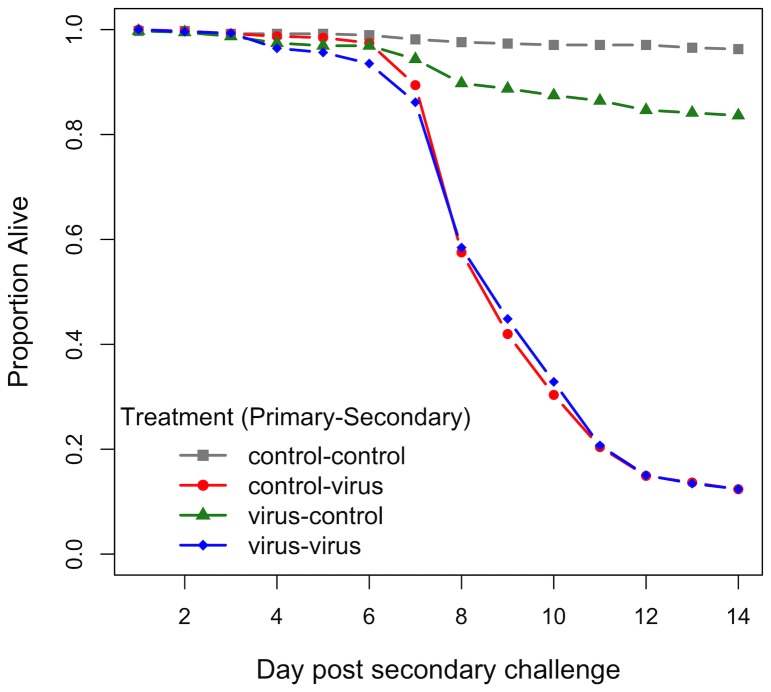
Results: In this experiment we found no evidence that prior exposure to Drosophila C Virus (DCV) protects flies from a subsequent lethal challenge, with almost identical levels of mortality in flies previously exposed to DCV or a control.
Conclusions: Our results confirm the finding that 'acquired' immune responses are not ubiquitous across all invertebrate-pathogen interactions. We discuss why we may have observed no effect in this study, with focus on the mechanistic basis of the RNAi pathway.
Conflict of interest statement
Figures
References
-
- Little TJ, Kraaijeveld AR (2004) Ecological and evolutionary implications of immunological priming in invertebrates. Trends Ecol Evol 19: 58–60. - PubMed
-
- Kurtz J, Franz K (2003) Innate defence: evidence for memory in invertebrate immunity. Nature 425: 37–38. - PubMed
-
- Sadd BM, Schmid-Hempel P (2006) Insect immunity shows specificity in protection upon secondary pathogen exposure. Current Biology 16: 1206–1210. - PubMed
Publication types
MeSH terms
Substances
Grants and funding
LinkOut - more resources
Full Text Sources
Other Literature Sources
Molecular Biology Databases
