. 2013 Sep 5;8(9):e73879.
doi: 10.1371/journal.pone.0073879. eCollection 2013.

Vicarious neural processing of outcomes during observational learning

Affiliations

Vicarious neural processing of outcomes during observational learning

Elisabetta Monfardini et al. PLoS One. .

Abstract

Learning what behaviour is appropriate in a specific context by observing the actions of others and their outcomes is a key constituent of human cognition, because it saves time and energy and reduces exposure to potentially dangerous situations. Observational learning of associative rules relies on the ability to map the actions of others onto our own, process outcomes, and combine these sources of information. Here, we combined newly developed experimental tasks and functional magnetic resonance imaging (fMRI) to investigate the neural mechanisms that govern such observational learning. Results show that the neural systems involved in individual trial-and-error learning and in action observation and execution both participate in observational learning. In addition, we identified brain areas that specifically activate for others' incorrect outcomes during learning in the posterior medial frontal cortex (pMFC), the anterior insula and the posterior superior temporal sulcus (pSTS).


Conflict of interest statement

Competing Interests: The authors have declared that no competing interests exist.

Figures

Figure 1
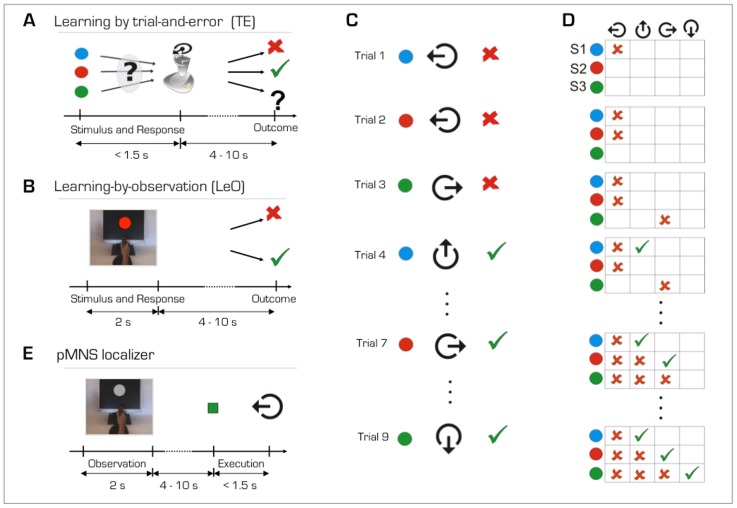
Figure 1. fMRI task design.
(A) Learning by trial-and-error (TE). A trial started with the presentation of a coloured stimulus. Participants had to displace the joystick in one of the four possible directions (up, down, right and left) within 1.5 seconds. After a variable delay, a feedback stimulus was presented for 1 second indicating whether the action was correct (green tick), incorrect (red cross) or late (question mark). (B) Learning-by-observation (LeO). Each trial started with the presentations of a video showing a hand on a joystick performing one of the four possible movements in response to the presentation of a coloured stimulus on a monitor. The camera view was set to actor’s perspective. The video lasted 2 seconds and the coloured stimulus was presented for 1.5 seconds, as in the trial-and-error condition. The outcome images were presented after a variable delay and they were identical to those used in the TE condition. Participants were instructed to learn the correct stimulus-action-outcome associations by looking at the videos and outcomes. (C) Task design of an exemplar learning session. Stimuli were randomised in blocks of 3 trials. (D) Matrix of all possible stimulus-response combinations corresponding to the exemplar session in (C). Correct associations were not set a priori, but they were assigned as subjects advanced in the task. The first presentation of each stimulus was always followed by an incorrect outcome, irrespective of the motor response (from trial 1 to 3). On the second presentation of S1 (the blue circle), any untried joystick movement was always followed by a correct outcome (trial 4). The correct response for S2 and S3 (red and green circles, respectively) was found after 2 and 3 incorrect joystick movements (at trials 7 and 9, respectively). In other words, the correct response was the 2nd joystick movement (different from the first tried response) for stimulus S1, the 3rd joystick movement for stimulus S2, and the 4th for stimulus S3. This task design ensured a minimum number of incorrect trials during acquisition (one for S1, two for S2 and three for S3) and fixed representative steps during learning. The LeO task was built using a design similar to the one used for the TE learning task. Given the scarcity of repetition and maintenance errors in TE, in LeO the actor neither repeated incorrect actions while searching for the correct association (i.e. no repetition errors in the acquisition phase of learning), nor made errors after the first correct response (i.e. no maintenance errors). Therefore, learning-by-observation consisted in 6 incorrect (one for S1, two for S2 and three for S3) and 12 correct trials. (E) Observation and execution of actions. Participants observed a video of a hand performing a joystick movement in response to a grey stimulus (i.e. action observation). After a variable delay, subjects were instructed to perform the movement they had previously observed (i.e. action execution).
Figure 2
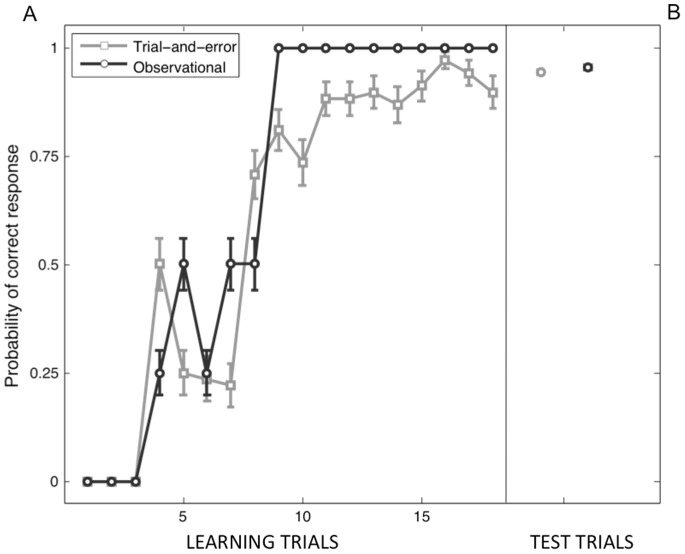
Figure 2. Behavioural performances of subjects in the fMRI learning sessions.
(A) Mean learning curve averaged across runs and subjects for the TE condition (gray curve) and the LeO condition (black curve). Note that the LeO curve represents the progression of the actor performance in the videos shown to the participant. Error bars indicate the standard error of the mean (SEM). (B) Mean percentage of correct responses in the TE-test and LeO-test sessions following learning. Error bars indicate the standard error of the mean (SEM).
Figure 3
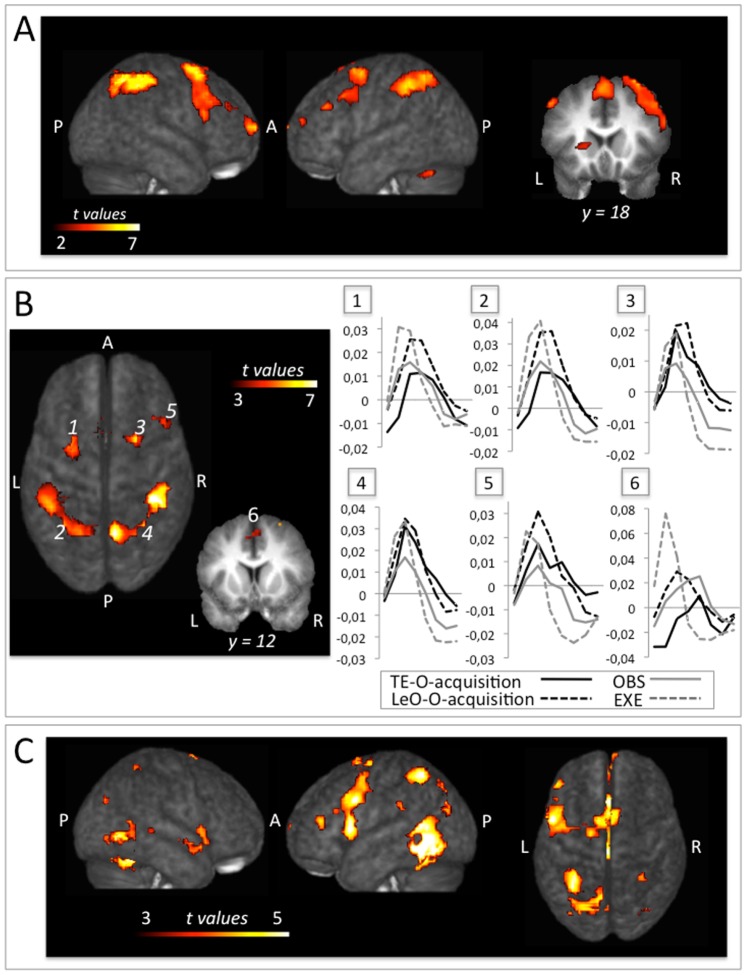
Figure 3. Clusters of activation are superimposed on to the average T1 image derived from all participants.
(A) Brain networks commonly recruited during the acquisition phase of learning (i.e. incorrect trials +1st correct trial) in both TE and LeO. Active brain regions in both TE (i.e. TE_O_acquisition>TE_O_consolidation) and LeO (i.e. LeO_O_acquisition>LeO_O_consolidation) contrasts (conjunction thresholded at punc<0.001, t = 3.24;k = 15; all clusters also survive qFDR<0.05). See also Fig. S1. (B) Brain networks commonly recruited during the acquisition phase of learning, action observation and execution. Intersection analysis between the results from (A) and the localizer mask for the pMNS. Grand-average BOLD responses in the regions of overlap for TE_O_acquisition and LeO_O_acquisition (black and gray continuous line), OBS and EXE (continuous and dotted light gray) conditions. (C) Brain networks commonly recruited during the processing of 1st correct outcome in TE and LeO. Positive effect of the 1st correct outcome (LeO_O_1stCorrect+TE_O_1stCorrect-LeO_O_incorrect-TE_O_incorrect) exclusively masked with the interaction of correcteness by learning condition (t = 3.24; punc<0.001, k = 15; all clusters also survive qFDR<0.05).
Figure 4
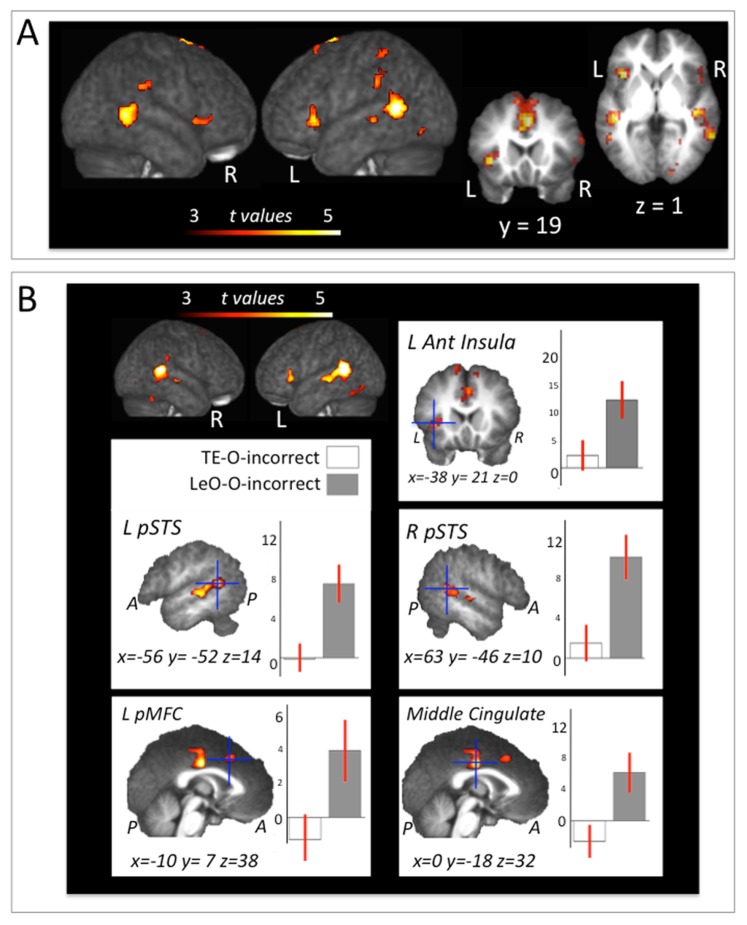
Figure 4. Clusters of activation are superimposed on the average T1 image derived from all participants.
(A) Direct comparison between LeO_O_acquisition and TE_O_acquisition. Results from Leo_O_acquisition>TE_O_acquisition t-contrast (t = 3.24; punc<0.001, k = 15; all clusters also survive qFDR<0.05). (B) Direct comparison between LeO_O_incorrect and TE_O_incorrect. Areas showing greater activation for processing of incorrect outcomes in LeO, with respect on processing of incorrect outcomes in TE (punc<0.001, k = 15; all clusters also survive qFDR<0.05). Plot of the mean value of the parameter estimates (arbitrary units) for the maxima of the left anterior insula, left and right pSTS, left pMFC and middle cingulate cortex.

References

    1. Bandura A (1977) Social learning theory. Englewood Cliffs (NJ): Prentice-Hall.
    1. Rendell L, Boyd R, Cownden D, Enquist M, Eriksson K, et al. (2010) Why copy others? Insights from the social learning strategies tournament. Science 328: 208–213. - PMC - PubMed
    1. Frith CD, Frith U (2010) Mechanisms of Social Cognition. Annu Rev Psychol 63: 287–313. - PubMed
    1. Galef BG, Laland KN (2005) Social learning in animals: empirical studies and theoretical models. Bio Sci 55: 489–499.
    1. Heyes CM, Dawson GR (1990) A demonstration of observational learning in rats using a bidirectional control. Q J Exp Psychol B 42: 59–71. - PubMed

Publication types